85% of Vietnamese businesses have positive business sentiment with trends promoting AI, diversifying supply chains, and expanding to ASEAN, according to UOB’s latest research.
Information stated in UOB’s 2026 Business Outlook Study, published on June 22, shows that the business picture in Vietnam is showing more positive signs. This year’s survey was conducted in 7 markets including Singapore, Indonesia, Malaysia, Thailand, Vietnam, China and Hong Kong (China).
In Vietnam, research results were developed from an online survey form that took 15 minutes to complete, with the participation of representatives from 226 large (revenue of 5,000 billion VND or more) and medium-sized (revenue of 200 billion to less than 5,000 billion VND) across the country… Survey participants were owners, senior executives or managers in 6 field groups: manufacturing, engineering art, industry; health, community, personal services; professional and business services; consumer goods, wholesale trade; construction, real estate; technology, media, telecommunications.
This survey notes that although the operating environment is still affected by rising costs, geopolitical tensions and global trade fluctuations, the business community still maintains optimism about growth prospects in the near future.
Specifically, 85% of Vietnamese businesses recorded positive business sentiment, a sharp increase compared to the 48% recorded by UOB in 2025 – a time when business confidence is affected by fluctuations related to global tariff policies. Growth is expected to continue to be maintained in the coming years. More than 9 out of 10 businesses expect improved business results this year, and forecast stronger revenue growth in the 2027-2028 period.
However, macro factors still create certain pressure on production and business activities. Nearly half of the businesses surveyed said operating costs increased due to the impact of geopolitical tensions and factors related to international trade. In that context, the need to improve operational efficiency, control costs and strengthen adaptive capacity becomes increasingly urgent.
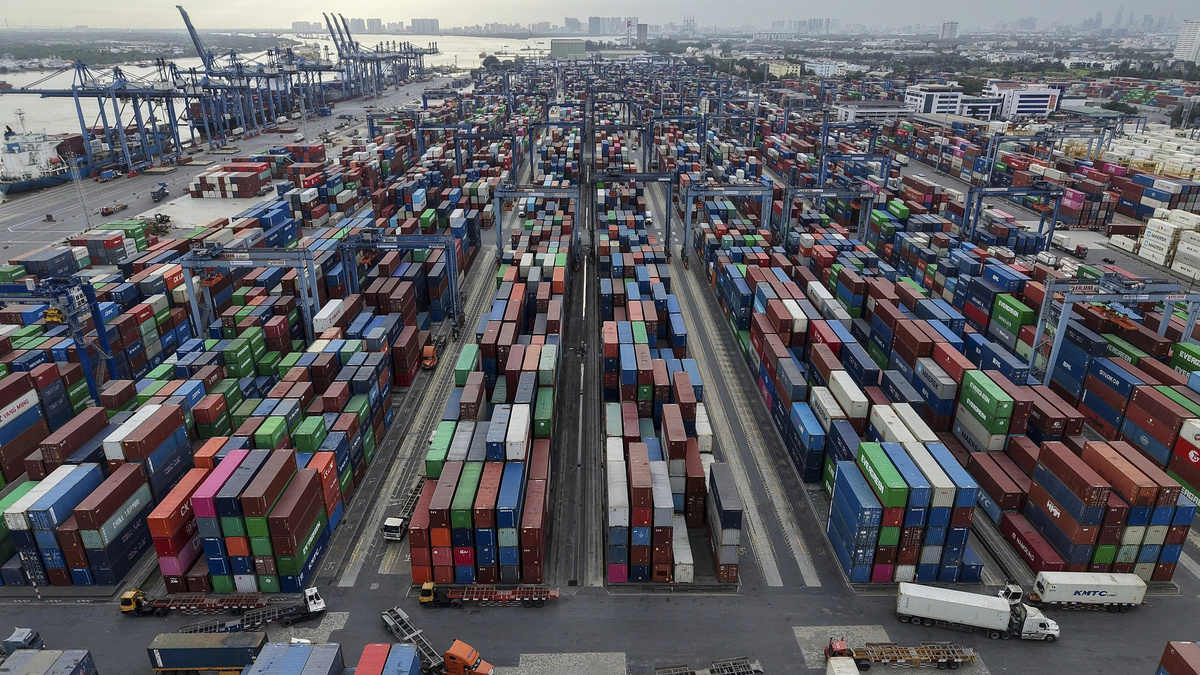
Cargo containers at Cat Lai port. Image: Thanh Tung
Prioritize energy management and AI applications
One of the prominent priorities noted in this year’s survey is energy management. Up to 96% of Vietnamese businesses rated this as an important issue, significantly higher than the regional average of 87%.
According to the results of the study, in response to fluctuations in the global energy market and the risk of supply disruption, units are adopting a more systematic and proactive approach to energy use. Specifically, 55% of responses said that ensuring a stable and sustainable energy supply for production and business activities is a priority. Meanwhile, 53% focus on optimizing energy use, 47% focus on cutting consumption and improving energy efficiency.
To achieve these goals, businesses are increasingly investing in solutions such as energy-efficient machinery (43%) and solar energy (42%), to balance cost management with sustainable operations.
At the same time, Vietnamese businesses are also accelerating the digital transformation process, with artificial intelligence (AI) gradually asserting its role as a key growth driver. Although adoption is still in its early stages, 80% of businesses have begun implementing AI, however, only about 25% of these have used AI at an advanced level.
According to UOB, the level of digital maturity is a factor that greatly influences the ability to apply AI. Businesses that have built a synchronous digital system often have a significantly higher speed of deploying and exploiting this technology.
The survey results also show that AI is bringing positive impacts to business operations. 49% of units recorded improved productivity, 47% said operating costs were optimized and 46% recorded increased revenue. Confidence in the potential of AI continues to increase as about two-thirds of businesses plan to increase their investment budget for this technology by more than 25% in 2026.
However, the implementation of AI still faces many obstacles. The biggest barriers mentioned by businesses include investment costs and limited financial resources (49%), limitations in AI solutions – partner ecosystem (48%), along with data limitations – system readiness (47%).
Diversify the supply chain, expand to ASEAN
In addition to energy and digital transformation, supply chain management also continues to be considered a central priority. Up to 97% of Vietnamese businesses consider this to be a factor of strategic significance for their business activities. Although supply chain disruptions have reduced compared to the previous period, businesses still face many challenges such as geopolitical risks (40%), procurement complexity (34%), and changes in legal regulations. Up to 88% of businesses say legal and compliance requirements are affecting their operations.
To enhance resilience, Vietnamese businesses are proactively diversifying their supply chains. Accordingly, about 80% of businesses plan to expand their supplier networks this year, with more than half aiming to increase the number of suppliers in the ASEAN region and about 23% focusing on domestic supply.
This is also consistent with the trend of moving production activities to closer markets (nearshoring). About one-third of Vietnamese businesses plan to establish or expand domestic production operations, while many businesses are also considering expanding into the ASEAN region (43%), thereby strengthening the region’s role as a key production and supply chain hub.
According to UOB, this shift is strongly promoting the wave of expansion into the international market. Of the 10 Vietnamese businesses participating in the survey, 7 said they had expanded their business activities abroad in 2025 and 9 said they had plans to continue expanding in the next three years. Similarly, 80% of Vietnamese businesses plan to invest abroad in the next two years with the average investment scale expected to exceed 28 million USD.
Through business responses, ASEAN demonstrates its role as a top priority destination, chosen by 65% of Vietnamese businesses for their expansion plans. Among them, Thailand, Singapore and Indonesia are the markets that receive the most attention. However, businesses still face many challenges, especially in meeting legal, regulatory, compliance and tax obligations (36%), finding suitable local partners (36%), as well as accessing cooperation opportunities with large businesses or organizations linked to the Government.
To support businesses in solving legal and operational challenges and expanding operations into international markets, UOB leverages its regional network with 11 Foreign Direct Investment (FDI) Advisory Centers across Asia. This system supports customers in many stages, from market access, legal advice to connecting local partners.
In parallel, the bank deployed Supply Chain Financial Management solutions on the UOB Infinity platform in Vietnam. The platform allows customers to digitize and manage the entire supply chain on a unified system, connecting across many markets in the region.
Ms. Pham Nhu Anh, Director of UOB Vietnam Wholesale Banking Division. Image: UOB Vietnam
Commenting on the research results, Ms. Pham Nhu Anh, Director of UOB Vietnam Wholesale Banking Division, said that Vietnamese businesses are demonstrating adaptability and positive resilience in the face of fluctuations in the global business environment. According to her, the trend of investing in digital capabilities, strengthening supply chains and increasing presence in ASEAN shows that the business community is not only focusing on short-term recovery but is aiming for more sustainable, long-term growth strategies. As one of the leading banks in ASEAN, with a deep understanding of the local market and a wide network in the region, UOB makes many commitments to accompany businesses on this journey to exploit cross-border opportunities and sustainable development in the region.
2026 is the 7th year UOB has conducted the Business Outlook Study. The program continues to expand in both survey frequency and research scope to promptly reveal changes in the global economic and geopolitical environment.
Bonusy
Bonusy
Bonusy
Bonusy
Bonusy
Bonusy
Bonusy
Bonusy
Bez Depozytu
Bez Depozytu
Bez Depozytu
Bez Depozytu
Bez Depozytu
Bez Depozytu
Bez Depozytu
Bez Depozytu
Bez Depozytu
Bez Depozytu
Bonus Bez Vkladu
Cashback
Cashback
Cashback
Cashback
Cashback
Cashback