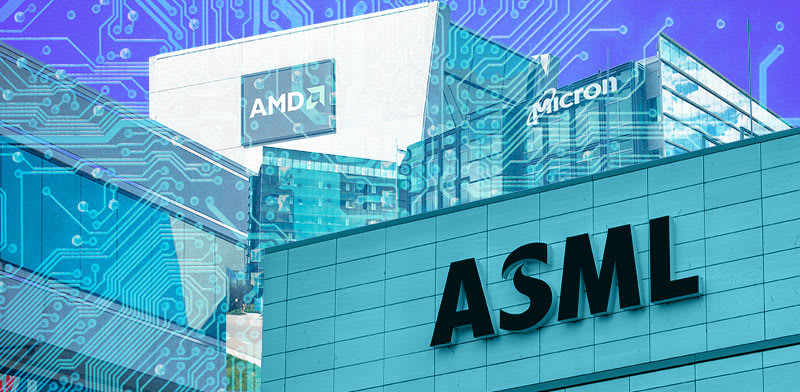
The chip sector on Wall Street, which has become the engine of gains for the American stock market, continues to generate interest every day. Along with the positive trend in recent months, there are also days of sharp downward fluctuations. Thus, at the beginning of the current trading week, chip stocks soared and the Philadelphia Chip Index reached an all-time high, after rising more than 100% in less than three months. However, the next day the index fell by 7.8% and chip stocks stood out in declines on Wall Street. In the quarters the index traded stably.
And so, prominent shares in the sector, which on Tuesday fell by 6%-8%, such as Intel and AMD, recorded only slight fluctuations on Wednesday, while Qualcomm weakened by 8% on Tuesday and continued to weaken in the following days as well; Micron’s stock fell sharply by 13.2% on Tuesday, perhaps because the market worried that analysts’ forecasts for its reports were too high.
But Micron’s after-market reports on Wednesday were particularly strong, allaying those concerns, and the company’s stock jumped double-digits in late trading as it provides a boost to the chip sector as a whole.
So what caused the upheaval and declines in the chips sector this week? Reuters mentioned the increasing costs of building artificial intelligence (AI) infrastructure – which is driving the positive sentiment for the chip sector in recent times – a significant part of which is financed through debt. At a time when the Federal Reserve Bank in the US is becoming more “hawkish”, this raises concerns, certainly when stocks are already at record levels.
without “cracks in the armor”
Matthew Rachter, head of equity strategy research at Julius Baer Bank, wrote that investors have reduced exposure to technology and in particular to chips. “While we continue to be positive about the AI opportunity in the long term, the correction highlights the risks associated with market leadership becoming increasingly concentrated,” Rachter wrote.
After AI-related sectors drove a significant portion of global equity returns in the first half of the year, they have become the focus of broader risk reduction.”
He believes that investors “continue to digest the hawkish Fed meeting from last week, and the markets are now fully pricing in an interest rate hike by October.” At the same time, in his estimation, some investors have begun to reexamine the most optimistic assumptions surrounding AI-related demand growth, after a particularly strong rally.
According to him, “We see no evidence that the investment cycle in AI is ending. Similar to the correction earlier this month, it seems that the move is driven mainly by positions, pricing concerns and a change in interest rate expectations, and not by a broad deterioration in the companies’ fundamentals. Profit growth remains strong and continues to be the main engine of the gains in the stock markets this year.”
What is expected then in the chip market? Analysts who cover the sector are generally optimistic. For example, Dan Ives of Wedbush Securities told CNBC this week that the current trends and demand for AI do not show “cracks in the armor”, and the decline is mainly against the background of the sharp rise earlier and not a sign of weakness in the economic fundamentals.
Chip analyst C.J. Muse from Cantor Bank mentioned last week (after a weekly increase of 6% in the chip index, above the increase of the S&P 500 that week), that last April at Cantor they expected a return to Risk On in the chip sector (that is, investors are willing to take higher risk in order to achieve a higher return).
Since then, the chip index has more than doubled, and Muse noted that “there is no change in our multi-year bullish approach to chip stocks, led by AI,” but also warned that following the sharp rise the markets could become more volatile – which indeed happened this week. Muse recommends a long list of stocks in the sector, including Micron, SanDisk, Nvidia, Broadcom, AMD, ASML and others.
Bank of America this week published an extensive overview of the chip market, which included both raising the forecast for the size of the entire market and a series of target price updates for stocks in the sector. If earlier Bank of America economists estimated that the market size would reach $2.3 trillion by 2030, after growing at an average of 23% per year, now they expect a market of $2.7 trillion, after growing at an average of 28% per year until 2030. “The main growth engines are systems for data centers for AI, memory, chip equipment (semicap), supplier management components and AI agents.
“We reiterate our thesis that the AI industry is moving to deal with structural and physical constraints (chips, carrier), as opposed to dealing with the need to protect the investment return earlier,” Bank of America writes.
Among the stocks whose target prices are updated upwards is ASML, which is recommended with a “buy” recommendation and now has a target price of 2,022 euros, compared to 1,921 euros previously. The new target price reflects a 28.7% premium over the current price, thanks to long-term agreements the company has in the memory market (DRAM) as well as strong demand in AI and the server sector.
The report that brought back optimism
As mentioned, the memory chip giant Micron provided a particularly impressive financial report on Wednesday night, when it presented results that exceeded analysts’ forecasts by a considerable margin, and restored optimism to the sector’s shares.
In response to the reports, Micron jumped in late trading by about 18%, after having weakened by about 13.5% in the two previous trading days. Even before the spike in late trading, Micron’s stock recorded an extraordinary return since the beginning of the year – 268%, and the company surpassed the trillion dollar mark in value for the first time.
This is the third highest return on the S&P 500 this year. All the first four are companies from the field of memory components: SanDisk, Western Digital, Micron and Seagate. These enjoy great demand for the memory chips, against the background of huge investments in AI infrastructure, while the supply and production capacity are in short supply.
For example, Micron reported that in the third quarter its average selling price increased by about 60% in the field of DRAM memories, and by about 85% in the field of NAND memories compared to the previous quarter.
In the reports it published for the third fiscal quarter (which ended at the end of May), Micron surpassed analysts’ forecasts, and provided a higher than expected forecast for the last quarter of the year. Revenues were $41.5 billion, compared to $9.3 billion in the corresponding quarter and $23.9 billion in the previous quarter. The net quarterly profit jumped 15 times – to 28.2 billion dollars compared to 1.9 billion dollars in the corresponding quarter.
The forecast for the fourth quarter is for revenues of approximately $50 billion, gross profit of approximately 86% and net profit of $30.7 per share (GAAP) and $31 per share (Non-GAAP).
In the meantime, another company from the memory market, the Korean SK Hynix, submitted a prospectus for listing for trading at the same time on Nasdaq. It plans to raise over 29 billion dollars.
For your attention: The Globes system strives for a diverse, relevant and respectful discourse in accordance with the code of ethics that appears in the trust report according to which we operate. Expressions of violence, racism, incitement or any other inappropriate discourse are filtered out automatically and will not be published on the site.
User pinkeggnog6 – Physicsgurus Q&A
Redirecting…
mayskin5
pajamasailor3 » CSMouse
screwcrush1 » ""
trunkkettle2 » Чернігівський обласний навчально-курсовий комбінат Чернігівської обласної ради
Public profile – hooddragon7 – Pikidi – Buy And Sell Online In Nigeria
Trunkboat9
creekpolice0
oiaedu.com
JoinUs4Health
fearcrush7, Author at Nhadat24
Penzu
Rising Demand for Urgent Care in Tampa Reflects Changing Healthcare Landscape
Finding Immediate Medical Care: The Growing Need for Urgent Care Near Me
Meeting Tampa's Growing Demand: The Rise of Urgent Care — TopUrgentcare
Finding Timely Medical Attention: The Rise of Urgent Care Centers — UrgentcareOnline
Finding Prompt Medical Attention: Urgent Care Options in South Tampa
Finding Quality Care Fast: The Rise of Urgent Care Clinics
Meeting the Demand: Urgent Care Services in Tampa Experience Rapid Growth
Home – HackMD
89.3 KB file on MEGA
Freestanding ERs in Colorado and Beyond | Healthcare aesthetic hospital, Emergency care, Emergency rooms aesthetic
Extended Hours Urgent Care Clinics in South Tampa ..
Urgent Care Tampa: Meeting Immediate Healthcare Needs with Speed and Efficiency — fasttrackurgentcare