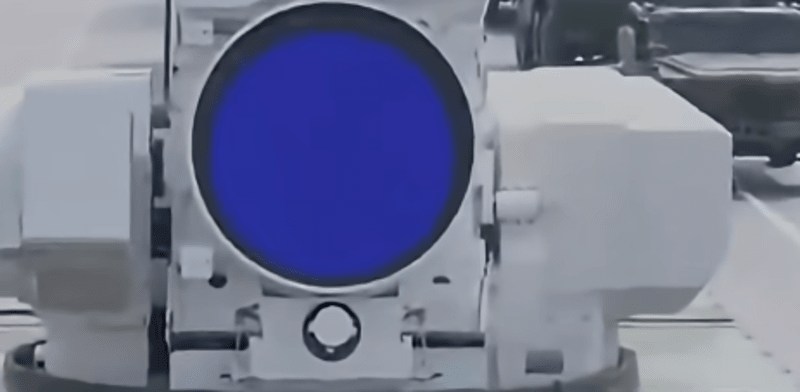
The defense industries’ preoccupation with laser weapons does not stop, and is even gaining momentum: China wants to place them on the backs of fighters, while Britain wants to send systems directly to ships. And in the Middle East, Turkey continues to strengthen in all areas, with measures that may also threaten Israel. All this in the defense industries corner of Globes.
China presents: a laser weapon for the lone soldier
The Chinese company Harbin Xinguang, which deals in electro-optical systems, launched a unique product on an international scale: Lijian, a laser system for intercepting drones carried by a single fighter. If until now laser systems were characterized by a particularly heavy platform, according to the company, they have created a product that is carried in a backpack and with a power of two kilowatts can intercept a drone in four seconds, and recharge the system in five seconds.
This system has relatively low power due to the desire to be carried by a single fighter, while China has much larger systems. About five months ago, for example, China took advantage of the World Defense Exhibition in Riyadh in order to present the LW 30 laser system produced by the “Chinese National Precision Machinery Import and Export Corporation”.
This laser system is designed for air defense against drone threats based on a 30 kilowatt beam. Such a power allows blinding or interception of unmanned aircraft, but it is significantly lower than the Israeli Or Ethan system, which has a power of 100 kilowatts and is capable of intercepting many more significant threats. However, until now this system has not yet been deployed on a significant enough scale, to respond, for example, to the threats of Hezbollah’s drones.
Britain wants to send the laser directly to ships
Laser weapons are not the lot of Israel and China alone, and there is a development race all over the world. One of the most prominent of them is the United Kingdom, which is progressing in the Dragon Fire process: a laser system with a power of 50 kilowatts, which is expected to enter operational service next year. As with all laser systems, its essential advantage lies in the negligible interception cost – about $13. For the sake of comparison, the interception of an Iron Dome, which is not considered one of the most expensive in the world market, is estimated at about 30 thousand dollars.
In the UK, Dragon Fire is not expected to be operational next year, and already now the project partner, QinetiQ and the British affiliates of the MBDA and Leonardo corporations are working on the miniaturization of the system, so that it can fit into the Model 45 destroyer as early as next year.
“The study of the total production of the laser beam is about trying to reduce the size of the entire system even more,” said the head of the customer portfolio for the British Navy at Kinetic, James Anderson. “We also check the support required throughout the life of the system.” Speaking to reporters at a NATO event, he noted that the target of installing Dragon Fire on destroyers next year was “on track”, which would make Britain the first alliance member to field a laser system.
Turkey is arming itself with means that could threaten Israel
Turkey continues to increase its ballistic missile arsenal, with the delivery of Typhoon Block 2 ballistic missiles from Roketsan. This is the first short-range ballistic missile developed in Turkey and has a range of about 560 km. This means that those missiles could threaten Israel. In relation to Iran, the distance from Turkey to Israel is much shorter.
Block 2 is an upgraded version of the original Typhoon missiles, although unlike many previous cases, the Turks chose not to publicize the nature of the upgrades. These may be, among other things, the accuracy of guidance, the types of possible warheads, or the improvement of propulsion systems. The typhoon reflects a horizontal Turkish trend in which Ankara strives, whether on the basis of Roketsan, which is a government-controlled company, or on the basis of other local companies, to improve security independence.
Ankara’s progress in the aspects of security independence are not limited to missiles, or on land. As part of a new series of experiments, Baykar drone company joined forces with the Italian Leonardo, in an experiment that tested a combined attack using the Turkish Kizillama model drones and the Italian M-346 combat training aircraft. Initially, the drones took off on their own, then during the flight they were transferred to the control of the crew sitting in the Italian two-seater plane. Such an attack method is expected to be typical for the coming years, in which fighter pilots will simultaneously conduct an attack on the base of the plane under their control and in addition to attacking drones.
For your attention: The Globes system strives for a diverse, relevant and respectful discourse in accordance with the code of ethics that appears in the trust report according to which we operate. Expressions of violence, racism, incitement or any other inappropriate discourse are filtered out automatically and will not be published on the site.
Astma Idag Orsaker Behandling Och Vardag
Guide Til Valg Af Bryllupsmenu
Tapas Til Den Uformelle Fest
Lonsikring En Tryg Fremtid I Usikre Tider
Har Tiden Sat Sine Spor I Ansigtet
Drommer Du Om Mere Fylde Her Er Hvad Du Skal Vide
Miten Teknologia Muuttaa Nfl Fanien Suhdetta Lajiin Ja Ottelukokemukseen
Miten Nettikasinot Tasapainottavat Jattipotit Kolikkopelit Ja Poytapelit Eri Pelaajatyypeille
Miksi Jotkut Kasinopelit Nousevat Trendeiksi Ja Toiset Katoavat Nopeasti
Lotment Capital
Lotmentcapital
Lotmentcapital
Ka Imone Turi Zinoti Pries Diegdama Greitus Mokejimus Internetu
Vm 2026 Det Stoerste Fodboldshow I Historien Er I Fuld Gang
Jackpot Spilleautomater Vind De Stoerste Casino Jackpots
Naturliche Regeneration Im Sport Wege Zur Optimalen Erholung
Boligkob Og Tryghed I En Vigtig Beslutning
Hvad Koster Det At Fa Repareret Sin Iphone En Gennemgang Af Priser Faktorer Og Hvad Du Bor Vide
Kjolelosninger I Bobilen Og Baten Kompressor Eller Termoelektrisk Kjoleboks
Derfor Boer Du Altid Vaelge Et Godkendt Online Casino
Solar Carports With Integrated Ev Charging Why Car Parks Are Untapped Energy Assets
Wie Verbessert Steuerplanung Die Eigenen Finanzen
De Smarteste Mader At Holde Styr Pa Dine Hjemmeudgifter
Krydsord Er Ikke Kun For De Aeldre Sadan Loser Yngre Danskere Dem I Dag
Krydsord Vs Online Spil Ordgenkendelse Og Monstertaenkning