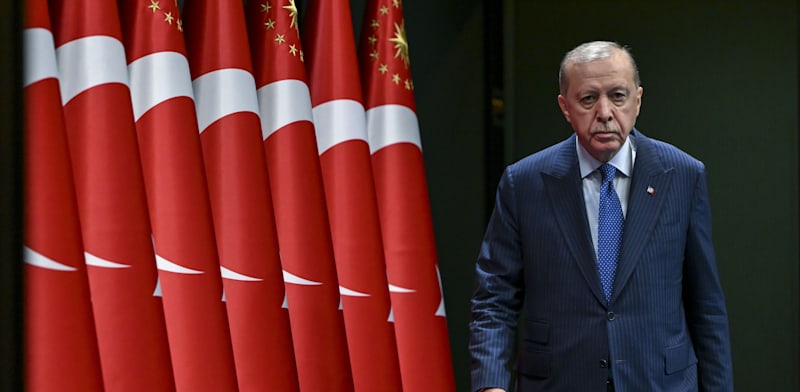
The NATO 2026 conference, which will open on Tuesday in Ankara, is the clearest proof that in the geopolitical game, narrow interests always win over values. While Turkish President Recep Tayyip Erdogan is presenting his most aggressive line ever towards Israel, the Western countries are falling into his hands.
Starting with Washington’s ambition to sell it F-35 planes, through Canada’s desire to develop Turkish nuclear capabilities, to the European Union, which makes sure that Turkey serves as a “dam” against the flow of refugees.
● At Israel’s expense: Turkey and Saudi Arabia are promoting a new trade route
● Turkey and Egypt are tightening their security cooperation
What is Israel worried about, how is the Trump administration trying to circumvent congressional opposition, and how are the billion dollar transactions of Great Britain and Italy related?
The fear: an end to the air superiority of the IDF
Jerusalem’s greatest strategic concern stems from the F-35 issue. Of all the military aspects, the Air Force is the only one in which the IDF enjoys absolute regional superiority. The Turks, who were part of the original F-35 program, were excluded from it after Erdogan insisted on purchasing Russian air defense systems of the S-400 model. This move triggered the American CAATSA sanctions against them in 2019, according to which any country that purchases advanced defense systems from Russia is defined as Washington’s adversary – and she is denied access to American edge technologies.
But now the Trump administration wants to re-promote the deal, and for that it is necessary to pass complex legislative changes in Congress. President Donald Trump’s problem is the widespread opposition to the move in the House of Representatives and the Senate, both among Democrats and Republicans. “It is a delusion that at a time like this NATO chooses to hold the conference in Ankara,” a senior Israeli government official tells Globes, adding that “it is not clear how the American government is even considering allowing such a sale.”
F-35 aircraft. Widespread opposition in Congress to the sale to Turkey / Photo: Shutterstock
In the shadow of the opposition in Congress, and not necessarily because of the Israeli position, in Washington they have already formulated plan B: the sale of advanced aircraft engines. The administration recently informed Congress of its intention to sell dozens of F110 engines made by GE to Ankara, in a deal worth approximately $700 million. The engines are intended for the development of the “Kaan” – a fifth-generation aircraft that Erdogan is building on as a backup for being removed from the F-35 project. However, Ankara is finding it difficult to meet the goals of its own security independence, including the development of the local TF35000 engine, and therefore the purchase of the F110 is seen as an “interim” solution.
This is not the only interim solution that the Turks are forced to adopt due to difficulties in their defense industries. In recent years, Erdogan has been promoting the “Steel Dome” project, which aims to produce a multi-layered air defense system based entirely on Turkish technology. But at the highest levels, Ankara remains completely dependent on the Russian S-400 system.
During the “Hari’s Roar” operation, Turkey was even embarrassed when Iran launched ballistic missiles that passed through its territory – and those who actually carried out the interceptions were the partners from the NATO alliance. This week, Turkish Defense Minister Yasar Guler admitted that the government is now considering the purchase of the American Patriot system.
The turning point in relations with Canada and the billions from Britain
The Americans are not the only ones who find economic and strategic interest in Erdogan. Turkey suffers from a huge energy challenge and does not enjoy independence in any field – oil, natural gas or renewable energies. Because of this, it turned to the Russians for the purpose of establishing the “Akoyo” nuclear power plant. The project suffers from delays and it is only next year that the first production unit (out of four) is expected to start operating.
In the long term, Ankara aims to rely on nuclear energy. The issue was at the center of a meeting held in Ottawa last week between Canadian Foreign Minister Anita Anand and her Turkish counterpart, Khan Fidan. It was the Canadians who proposed on their own initiative to expand nuclear cooperation.
The Canadians are interested in signing a huge deal with Ankara, following Turkish Energy Minister Alferslan Beyrakter’s statement earlier this year about the country’s intention to build eight more nuclear reactors. The Canadians offer the Turks “Kando” type reactors, which are operated using unenriched natural uranium. In this way, Canada hopes to sell Turkey both the miners and the uranium that will be produced in its mines.
This is a dramatic turn in the Canadian attitude. Unlike Trump, who defined Erdogan as a “good friend” or a “great leader” despite his stance towards Israel, Canada has until recently held a hard line: just five years ago, it canceled 29 defense export permits to Turkey, after it was revealed in an investigation by “Global Affairs” that Turkish drones containing Canadian components were used by Azerbaijan in the Second Karabakh War against Armenia.
The narrow Western interests vis-à-vis Turkey are not limited to North America, and the Turkish-Italian security combination of forces stood out above and below the surface. In March last year, the Turkish drone corporation Baykar (whose VP of Technology is Selcuk Bayrakter, Erdoğan’s son-in-law) signed an agreement to establish a joint venture with the Italian security giant Leonardo. The collaboration includes an Italian focus on IEDs (special payloads), electronics and integration systems, while the Turks provide the drone platforms and production chains.
Only three months later, Baycar acquired the Italian company Piaggio, which develops and manufactures aircraft. This purchase gives the Turks an official foothold within the European Union, making it dramatically easier for them to conduct transactions on the continent.
Britain is the next rib in the expansion of defense deals with Ankara. Last October, the contacts reached a peak, when Erdogan signed with the British Prime Minister, Keir Starmer, a huge deal to purchase 20 Eurofighter Typhoon (EF-2000 model) aircraft for approximately $10.7 billion (8 billion pounds). For London, this is the largest defense sale in the last 25 years, and the first of Typhoon aircraft since 2017.
A notable beneficiary of the agreement is once again the Italian company Leonardo, a partner in the Eurofighter consortium and responsible for the avionics, radar, electronic warfare, armament and engineering maintenance of the aircraft.
Supreme interest: the refugees who dictate the policy
In conclusion, when the average European leader looks towards Turkey, his biggest concern remains the refugee issue. The consequences of the civil war in Syria are still weighing heavily on the European economy, which hosts about 1.3 million refugees who arrived through Turkish territory. Since the outbreak of the war in 2011, Erdogan has become a pilgrimage destination for senior officials of the Union, with the aim of ensuring that he continues to serve as a “policeman” of the borders.
Syrian refugees in Germany in 2015. 1.3 million refugees are still in Europe / photo: ap, Martin Meissner
Just this week, EU Foreign Minister Kaya Callas, one of the most prominent anti-Israel figures in Brussels, arrived in Ankara, so much so that two weeks ago Foreign Minister Gideon Sa’ar decided to sever ties with her. The Israeli boycott followed a report on the Euractiv website, according to which Callas, in a closed conversation with diplomats, compared Israel’s policy in Judea and Samaria to the apartheid regime in South Africa.
The same Callas defined Turkey in her meeting with Erdogan as a “key partner” of the Union in the fields of security, immigration and energy, and even emphasized that it is a candidate country to join the Union. The two discussed strengthening the ties between Brussels and Ankara, as well as the importance of “good relations between the neighbors”, according to her. Kalas also used the opportunity to deal with the Russia-Ukraine war and tensions in the Middle East, as part of the preparations for the NATO conference. According to her, “Turkey provides a significant contribution” to the defense of NATO’s eastern area.
For your attention: The Globes system strives for a diverse, relevant and respectful discourse in accordance with the code of ethics that appears in the trust report according to which we operate. Expressions of violence, racism, incitement or any other inappropriate discourse are filtered out automatically and will not be published on the site.
104132 House Cleaning In Dubai For Spotless Kitchens And Bathrooms.Html
16482
18015
PureKonect™ – Real People Real Life
21623 Best Deep Cleaning Services In Dubai For Modern Apartments.Html
Professional House Cleaning Services In Dubai For Offices And Homes
19816 Best House Cleaning Services In Dubai For Sanitized Homes.Html
Discover & Grow with Global Business Listings | Allbiz Listing
Cleansy on NZ Community Directory
Cleansy on BizMakersofAmerica
Cleansy
Cleansy on Perry's Place Promotions
Cleansy on Local Business Nation
Cleansy on Search Direct
Cleansy on BizBangBoom
Cleansy on Cargo Directory .CO
Cleansy
Cleansy on ibi Directories
Ca Ab 1 Dubai Investments Park Dubai Uae Accountants Cleansy Danny Hawk
Cleansy – Property Investment – Office S163 – Office 4 – S1, Dubai, 1 – Dubai Investments Park | n49.com
Go www List.com : Cleansy
One Cool Dir.com : Cleansy
Danny Hawk, autor en Aprender Fotografía – La Red Social
8522849.Htm
Why Is Upholstery Cleaning Important for Indoor Air Quality? – Organesh