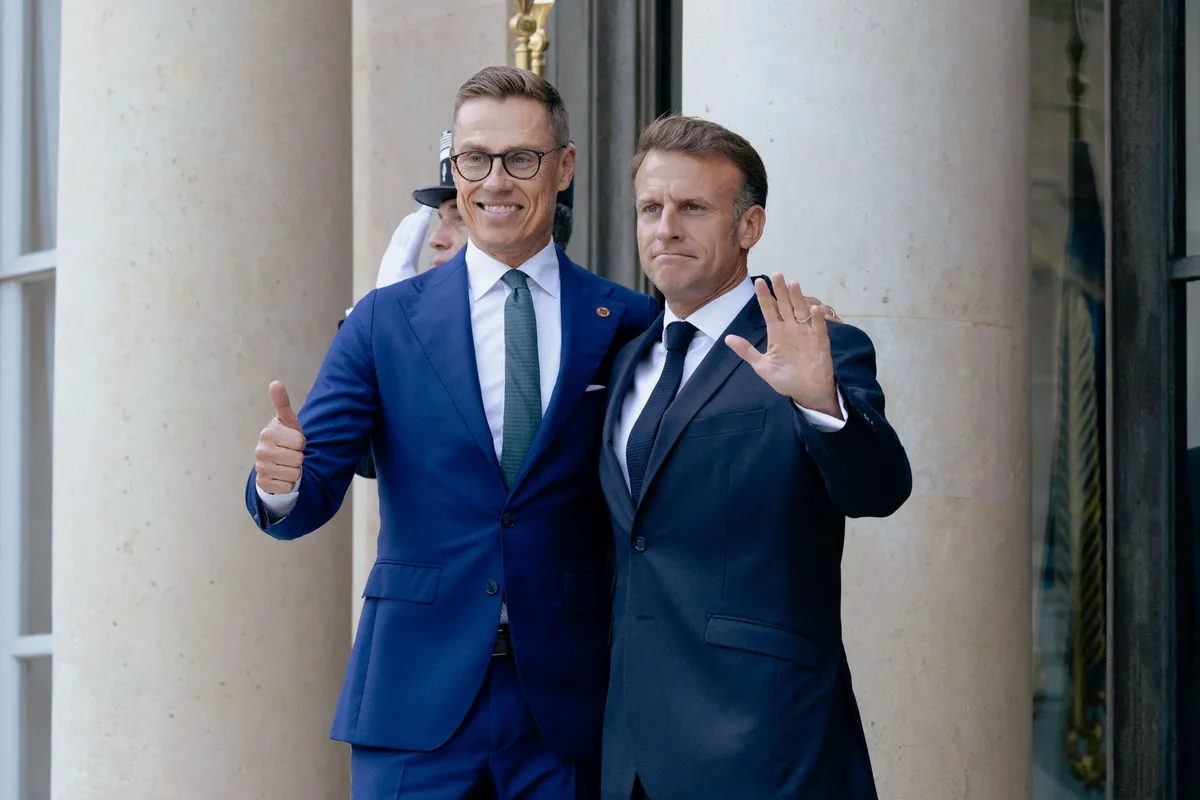
The strategic partnership between France and Finland to be signed on Monday will consolidate the commercial cooperation between Finland and France in, for example, nuclear power projects.
According to information from Kauppalehti, the strategic partnership document confirms the will to promote cooperation in both large reactors and small modular reactors, and explores opportunities for cooperation in the field of renewable energy as well.
The Ministry of Foreign Affairs said on Monday that France has “interests and expertise” in nuclear energy cooperation with Finland.
Finland and France already agreed on a nuclear energy declaration of intent a year ago, the goal of which is long-term and versatile cooperation in the nuclear energy sector. The cooperation includes, among other things, the joint construction of small modular reactors (SMR) for the production of energy or heat.
A French state-owned company EDF is developing its own NUWARD small reactor as an export product to Europe and considers Finland one of the potential markets.
According to information previously obtained by Kauppalehti from Élysée sources, French nuclear power cooperation would be involved Helen’s For SMR small nuclear power plants.
Helen has researched the use of small nuclear power, especially in the production of district heat in Helsinki.
The French NUWARD is technically also designed for district heating, so there is a market connection.
Small modular nuclear reactors have also been talked about in connection with the data center boom in Finland. For example, Google and Fortum have announced that they are investigating new nuclear power and renewable energy development opportunities in Finland.
Senior Vice President of the Commission Henna Virkkunen previously commented to Kauppalehti that combining nuclear power and data centers can be “very promising”.
Arctic know-how and Russia
In addition to nuclear power, the cooperation between France and Finland also includes defense and security, the energy sector, artificial intelligence, quantum technology, and critical minerals and metals.
When I had a conversation with a French diplomat in France on Friday about why France wants to enter into a strategic partnership specifically with Finland, the answer brought up, in addition to commercial cooperation, the fact that Finland is an important like-minded ally for France, whose location in the north and Russia’s neighboring country is of interest. Furthermore, in the current geopolitical situation, it is important for France to deepen cooperation with close and like-minded partner countries.
On the defense side, France is especially interested in Finland’s Arctic know-how: the French want to learn from Finland how Arctic defense is managed. The fact that in July France announced that it would participate in Finland’s forward-looking (FLF) NATO forces is indicative of the concrete strengthening of cooperation.
On Monday, it was also heard that Finland will join France’s European nuclear deterrence initiative. President Emmanuel Macron has described the European dimension of France’s nuclear deterrence as “advance deterrence”. It means that France does not offer its partners a nuclear umbrella and keeps the decision-making about the use of its nuclear weapons to itself. Cooperation is agreed upon in accordance with the interests of the participating country. It can be, for example, joint exercises.
Like the defense minister Antti Häkkänen (kok) stated in its press release: “In the extreme, the temporary presence of parts of the French strategic air force in an allied country.” It means that the French strategic air force, which can launch a nuclear weapon, could be temporarily in Finland, if France so decided and Finland allowed it.
THE FACTS
Declaration of intent for nuclear power cooperation concluded in October 2025
According to the declaration of intent, long-term cooperation could be established between the countries, e.g.:
- In the construction of new large nuclear reactors and small and advanced modular reactors for electricity or heat production and cogeneration
- In supporting the maintenance, life extension and power increases of power plant reactors in use
- By promoting an EU regulatory, industrial and financial framework that promotes the construction of new nuclear power projects
- By strengthening the security of supply of nuclear materials and fuels
- By developing safe solutions for the management of spent nuclear fuel and radioactive waste
- By promoting the exchange of experiences and cooperation in the field of research