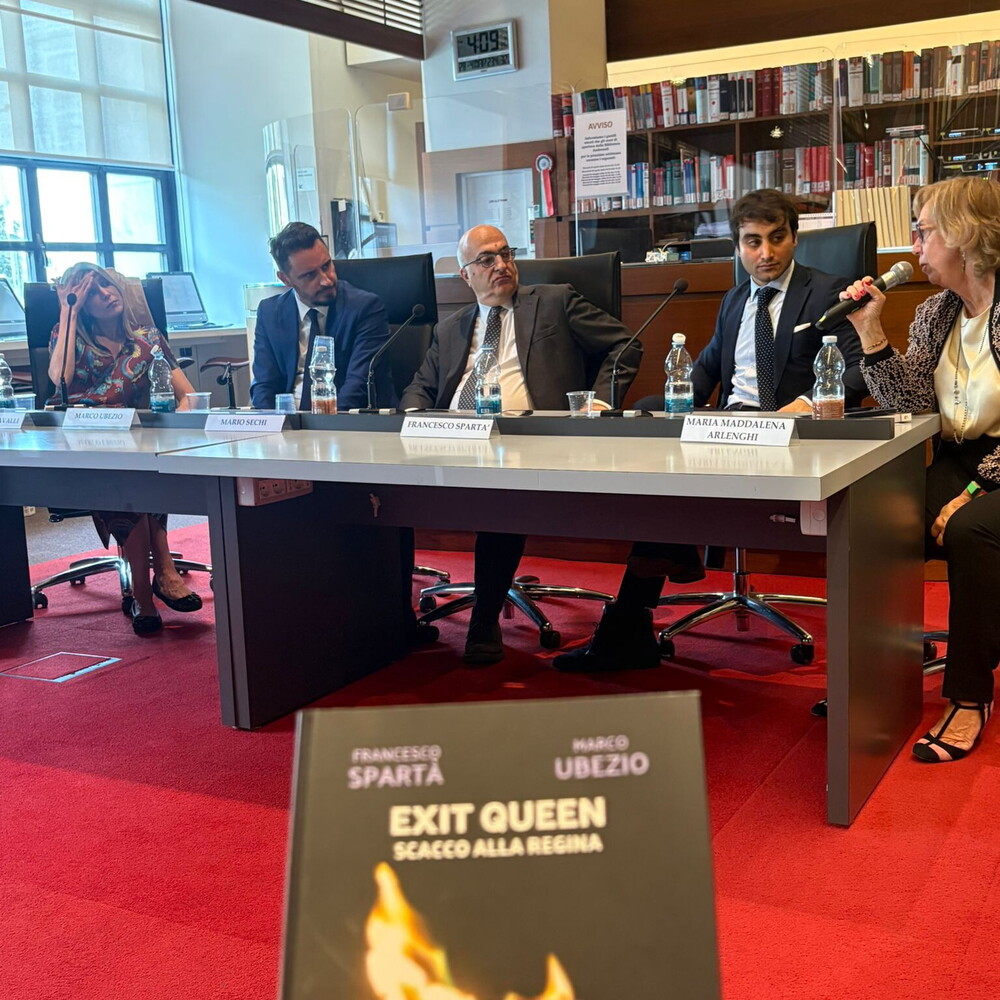
There were those who took notes, those who nodded, those who remained standing so as not to miss a step. At the “Avv. Giorgio Ambrosoli” Library, in the heart of Courthouse of Milanthe meeting on the presentation of‘Exit Queen, check to the Queen’ it immediately had the tone of occasions that surpass the pretext for which they arise. It was supposed to be a presentation, it became a real comparison, almost a small laboratory of applied geopolitics.
The starting point was the book by Marco Ubezio e Francesco Sparta (released on April 10th by Bonfirraro and already in reprint) but it didn’t take long for the discussion to widen, thanks to the authors’ dialogue with Mario Sechi, Costanza Cavalli and the lawyer Maddalena Arlenghi.
From the United Kingdom as an empire to today’s conflicts
We started from the United Kingdom, evoked in the title of the meeting as “disunited”, and emerged in the various interventions as a country that today tries to understand what it really wants to be, and we arrived at a broader analysis of the economic, political and global situation. In the background, present, albeit silently, the role of the Crown.
At a certain point, the room became quieter when Mario Sechi spoke. His speech was, without forcing, the true geopolitical center of gravity of the afternoon. Sechi invited us to look at the United Kingdom not with the categories of the immediate present, but with those of the long historical duration.
The starting point was clear: London it is a former empire that has not yet fully metabolized its transformation. For centuries the center of a global system, the United Kingdom has built its identity on external projection, on the control of routes, on the ability to influence distant balances. There Brexitin this key, is not just a recent political choice, but almost a reflection of that imperial memory: the idea of being able to return to being a fully sovereign actor in the ever-changing global space.
For the director of Libero, today the competition is played on a different scale, between large blocks capable of exercising systemic influence. On the one hand United Stateson the other side China: not simple powers, but poles that attract and attract entire areas of the world around them, economically, technologically, militarily. And Europe and the West must be clear on which side they are on, without ifs or buts.
Immediately afterwards, Costanza Cavalli shifted the focus to the dynamics between Washington e Beijing. The name of Donald Trumpof which Cavalli is a refined scholar and author of a book ‘The Trump Tuft’, arrived almost inevitably.
His starting point was clear: to understand today’s global balance one cannot avoid the figure of Donald Trump or pass him off as a “madman”. Like it or not, he underlined, Trump represents a real and consistent part of the West, and reducing him to a caricature means not understanding a fundamental dynamic.
From here, Cavalli broadened the reasoning to what he defined – in critical tones – a sort of “fragile self-narration” of the West. A West which, in an attempt to question itself, however, risks slipping into a form of systematic self-denigration, losing awareness of its own historical, cultural and political strength. Into this void, he suggested, actors such as China fit in, capable of moving with greater strategic cohesion, fewer hesitations and existential doubts.
Exit Queen, between ucronia and dystopia
The authors, meanwhile, insisted on one point: Exit Queen it is first of all a novel that does not want to explain everything, but tries to read the present through a story that mixes fiction and reality. The “Queen” almost becomes a term of comparison with an era now over.
The transition from the book to reality was continuous. There was talk of national identity, of internal fractures, of a monarchy called to reinvent itself as the country sheds its skin. And when the interventions arrived from the public, the tone became even more direct: questions about the possible return of Great Britain to the EU, on the future of Europe itself and also of the relationship with i Brics.
More than offering certainties, the meeting lined up well-founded doubts, plausible scenarios, even uncomfortable hypotheses, but which today cannot fail to be taken into consideration. A comparison that had the great merit of keeping and touching on different themes together with a vast and heterogeneous audience, but without ever losing the thread.
More than telling a story, the Milanese event brought into focus a series of questions: what place can the United Kingdom (and more generally Europe and the entire West) occupy today in a rapidly changing global balance? And in all of this, will the monarchy be able to survive or risks being called into question as the authors hypothesize in their book? It is precisely here that ‘Exit Queen’ stops being just a title, a novel and becomes a key to understanding. Because the “exit of the sovereign” is not necessarily an event, but a possibility that hovers, a symbolic crack even before an institutional one. And the meaning of the meeting, ultimately, remained suspended in this ambiguity: not so much predicting what will happen, but recognizing that something, deep down, has already changed.