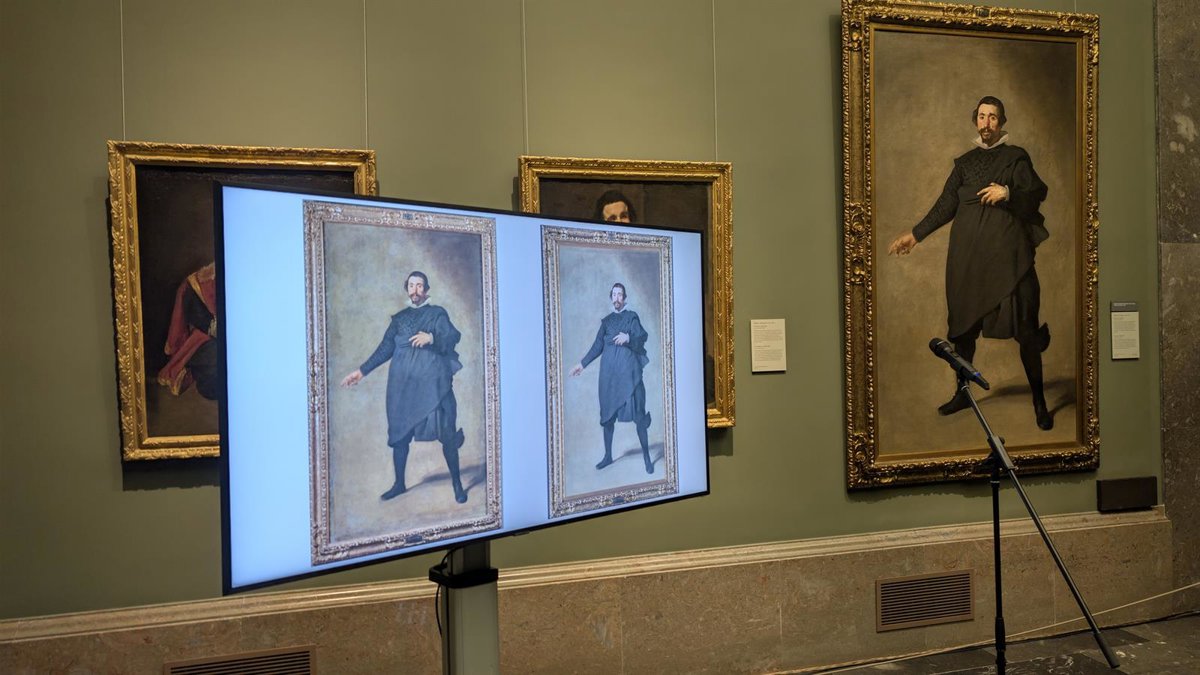
The National Prado Museum presented this Monday the restoration of ‘Paul of Valladolid’which reveals new information about Diego Velázquez’s creative process and offers a version “very close” to the original.
The restaurateur María Álvarez has pointed out that the restoration “It hasn’t been especially long, because it has been very intense“. Specifically, he detailed that they have worked on this work for three months.
In recent years, the Prado Museum is developing an extensive restoration project of several works by Velázquez that had not been intervened since the great campaign carried out in the 1980s.
This program, which is sponsored by the Iberdrola Spain Foundation as a ‘protective member’ of its Restoration Program, aims to ensure the conservation of the canvases and restore to them, as far as possible, the aesthetic and expressive values conceived by the artist.
‘Paul of Valladolid’ It has enjoyed a unique prestige among artists and art historians. Precisely, Manet defined it as ““the most amazing painting ever painted.”
In this sense, the head of Spanish baroque painting at the Prado Museum, Javier Portús, has stressed that “There is no better proof of the quality of a work than how much it has interested successive generations of artists.“.
Thus, he explained that Manet, with his comments, “placed this painting at the forefront of European painting” and stressed that the restoration has made it possible to “renew the technical studies of the painting, with more advanced technology that has made it possible to clarify relevant issues related to the genesis and technique of the painting.”
Velázquez dispenses here with architectural or landscape references and builds the space solely from the body of the jester, the shadow he projects and the air that surrounds him. This solution, ahead of its time, turns the figure into the absolute axis of the composition and explains the intense sensation of presence and three-dimensionality that the work transmits.
ALTERED THE RELATIONSHIP BETWEEN THE FIGURE AND ITS SURROUNDINGS
Although The painting was in good condition.presented historical interventions that altered the relationship between the figure and its environment, one of its most essential values. Already in the 18th century, the scene was expanded by adding bands of fabric on both sides and on the lower edge, while the upper edge was limited to a doubling of the perimeter nailed to the frame. Added to this were repaintings of more recent interventions whose tones, with the passage of time, had changed and affected the chromatic balance of the whole.
The current restoration has had as one of its main axes the restitution of the original dimensions of the canvas. For this It has been decided to preserve the added bands, given their historical interesthiding them under the new frame using an internal boxing system. This non-invasive solution allows only the surface painted by Velázquez to be shown to the public, offering a view very close to the original.
“It is a work that cried out for restoration. The stylistic resources that Velázquez makes with this painting were not seen. The technical quality, the mastery of Velázquez, helps the restoration. Used very good materials“said the restaurateur.
The new x-ray performed with state-of-the-art equipment has been key to accurately establishing the original dimensions of the portrait and analyzing its enlargements. Its study and treatment using the Aracne software have allowed us to determine that the three bands sewn to the original canvas come from the same cloth and were added at a single moment.
The application of advanced infrared reflectography techniques has significantly expanded knowledge of Velázquez’s creative process. Compared to previous analyses, based on a single wavelength, the use of new cameras has allowed the study of more than a dozen ranges and has revealed an underlying drawing made with a brush and freehand, of great spontaneity and quality, with multiple corrections and compositional adjustments.
These techniques have been equally fundamental for the detection of repainting, revealing an identical reflectance between the paint of the non-original additions and numerous retouches present on the original surface, which have been eliminated during the restoration.
“Our technical studies have allowed us to make considerable progress. The work was in very good condition from a structural point of view and we could tackle it without encountering many problems,” said the restaurateur.
Likewise, the intervention has allowed us to review the pigment studies carried out previously and confirm that the canvas’s primer is very clear and is composed mainly of lead white, a characteristic typical of this moment in Velázquez’s career, especially evident in the works made for the Buen Retiro Palace.
The study of pigments has also provided relevant information about the intense blacks of the jester’s costume, obtained through a combination of carbon black and carbon black, both of which have a bluish hue.
Furthermore, the similarity of the internal layers of the additions has reinforced the hypothesis that they come from the same cloth, and the presence of some modern touches that have been removed in the course of the restoration has been confirmed.
LA MANGA, ONE OF THE “MOST PROBLEMATIC” AREAS TO RESTORE
“When the painting arrived at the workshop its appearance was yellowish and we undertook a very global cleaning.. Once the cleaning was carried out, the color of the most lost areas was reintegrated. One of the most problematic areas was the sleeve, which had eroded a lot. There was no need to intervene too much in the painting,” commented the restorer during the presentation.
For his part, the president of the Iberdrola Spain Foundation, Jaime Alfonsín, celebrated that the “extraordinary” work carried out has allowed “the spatial and visual balance conceived by Velázquez to be returned to the canvas, while the new technical studies provide an unprecedented look at his creative process.”
“Initiatives like this reflect the value of cultural patronage as a stable collaboration between institutions serving the general interest“Alfonsín added.
Thanks to this intervention, ‘Pablo de Valladolid’ fully recovers its visual and conceptual strength, while the new technical studies allow us to delve in an unprecedented way into Velázquez’s creative process, reaffirming the extraordinarily modern and experimental character of one of the great masterpieces of the Spanish Golden Age.
https://dakotarecords.us/court-records
https://dakotarecords.us/property-records
https://dubuquerecords.us/court-records
https://fauquierrecords.us/divorce-records
https://frederickrecords.us/warrant-search
https://harfordrecords.us/inmate-search
https://harnettrecords.us/divorce-records
https://inghamrecords.us/criminal-records
https://kenosharecords.us/arrest-records
https://kingrecords.us/divorce-records
https://losangelesrecords.org/warrant-search
https://mecklenburgrecords.org/property-records
https://nashrecords.us/arrest-records
https://nashrecords.us/court-records
https://nashrecords.us/divorce-records
https://nashrecords.us/inmate-search
https://nashrecords.us/property-records
https://nashrecords.us/warrant-search
https://Newyorkrecords.us/arrest-records
https://Newyorkrecords.us/court-records
https://Newyorkrecords.us/criminal-records
https://Newyorkrecords.us/divorce-records
https://Newyorkrecords.us/inmate-search
https://Newyorkrecords.us/property-records
https://Newyorkrecords.us/warrant-search