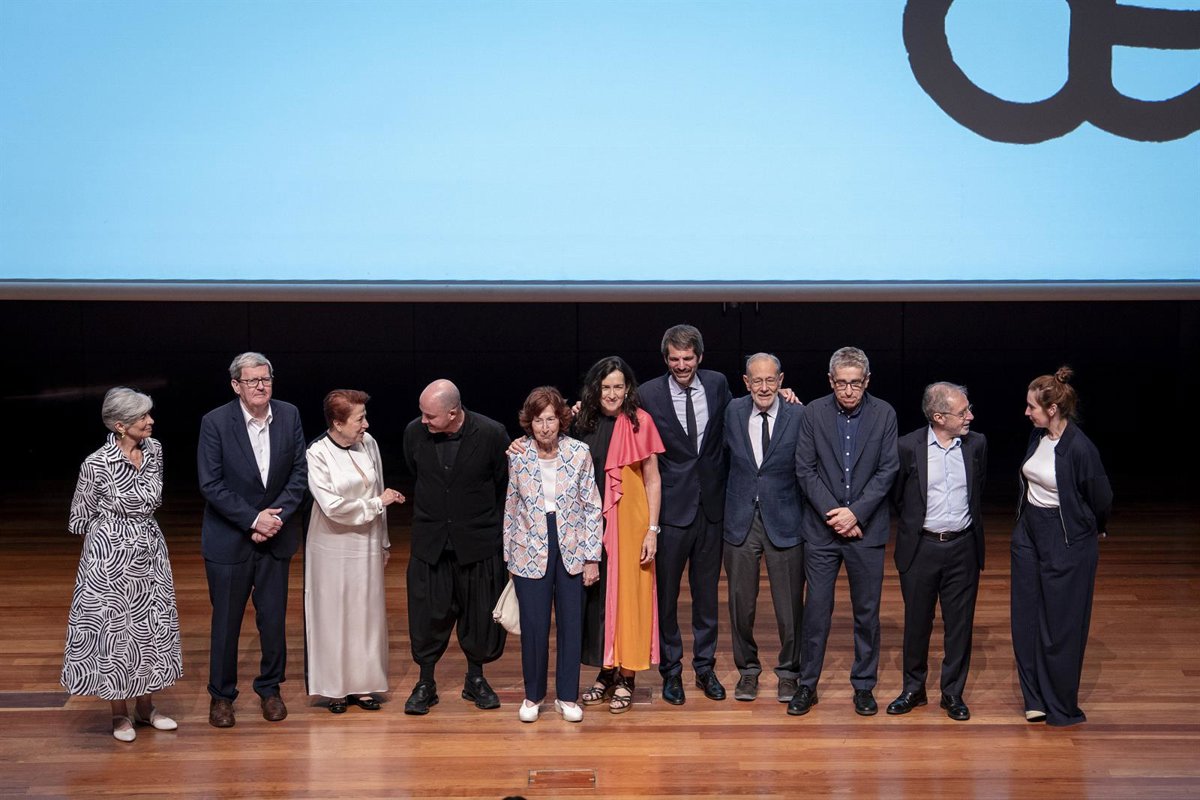
The Reina Sofía Museum celebrated its 40th anniversary this Tuesday, reclaiming its historical and artistic role in an event in which Picasso’s Guernica was highlighted as the “heart” of its permanent collection.
In an event that has brought together personalities from the artistic sector, the Government and culture, the president of the Royal Board of Trustees of the National Museum, Ángeles González-Sinde, has praised the work of the different directors of the institution since it opened its doors as an art center in 1986 until the present.
“What began as a temporary exhibition center, two years later was planned as a national museum. In 1992 it presented its permanent collection with a work that continues to be the heart of the institution, Guernica,” recalled González-Sinde, who has estimated the pieces housed in the art gallery at more than 31,000.
For his part, the current director of the museum, Manuel Segade, has assured that the Reina Sofía “exists as a space for contact with history” and that “it allows us to better understand” the present moment. “For 40 years now, the Reina Sofía has been part of the space for collective construction of everything that is common in our society,” he assured.
Thus, Segade has insisted that art is a way to be “interpellated”, since the works “address us or even raise their voices, like Guernica, to unsay our ways of seeing the world.”
The Minister of Culture, Ernest Urtasun, who closed the event, also thanked the directors and the different departments of the museum for their work at the head of an institution that has granted Spain “its own and prestigious place in the world of contemporary art.” “Also to the city of Madrid, which houses within these walls something as great as Guernica,” he highlighted.
Like Segade, Urtasun has focused on the political and social changes that have accompanied the stages of Reina Sofía, offering with its existence an image of “what we were then and what we are now.”
For the minister, it is not only talking about the institution itself, but also “about the bodies, desire, identities and discourses that subvert a reality that is unfair, unequal or oppressive.”
Urtasun has also highlighted the role of the 1.7 million visitors last year, whom he assured have been part of “an open and participatory center.”
“Art also happens behind the doors of the museum,” recalled the Minister of Culture, who compared the dent that the public leaves in the works with “a sheet of paper that goes from hand to hand telling us about stories yet to be written, painted or imagined.” “Today, 40 years later, the Reina Sofía continues to appeal to us, continues to move us and accompanies us,” he claimed.
TRIBUTE TO ITS DIRECTORS
Throughout the event, the institution paid tribute to the previous directors who have headed the museum: Tomás Llorens and José Guirao, to whom they dedicated an ‘in memoriam’; and María de Corral, Juan Manuel Bonet, Ana Martínez de Aguilar and Manuel Borja-Villel.
Through a projection, these last four former directors have relived the most important moments of their careers, such as the arrival of Guernica to inaugurate the permanent collection, erected as a symbol of the “culture of exile”; the internal structuring of the institution or the creation of the Foundation to promote the museum’s mission, especially after the 2008 crisis.
Borja-Villel has highlighted how within the Reina Sofía “it has been possible to debate and confront ideas that are often totally antagonistic. And that for me has been what the Reina Sofía has contributed in some way with its function throughout these years.”
In this context, Segade, who recalled the “contradictions of the system”, celebrated that the museum “was made by people who precisely advanced in one way or another in those contradictions” with “a hope for transformation” and with their own way of “understanding humanity.”
“The Reina is the footprint and vision of all the people who have contributed to this collective reflection, with very different sensitivities and management models, in more or less favorable historical moments, but leaving a trail of gratitude in your wake,” added Urtasun.
https://hedgedoc.studentiunimi.it/s/U4VuXodNx
https://pad.sfz-aalen.space/s/m3XH_MKkHV
https://data-catalogue.operandum-project.eu/user/dautoscarfans
https://dadosabertos.ifc.edu.br/es/user/vaporesfans
https://fic.decidim.barcelona/profiles/vaporesfans/activity
https://go.chinesewire.com/article/NYC-Office-Study-Name-and-Category-Beat-Traditional-Leasing-Visibility-Signals?storyId=6a2ad682a2947d0002762658
https://hedgedoc.stanleysolutionsnw.com/s/qudRrKeFgx
https://pad.keks.cloud/s/9nIPtElo4n
https://dadosabertos.ufersa.edu.br/user/fansdeski
https://hedgedoc.catgirl.cloud/s/JA0Ek0wL9B
https://notes.netd.cs.tu-dresden.de/s/AZETyKyRU
https://smb.magnoliastatelive.com/article/NYC-Office-Study-Name-and-Category-Beat-Traditional-Leasing-Visibility-Signals?storyId=6a2ad682a2947d0002762658
https://md.emile.space/s/GoKbgeO2h7
https://verwirrung.institute/s/QknGEnUfX0
https://hackmd.astamuse.net/s/HkZe_AYbMe
https://hedgedoc.arch-linux.cz/s/VP9uvkErG9
https://www.luarco.es/armarios-de-puertas-correderas/dos-hermanas/
https://rant.li/df3mgxj7nz
https://docs.copincha.org/s/-4QjoZHkC
https://hedgedoc.schule.social/s/MxWbeO7pY2
https://transportdata.be/user/vaporesfans
https://linkmate.mn.co/posts/expert-installation-of-calderas-de-gas-girona-by-ainstallscaler-with-20-years-of-trust
https://www.bitart.info/produccion-audiovisual-para-empresas-industriales-en-bilbao/
https://stephenpjui81693.fireblogz.com/73282396/regulatory-compliant-calderas-de-gas-girona-with-confirmed-guarantee
https://hedgedoc.catgirl.cloud/s/EaJunqj7Ku