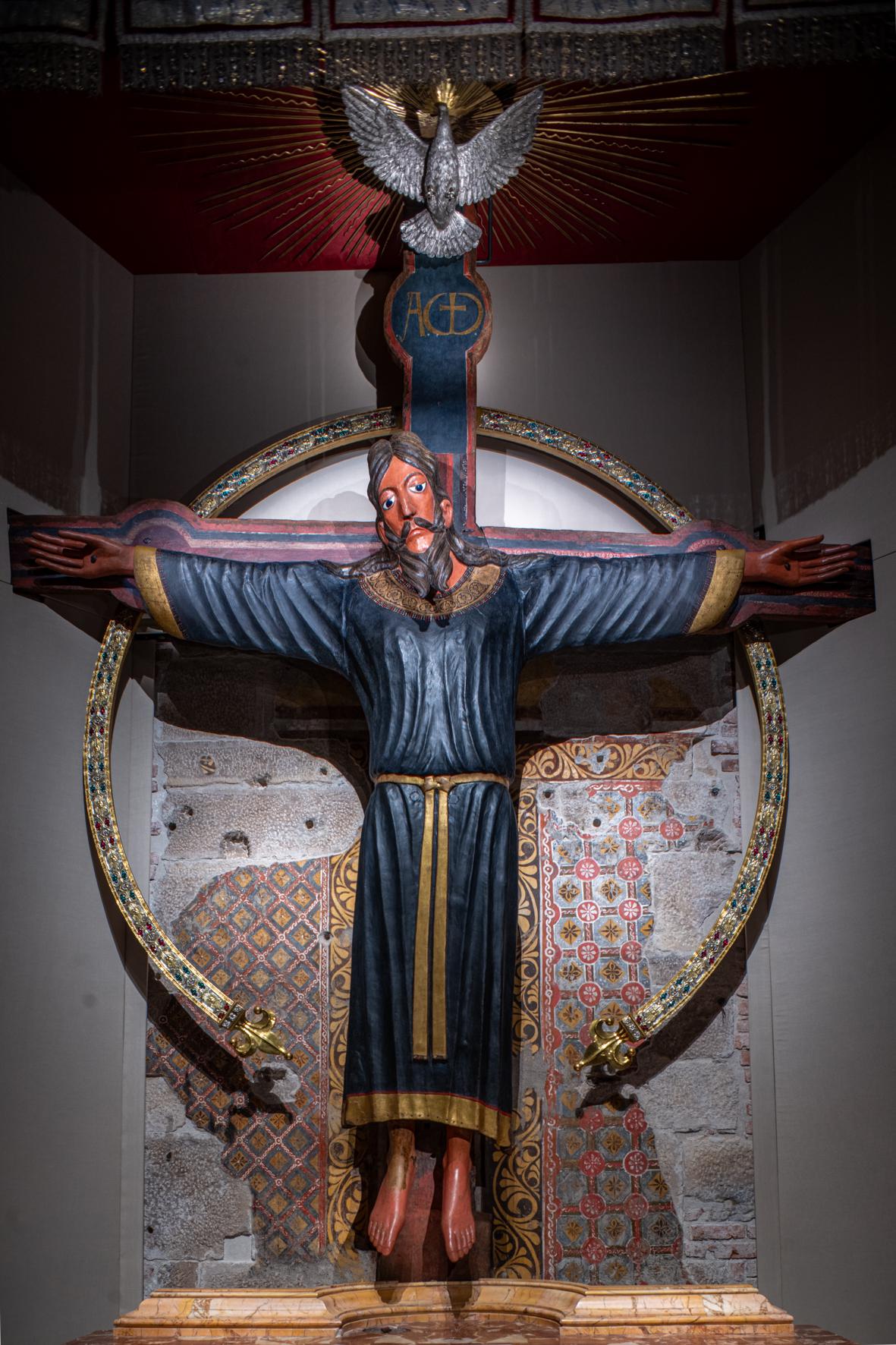
The Holy Face is visible again in Matteo Civitali’s Tempietto in the Cathedral of Lucca. This is the definitive relocation, after the restoration which returned the monumental wooden crucifix to the appearance it had before the 17th century. Preserved for over a thousand years in the Cathedral, the Holy Face represents a Christus triumphans, victorious over death and evil. Tomorrow, Friday 19 June, will be the day of restitution: at 9:00 am the Archbishop of Lucca, Monsignor Paolo Giulietti, will preside over the mass during which he will bless the Holy Face, while at 6:30 pm the presentation to the public will take place.
Subjected for the first time to a restoration (which began with the complex handling and diagnostic investigations in 2022 and ended in September 2025), necessary due to the state of degradation in which the work was, the intervention led to numerous discoveries on the dating, construction technique and materials with which the Holy Face was created. In particular, under a dark surface colour, present on the figure of Christ and on the cross since the 17th century, the beautiful polychromy that still exists has been found and brought to light. Diagnostic investigations have confirmed that it is a 9th century work and not a later replica of a lost original. The Holy Face of Lucca is therefore one of the three oldest monumental wooden crucifixes in the West. Although all three represent a tunic Christ, the monumental wooden crucifix of Lucca is the best preserved and the only one to have eyes in glass paste with blue pupils, made, as discovered during the restoration, by remelting glass from the Roman era. Such penetrating eyes that everyone has been talking about since ancient times.
The restoration, entirely financed by the Cassa di Risparmio di Lucca Foundation thanks to an allocation of 600 thousand euros, was promoted by the Ente Chiesa Cattedrale di San Martino and directed by the Opificio delle Pietre Dure of Florence under the high supervision of the Superintendency of Archaeology, Fine Arts and Landscape for the Provinces of Lucca, Massa Carrara and Pistoia.
From Saturday 20 June, after the movement of the crucifix from the restoration laboratory to the small temple of Civitali, in parallel with the preparation operations, a system has been created that will allow us to continue with the traditional “dressing” of the Holy Face for the solemnities of the Holy Cross with greater safety for the work: a new attachment of the crown will avoid unloading its weight on the top of the sculpture, the handpieces will no longer be fixed to the cross but to a special structure, modifications to the support of the skirt and a series of special protections applied to the collar, jewel, pendants and crown will allow you to avoid friction on the paint film.
Protector and identity symbol of the city, the Holy Face (250 cm high, 270 wide by 40 deep and its cross 442 x 286 cm) was in the Middle Ages among the most famous and venerated images in Italy and Europe, as it was believed to be a true portrait of Christ, sculpted after his death by the disciple Nicodemus. Together with Rome and San Iacopo de Compostela, Lucca found itself among the main pilgrimage destinations of Christianity. The numerous medals with the image of the Holy Face, which pilgrims pinned on their robes, found as far away as Norway, also bear witness to this. If such an ancient work has reached the present day intact, a very rare occurrence for a perishable material like wood, it is due to the great veneration of which it was the object. Dressed in a long tunic with sleeves, which configures him as a priest celebrating self-sacrifice, he shows no signs of suffering – usual instead in the crucifixes of the Middle Ages and subsequent eras – where Christ is dressed only in a loincloth.
Here are the stages of the extraordinary history of the restoration that began in 2020, for the celebration of 950 years since the re-foundation of the Lucca cathedral, when the Cathedral of San Martino di Lucca commissioned the National Institute of Nuclear Physics of Florence (Infn) to carry out, for the first time, investigations with Carbon 14 on three samples of the walnut wood, in which the Holy Face is carved, and a fragment of canvas. For the Holy Face, the result was a sensational dating between the end of the 8th and the end of the 9th century, confirming that it was not a work of the 12th century, a replica of an older original that had been lost, as believed until then. The following year the organization consulted the Opificio delle Pietre Dure di Firenze (OPD) for an assessment of the state of conservation of the work. After a series of reflections and given the state of degradation of the sculpture, in 2022 it was decided to subject the Holy Face to a restoration whose results no one would have imagined at the time. The direction of the works, entrusted to the Polychrome Wooden Sculpture Restoration Sector of the Opificio delle Pietre Dure, shared all the most important decisions with the Promoting Committee and the Scientific Committee. From January to December 2022, the Holy Face was subjected to the first diagnostic investigations inside the temple. After securing it, on 1 December 2022, the crucifix was transported from the small temple to the restoration laboratory built in the transept of the Cathedral. After a subsequent cognitive phase of diagnostic investigations, the restoration work began in 2023, carried out by Francesca Spagnoli, and ended in September 2025. From then until 4 May 2026 – when the preparatory operations for moving the Holy Face began in view of its relocation in the Civitali Temple – the monumental crucifix was visible in the restoration site set up specifically for this purpose.
On May 20th, the movement operations from the Laboratory to the temple took place and the internal preparation of the same began. During this period, the rich gilded wooden apparatus, which has covered the interior of the small temple since the second half of the eighteenth century, was relocated, leaving only the decoration with candelabra and seraphim visible above the left side arch (found evidence of the small temple in the Renaissance period), which can only be appreciated from a side view. The front of the canopy that crowns the Holy Face with its fabric strips has been restored. The backdrop paneling, removed during the restoration, was replaced with light fiberglass panels lined with beige fireproof fabric, fixed with magnets to ensure easy dismantling and future interventions. The fragments of wall painting found during the restoration on the back wall of the chapel (which represent a cross and decorations inspired by silks produced in Lucca from the medieval period), in response to the request of the Archdiocese, were covered with a fabric curtain, which guarantees easy opening for future monitoring and the possibility of periodic viewing.
Under a dark surface color, present on the sculpture and on the cross since the 17th century, in a non-uniform manner in the different parts, the incarnations of Christ’s face, hands and feet have become visible again; the gold leaf decorations on the edge of the sleeves and the hem of the dress; the refined one of the choker (perhaps fifteenth century); the yellow-brown coloring of the hair and beard. The robe is now dark blue in colour, a layer made of very high quality lapis lazuli and in a good state of preservation. Below this, traces of two further layers of the same color were found. The stratigraphic samples show how the blue color and gilding of the robe were repeated over time. On the cross of the Holy Face, as ancient as Christ, also subject to repainting over time, a precious “alpha and omega” in gold leaf on a blue background was recovered and evidence of the existence of at least two previous polychromies, in shades of red and blue, enriched by decorative motifs of bands and palmettes.
The restoration also made another exciting discovery: the glass paste of which the eyes of the Holy Face are made was made by remelting glass from the Roman era. If the deep blue pupils were already visible, the white sclera was covered by a 19th-century zinc white paint, which has been removed. On the left eye the sclera had a gap which was repaired with resin integration. The intervention made it possible to restore the gaze of the Holy Face to its profound expressiveness. A penetrating gaze that everyone has talked about since ancient times, calling it “terribilis”. The Holy Face is the only 9th century wooden sculpture still in existence with eyes made of glass paste.
The separation of Christ from the cross, which was found to be contemporary, carried out without altering the original attachment system, made it possible to understand the construction technique and discover the wood species of which the sculpture is made. It was also possible to deepen our knowledge of the anchoring system, made up of six oak and cedar wood pins, and to design the metal reinforcing structure inside the Christ and behind the cross. The Holy Face – including head and legs – is carved from a single trunk of walnut wood. The head, which protrudes a lot from the body, about 40 cm, is obtained in the part of the trunk towards the root of the tree, the legs correspond to the part facing the foliage. The Christ is hollowed out along its entire length on the back, as was the norm for wooden sculptures, reducing its thickness and thus attenuating the harmful expansion of the wood, and the back of the neck is closed by a wooden lid, in the past covered with red fabric, where the relics were probably placed. The cross was made using two different wood species: the vertical arm is made of chestnut wood, while the horizontal one is made of silver fir.
Even the large nimbus (whose dating is still being studied), which surrounds the Holy Face (about 240 cm in diameter) in the shape of a semicircle, was covered with a thick dark-coloured layer, identified as an altered vegetable gum. Now it is possible to admire it in all its beauty: 14 plates of embossed and chiselled silver with cherubs have been placed on a wooden support, within golden relief ribs, set with 384 glass paste gems of very intense emerald green and ruby red colour, in the center of which is a four-petalled silver flower. Two lilies in golden copper foil are fixed to the lower ends.
In 2020, for the celebration of the 950th anniversary of the re-foundation of the Lucca cathedral, three samples of walnut wood, in which the Holy Face is carved, and a fragment of canvas were subjected for the first time, by the National Institute of Nuclear Physics of Florence (INFN), to investigations with Carbon 14 resulting in a dating between the end of the 8th and the end of the 9th century (until then the Holy Face was believed by scholars a work from the 12th century, a replica of an older original that was lost). The results of the diagnostic analyzes carried out during the recently completed restoration all converge in dating it to the 9th century. In particular, the dendrochronological investigations, carried out by the IBE-CNR Laboratory of Florence, on the wood of the cross coeval with Christ, were able to precisely attest to a dating of 860 with a chronological margin of deviation slightly beyond that, always within the 9th century. “It is a date which is also confirmed in the typology of the Holy Face – explains Anna Maria Giusti, historical and artistic consultant for the museum and archaeological complex of the Cathedral of Lucca and for the restoration of the Holy Face – which has close affinities with the Crucifix of the Cathedral of Sansepolcro, also assigned to the 9th century by Carbon 14 investigations. A similar dating was diagnosed for a Crucifix preserved in Tancrémont in Belgium and coming from a foundation abbey Carolingian Crucifixes of this type, lost but remembered in documents, were concentrated in large numbers in the territories of Charlemagne’s Empire, of which Lucca was also part from 774, and it cannot be ruled out that the origin of the Holy Face can be hypothesized from that Carolingian area, which was the epicenter of an extraordinary artistic flowering”.
Verantwoord Spelen
Verificacion
Verificacion
Verificacion
Verificacion
Verificacion
Verificacion
Verificacion
Verificacion
Verificatie
Verificatie
Verificacion
Verificatie
Verificatie
Verification
Verification
Verification
Verification
Verification
Verification
Verifikacija
Verifikacija
Verifikacija
Wedden
Wedden