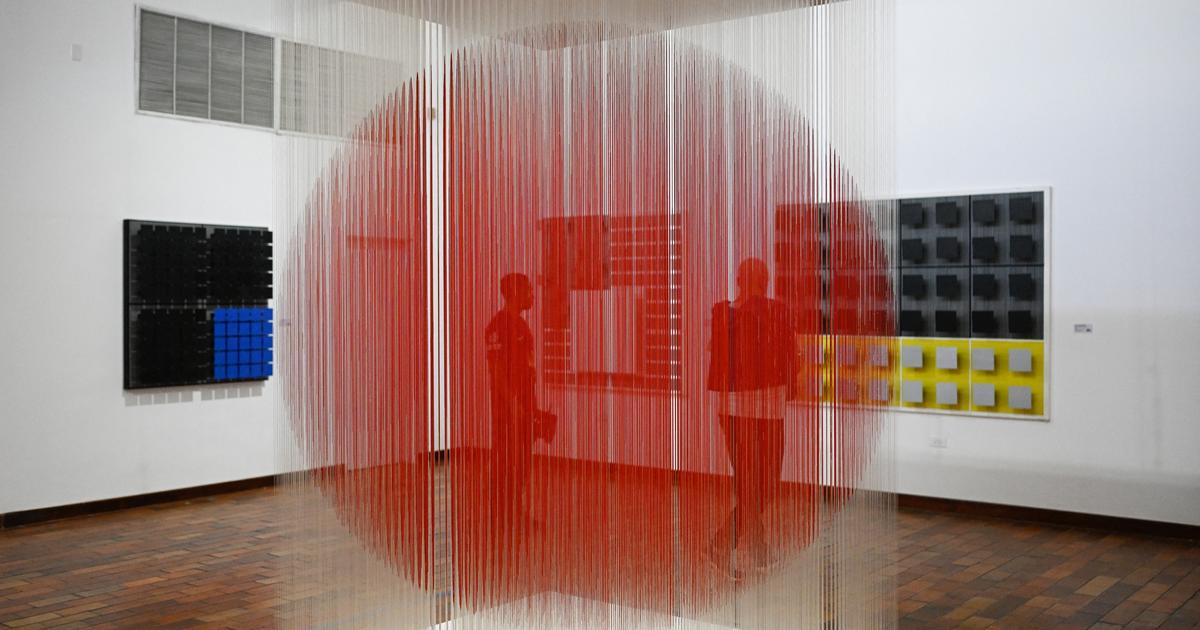
After a period of work, the Ciudad Bolivar museum once again combines the installations of the master who died in 2025 with the architectural gesture of Carlos Villanueva.
The iconic sculptures of Jesus Rafael Soto, the Venezuelan kinetic artist famous for his “penetrables” or “balls” composed of suspended rods, unfold in a custom-made museum in eastern Venezuela, reopening in 2025 after years of abandonment.
The museum, erected in 1973 in Ciudad Bolivar, in the artist’s hometown, brings together the most famous Venezuelan architect Carlos Villanueva (1900-1975), author in particular of the Central University of Venezuela (world heritage of humanity), and the art of Soto (1923-2005).
Also read
The shimmering mirages of Jesus Rafael Soto
Skip the ad
Yellow and silver stems
“The architecture of the museum is a work of art in itself (…) Its luminous spaces and the perfect integration with the natural environment invite introspection and wonder”underlines the museum in a text. Villanueva designed the buildings specifically for the work of Soto, a friend with whom he notably collaborated on the Venezuela Pavilion at the Montreal World’s Fair in 1967, where a work by Soto took pride of place.
The architect notably planned high ceilings to be able to hang the works, and a windowless room for the Yellow and Silver Rotating (Yellow and silver rotary, 1971), one of the major creations of the artist who “combines kinetics, mechanics and light” with motors rotating yellow and silver rods illuminated from the ground, points out one of the museum guides, Oasis Bolivar. This work is one of Soto’s few with a motor.
FEDERICO PARRA / AFP
Regularly exhibited at the Center Pompidou, the Louis Vuitton Foundation and many other institutions around the world, Soto was “one of the greatest exponents of kinetic art, he left a historical and artistic legacy, not only here in Venezuela, but throughout the world”estimates the guide.
In France in the 1950s
Born on June 5, 1923 into a modest family, the artist drew with charcoal when he was a child due to lack of materials. On scholarships, he traveled to Caracas, the capital, then to Maracaibo, the country’s second city, before leaving for France, where his career took off. Fascinated by movement and interaction with the viewer, Soto began exploring kinetic art in 1950 in France.
The museum bearing his name also hosts the works of friends or artists who influenced his work, such as his fellow citizen Carlos Cruz-Diez, the Pole Henryk Berlewi, the Ecuadorian Luis Molinari and Victor Vasarely, whom Soto met during the historic “Le Mouvement” exhibition in 1955 in Paris.
Also read
Venezuela celebrates the centenary of the Cruz-Diez and Soto “kinetics”
Skip the ad
“Soto’s intention is that the work is not something immovable, but that the viewer can experience it and become a fundamental part of it, and that it can have a kind of life of its own”explains Oasis Bolivar.
Soto believed that “the work of art must be capable of arousing an emotion in the person who contemplates it, but that does not mean that it must arise from an emotional situation. If it has an origin, it is the thought, the rigor, the logic of artistic research”underlines the guide.