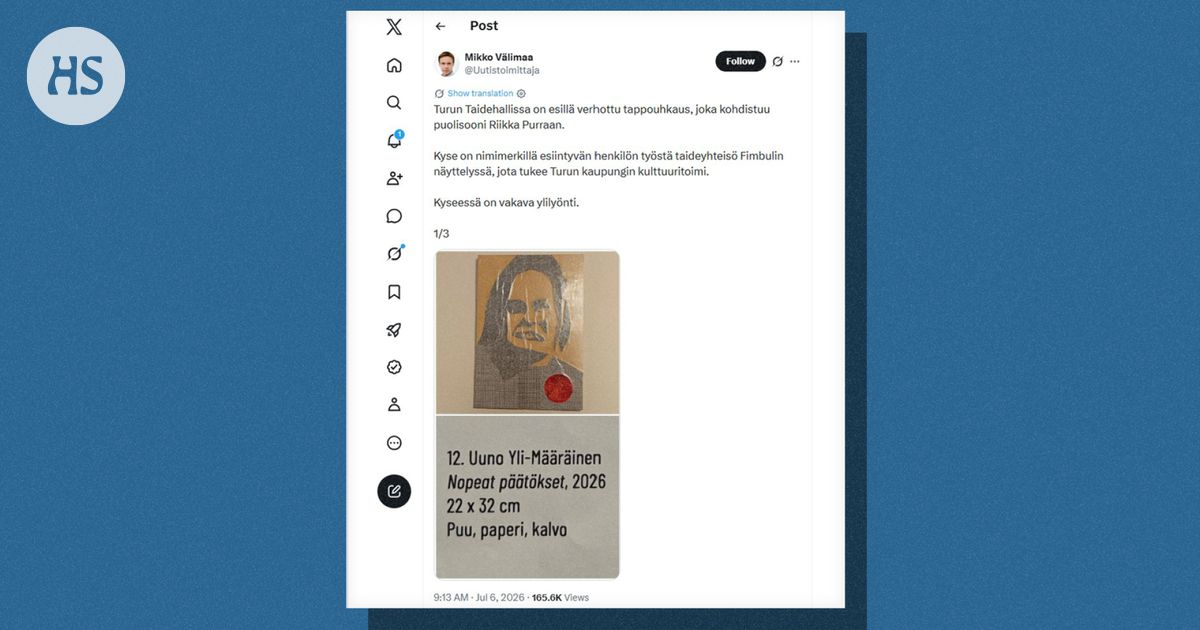
Supplier, finance minister Riikka Purran (ps) attacked Mikko Välimaa comment In the X message service The artwork on display in Turku Art Hall as a “veiled death threat” aimed at Purra and “tax-funded political hate speech”.
It is the work of the pseudonym Uuno Yli Quick decisionswhose materials include wood, paper and film. The work is on display in the artist house Fimbul’s group exhibition at Vanhalla Raatihuone until the end of this month.
Välimaa apparently interprets the character appearing in the work as Burra. The character has a large red spot that stands out from the gray background approximately at the collarbone.
In his three X messages, Välimaa did not specify which things in the work led to his interpretation. To HS’s inquiry, he replied: “My view on the matter must be exhausted in the message thread. I have nothing to add to it.”
Fimbul Taiteilijatalo ry chairman of the board, artist Jenny Mild told HS that he would only comment on the matter with the association’s press release.
The association published on Monday afternoon on their website and the following statement on Instagram:
“The association does not recognize a threat to life and health in the work, and does not under any circumstances accept threats, violence or illegal content. The artist appearing under the pseudonym has also by no means made or presented his work in a threatening sense and condemns all violence.”
“The association stands behind the artist’s freedom of expression and speech and finds it unfortunate that such a serious interpretation has been made of the work. The association takes a serious view of talk about threats to life.”
HS sought a comment from the artist who made the work, but Mild communicated that he too would only comment on the matter through a press release.
HS has not been able to confirm the identity of the artist. The nickname does not generate other online hits and it does not appear in the exhibition either in public information.
In background discussions with people familiar with Turku’s art scene, it became clear that many know it is a pseudonym and some believe they recognize the author from the style of the work.
Helsinki university lecturer in social law at the university Pauli Rautiainen by Quick decisions leaves so much room for interpretation, including the title, the artist’s moniker and the presentation, that it would be very difficult to prove it as an illegal threat.
“At the core of the freedom of art is the idea that art must be interpreted as art,” says Rautiainen.
“Välimaa itself seems to be unsure whether the work presents a legally prohibited illegal threat while talking about a veiled threat.”
Rautiainen has studied the relationship between fine art and freedom of speech, among other things, in his dissertation Legal status of visual artist (2012).
Art is characterized by ambiguity, which, according to Rautiainen, is also realized in the work of Yli-määinen.
“A person coming from within the art field reads the work through, for example, a ‘work has been acquired’ type of red dot, someone else in some other way.”
Many art people interviewed on the subject also said that the spot reminded them of the sign that is usually placed next to a work in a gallery to say that the work has already been sold.
How about the anonymity of the work? Could it be an aggravating issue?
“An anonymous person has the same freedom of expression as others,” Rautiainen says.
“In the art world, it’s completely normal to use different names, to play with artificiality, and that kind of thing enjoys the protection of artistic freedom.”
“The powers of the police to establish identity are determined by the law on preliminary investigation. They are limited, for example, by how serious a crime on the punishment scale the perpetrator should be suspected and whether the preliminary investigation threshold is considered to be exceeded.”
The middle ground also wrote that the city of Turku supports the exhibition in question. Can a sponsor or publisher be held responsible for questionable content?
“Basically, you shouldn’t go this far,” says Rautiainen.
“For example Harro Koskinen Pig messiah (1969) case, in addition to the artist, the jury that had selected the work for the exhibition was held responsible. Making the jury responsible has later been strongly criticized, but even then it was about people who had known the content of the work. Holding the financier accountable would go many steps further.”
In the early 1970s, Koskinen and the jury were sentenced to fines until the Supreme Court.
Rautiainen also refers to, for example, a case from the 21st century where It was discussed at the European Court of Human Rights artist Otto Mühlin the banning of the work in Austria. In the work, for example, a politician Jörg Haider and Mother Teresa were seen in sexual acts.
The Human Rights Court found that the ban violated Mühl’s freedom of expression as an artist.
Rautiainen according to us, we already live in a different time in the legal interpretation of art than twenty years ago. In our time, interpretations like the one presented by Välimaa are on the rise.
“Suspected illegal threats are generally on the rise,” says Rautiainen.
“People’s sensitivity to seeing things as they are is clearly a phenomenon of this time.”
Correction 7/7/2026 at 10:50 a.m.: Contrary to what was written earlier in the text, the work discussed by the European Court of Human Rights was not by the Swiss Josef Felix Müller. The artist was Austrian Otto Mühl.
https://www.find-us-here.com/businesses/Missouri-License-Plate-Jefferson-City-Missouri-USA/34529588/
Missouri License Plate on golocalezservices.com
Missouri License Plate
Montana License Plate on Western Business Collective
Montana License Plate on HomePros411
Listingdisplay.Aspx
Nebraska License Plate on Mediics Healthcare Directory
Nebraska License Plate
Listingdisplay.Aspx
Listingdisplay.Aspx
Nevada License Plate
Nevada License Plate
New Hampshire License Plate
https://www.find-us-here.com/businesses/New-Hampshire-License-Plate-Concord-New-Hampshire-USA/34537816/
https://www.a-zbusinessfinder.com/business-directory/New-Hampshire-License-Plate-Concord-New-Hampshire-USA/34537816/
New Hampshire License Plate on BizMaker
Social Bookmarking Sites 2021
New Jersey License Plate on https://newjerseylicenseplate.org/
New Jersey License Plate
New Mexico License Plate on BizMakersofAmerica
New Mexico License Plate
https://www.a-zbusinessfinder.com/business-directory/New-Mexico-License-Plate-Santa-Fe-New-Mexico-USA/34544292/
https://www.find-us-here.com/businesses/New-Mexico-License-Plate-Santa-Fe-New-Mexico-USA/34544292/
https://www.a-zbusinessfinder.com/business-directory/New-York-License-Plate-Albany-New-York-USA/34531069/
https://www.find-us-here.com/businesses/New-York-License-Plate-Albany-New-York-USA/34531069/