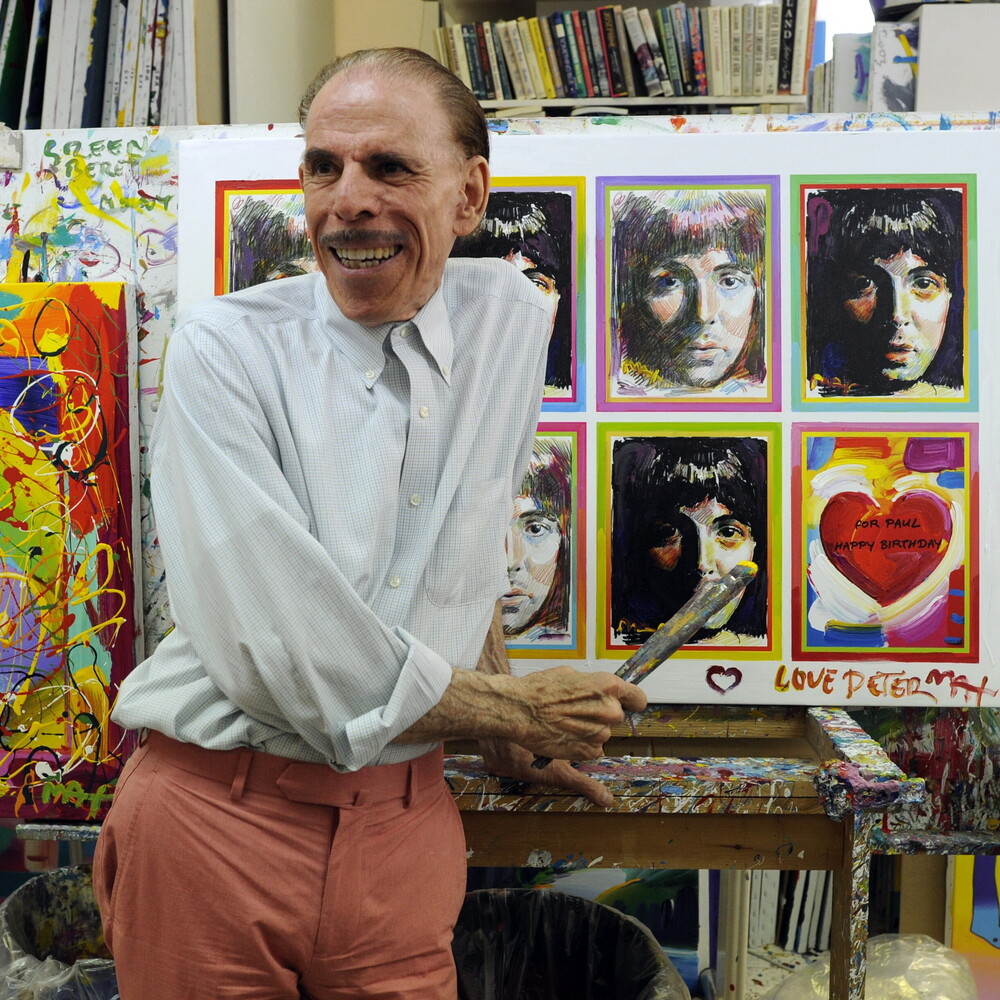
The Pop Artist Peter Max, whose vivid psychedelic creations helped define the counterculture aesthetic of the 1960s, has died at 88.
“We will remember his extraordinary creativity, his human warmth, his curiosity and the way he saw beauty and possibility everywhere,” his son Adam Max told ABC News “His art became part of the american culture, but the man behind that art – the father we knew and loved – is the person we will miss most.”
The disappearance of Peter Max, the flight of 60s psychedelia
Throughout his career, Max has created vibrantly colored graphic images, being recognized for capturing the essence of “Summer of Love” (the summer of love) and psychedelia of the 60s. “I see everything through eyes rainbow colour”, he once told ABC.
The man had been suffering from for some time dementia and died in hospital on Monday, the New York Times reports. His works have appeared on millions of posters – often colorful ones fluorescents and psychedelics that decorated college rooms — and on numerous magazine covers, as well as on government-commissioned welcome murals at the borders and on a postage stamp, according to its website.
The life of the artist behind the MTV logo
A prolific artist, Max has created highly commercially successful works, licensed for numerous consumer products: from shower curtains to airplanes and cruise ships, to a line of “art clocks” commissioned by General Electric.
He also created the logo for MTV in the 80sas well as posters for the 1994 World Cup, the Super Bowl and the New Orleans Jazz Festival.
Born in Berlin in 1937 under the name of Peter Max Finkelstein, he left Germany with his family during the rise of Nazism. They traveled through Asia, the Middle East and Paris before arriving in the United States in 1953, settling in New York when he was 16. Here, he studied art at the prestigious School of Visual Arts in New York and the Pratt Institute, before starting to work as a graphic designer and opening his own design studio.
“Max, vegetarian and teetotal that expanded one’s consciousness through yoga rather than drugs, he was one of the best-known and most successful artists of his era,” the Times wrote.
The shadows split the rainbow
However, success brought with it difficulties throughout his career. In 1998, Max was sentenced to carry out social work profits by teaching art in Harlem and to pay a fine of $30,000for evading taxes on $714,000 from the sale of works of art between 1988 and 1991.
In his guilty plea, Max admitted to exchanging artwork for real estate and concealing proceeds to purchase property in New York state and the U.S. Virgin Islands. Over the past decade, disputes over the artist’s treatment and ownership of his works have ended up in court and fueled gossip, with family and friends exchanging “scandalous accusations of kidnapping, hiring of henchmen, attempted murder” and money-making schemes, as recalled by the Times.
One of the main sources of income – and lawsuits – has been represented by art star, accompanied by rivers of champagne, organized on board the ships of the largest cruise companies, including Royal Caribbean, Carnival and Norwegian. Sales that triggered legal action from buyers according to whom the works received did not live up to expectations.