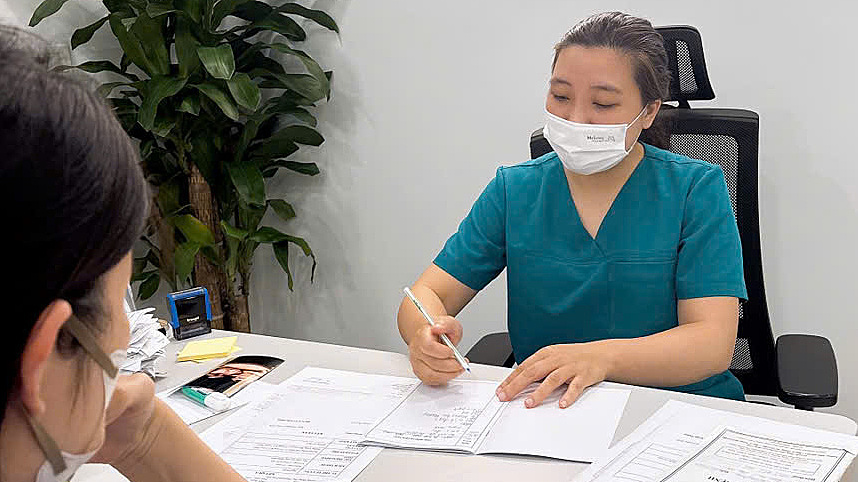
When the last patients left the clinic, Loan still tried to linger, clutching both hands on the crumpled medical record that recorded the diagnosis of “premature ovarian failure”.
For more than a year, her menstruation gradually decreased and then completely disappeared. At Hanoi Obstetrics Hospital, doctor Dong Thu Trang prescribed an ultrasound and tested AMH levels, an index that reflects the remaining follicle reserve in the ovaries.
The results showed that both ovaries had shrunk, with almost no dominant follicles remaining. The AMH index is only 0.005 ng/ml, a level equivalent to premenopausal women, while the normal threshold for people aged 20-30 ranges from 1.0 to 3.5 ng/ml. In addition, Loan often sweats, has hot flashes, and is easily irritable for no reason, typical symptoms of estrogen deficiency.
“The patient’s number of stored follicles is at a very low level and continues to decline over time. Without timely intervention, the opportunity to become a mother with her own eggs will increasingly narrow,” said Dr. Trang.
When asked about her lifestyle, Loan said she has been doing livestream online sales for the past 4 years. She maintains the habit of sleeping throughout the day, eating only one meal, and continuously drinking tea and strong coffee at night to stay awake and “closing orders” until 2 a.m., then cleaning until sunrise.
Doctor Trang said that in Loan’s case, a prolonged late-night lifestyle, poor diet and chronic stress are factors that can promote faster hormonal decline. However, the doctor also noted that severe ovarian reserve impairment like this case usually has no single cause. Genetics, underlying autoimmune diseases or physical factors also need to be ruled out through in-depth examination.
“It is important that patients be evaluated comprehensively to find the underlying cause, instead of just focusing on lifestyle,” the doctor emphasized.
Doctor Trang examines the patient’s health. Image: Doctor provided
Lien, 25 years old, was also shocked when she received the test results more than a year after giving birth. Last August, all her indicators were still within normal limits. Recently, her menstrual cycle was unusually shortened, so she decided to have it checked again.
Ultrasound results showed that the ovaries no longer had clear follicles, and the AMH index was down to 0.006 ng/ml. Without timely medical intervention, Lien’s ability to conceive naturally will be very low.
Talking to the doctor, she said that in the past time, she has been taking care of her child alone, going to work, and only sleeping a few hours a day. Daily meals are also bland and not nutritious enough. In just 5 months, she lost nearly 15 kg, was constantly sick, and supplemented many vitamins but did not improve her health.
Premature Ovarian Insufficiency (POI) has traditionally been considered a rare condition in women under 40 years of age, with an estimated incidence of approximately 1% in the general population. In recent years, doctors at several major hospitals in Vietnam have recorded an increasing number of women in their 30s, even in their early 20s, coming to the clinic with significant ovarian reserve decline.
According to Dr. Phan Chi Thanh, Deputy Head of the Department of Andrology and Gender Medicine, Central Obstetrics and Gynecology Hospital, the number of patients coming for examination for this reason has increased significantly compared to previous years. However, he also noted that this number has not had an official epidemiological survey in Vietnam, and part of the reason for the increase is due to increased public awareness of reproductive health, leading to more women proactively getting screened.
“We cannot confirm whether the incidence rate in the community is really increasing or just the number of people going to the doctor is increasing. To have an accurate conclusion, a large-scale epidemiological study is needed,” said Dr. Thanh.
In an international context, a meta-analysis found that approximately 9–24% of women in fertility treatment groups (but not in the general population) had reduced ovarian reserve. This number does not reflect the rate in the overall female population.
According to Dr. Thanh, reduced ovarian reserve and premature ovarian failure have complex causes, including genetics, autoimmune diseases or chromosomal diseases. The older a woman is, the lower her ovarian reserve. In particular, unhealthy lifestyle, drinking a lot of alcohol, smoking, using stimulants, often staying up late, experiencing a lot of tension, stress, and excessive weight loss are also risk factors.
Sharing the same opinion, Dr. Trang said the ovaries are like a “bank, only withdrawing but not depositing”. Unlike men, who continuously produce new sperm, women consume available eggs through each menstrual cycle.
“Once the ovaries have failed and become exhausted, currently medicine has no way to restore or stimulate it to function normally again,” the doctor said.
In particular, many girls think they are young and healthy so they “treat” their bodies without knowing that the ovaries are very sensitive organs to toxic stimuli. Specifically, the pressure of work, study, and living in big cities puts the nervous system in a state of “alarm”.
When stressed, the body secretes hormones that are harmful to health. In women, prolonged stress can lead to female hormone disorders, menstrual cycle disorders, affect the ovulation process, and reduce the ability to conceive naturally.
Staying up late after 11pm seriously reduces melatonin, a powerful antioxidant that protects egg quality. The trend of favoring a slimmer body shape causes many girls to seriously fast or take rapid weight loss pills, causing damage to their ovaries. Smoking, including passive smoking or e-cigarettes, alcohol and caffeine abuse are also risk factors.
“If the patient no longer has egg follicles, the last resort is to ask for eggs,” the doctor said. Depending on the patient’s condition and wishes, private doctors still provide appropriate treatment.
Women with ovarian failure often have amenorrhea or irregular bleeding, menstrual disorders, frequent fatigue, dizziness, nausea, insomnia, agitation, difficulty concentrating, pain during sex, and vaginal dryness. Many cases of decreased sexual desire, always avoiding sex, loss of fertility, urinary disorders…
“Ovarian failure causes the body to age 60 years in a 30-year-old body, which means health declines, the risk of cardiovascular disease, bone and joint disease, cancer… may increase,” Mr. Thanh said.
For cases like Lien, doctors said she needs to quickly adjust her lifestyle, supplement nutrition to restore her health, and coordinate with fertility support measures to save the last follicles if she still wishes to have more children.
As for Loan, the most important thing right now is to stabilize her mind and avoid falling into panic. She needs to closely follow her doctor’s endocrine treatment regimen to protect her overall health, prevent complications of early menopause, and consider the egg donation option if she wants to become a mother in the future.
Doctors recommend that young women who have unusual signs such as irregular menstruation, sudden decrease in menstrual flow or no menstruation for 3 months or more need to immediately go to specialized medical facilities for AMH testing and screening probe ultrasound, to avoid detecting it too late when the opportunity for treatment has passed.
Inconel 718 Welded Tubes Manufacturer In Mumbai, India
Inconel X-750 Plates Manufacturer, Supplier In India
Inconel X-750 Seamless Pipes Manufacturer In Mumbai
Inconel X-750 Seamless Tubes Supplier, Stockist In India
Inconel X-750 Tubes Manufacturer, Supplier In Mumbai
Japanese Origin Pipes Stockist, Supplier In Mumbai, India
Japanese Origin Plates Stockist, Supplier In Mumbai, India.
Japanese Origin Tubes Supplier, Stockist – Navrang Steel
Korean Origin EFW Pipes Stockist, Supplier In Mumbai, India
Korean Origin Pipes Stockist, Supplier In Mumbai, India
Korean Origin Plates Stockist, Supplier In Mumbai, India.
Korean Origin Seamless Pipes Stockist, Supplier In Mumbai, India
Korean Origin Welded Pipes Stockist, Supplier In Mumbai, India
Korean Origin Welded Tubes Stockist, Supplier In Mumbai, India.
Monel 400 Pipes Manufacturer & Stockist In Mumbai, India
Monel 400/ K500 Plates Supplier, Stockist In Mumbai
Monel 400/K500 Seamless Tube Manufacturer, Supplier in India
Monel 400 / K500 Tubes Manufacturer, Stockist In Mumbai
Monel 400/K500 Welded Pipe Manufacturer In Mumbai, India
Nickel 200 / 201 Pipes Manufacturer In Mumbai, India
Nickel 200 / 201 Plates Manufacturer, Supplier In India
SMO 254 Seamless Tubes Manufacturer, Stockist In India
SMO 254 Welded Tubes Supplier, Stockist In Mumbai, India
SS 253 MA Welded Tubes Manufacturer, Supplier In Mumbai
SS 309/309S Seamless Tubes Manufacturer In Mumbai, India