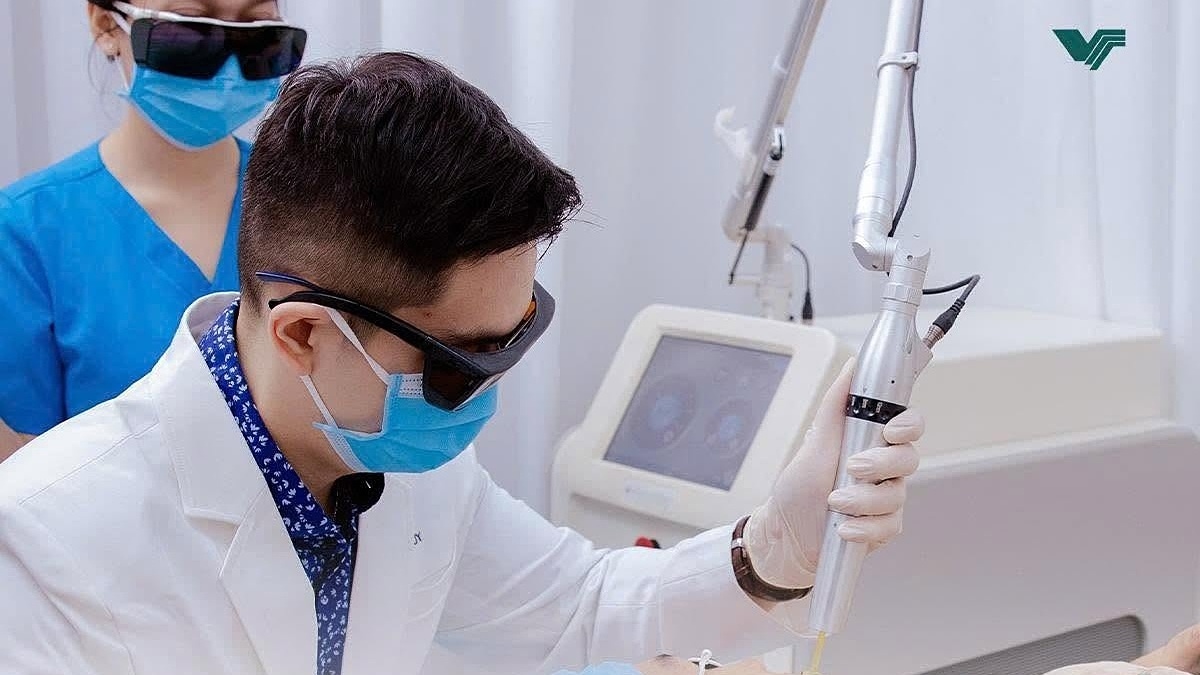
Many establishments advertise lasers that can instantly rejuvenate, even “10 years younger”, but experts believe that this is exaggerated information, easily causing beauticians to have false expectations and unnecessary costs.
Assoc. August 2, said that lasers and energy-generating devices have long been applied in many specialties such as dermatology, aesthetics, ophthalmology, surgery, ENT, orthopedic trauma and rehabilitation.
In recent years, this technology continues to be combined with regenerative medicine to improve treatment effectiveness. However, not all applications have enough scientific evidence to confirm effectiveness.
According to him, regenerative medicine, including stem cells, products extracted from stem cells and biological materials, is considered to have a lot of potential but still has many limitations. Most of the current research is small-scale and does not have enough evidence to agree on treatment effectiveness. Therefore, combining laser with regenerative medicine still needs more major research and standard protocols before being widely applied.
Referring to advertisements claiming that laser or regenerative medicine can help rejuvenate quickly, Mr. Trung said that low-energy lasers actually have a mechanism to promote tissue recovery and regeneration, but the effect happens gradually, not immediately. Low-energy lasers modulate the biological environment so that the body regenerates itself, rather than destroying tissue and immediately replacing it. Therefore, effectiveness takes time and depends on the correct indications, correct treatment parameters as well as each disease condition.
According to experts, each study uses different protocols and energy levels, so the results are also different. Therefore, advertisements about “spectacular” effectiveness should be viewed with caution.
Assoc.Prof.Dr. Van The Trung at the conference on August 2. Photo: Provided by the hospital
He said that in aesthetics, lasers bring clear results in some indications such as treating pigmentation, vascular damage or hair removal. In these cases, laser helps significantly improve appearance and quality of life.
However, not all dermatological problems respond well to laser. For example, melasma – a condition affected by many hormonal, sunlight, genetic and lifestyle factors – if treated only with laser, it will be difficult to achieve optimal results. Patients often have to combine topical medications, oral medications, sunscreen and lifestyle changes to get better results.
Another fact that worries experts is that many facilities over-promote the benefits of laser while the practitioners have not been properly trained. According to Mr. Trung, high-power laser devices can cause eye damage if not used according to safety procedures. Choosing the wrong treatment parameters also risks causing the skin to become patchy, hyperpigmented, infected or leave scars.
“The more modern the device is, the more in-depth training it requires. You cannot buy a machine and use it yourself without professional knowledge,” he emphasized. Laser operators must be trained at universities and hospitals and continue to practice under guidance before becoming proficient in using each type of equipment.
Laser users need to be properly trained and follow instructions correctly. Photo: Provided by doctor
Regarding advertisements such as “10 years younger after just one treatment”, Mr. Trung affirmed that this is just a way to impress customers. There is no device that can help you look 10 years younger and there is no such way to measure it. Even high-power lasers take time for tissue to regenerate. Even if a treatment is effective, it is not permanent because the aging process continues to take place.
He recommends that people should not make beauty decisions based only on advertising, but need to carefully study the indications, implementation facilities and qualifications of the equipment operator. Excessive advertising not only causes customers to have false expectations but can also lead to disputes when the results are not as expected.
Speaking at the conference, Associate Professor, Dr. Nguyen Thi Ngoc Dung, President of the Ho Chi Minh City Medical Association, said the development of lasers, energy generating devices and regenerative medicine is opening up many new approaches to treatment. However, the trend of modern medicine is to apply these technologies on the basis of scientific evidence, with the right indications and in an interdisciplinary manner to bring about more effective treatment, less invasiveness and improve the quality of life for patients.