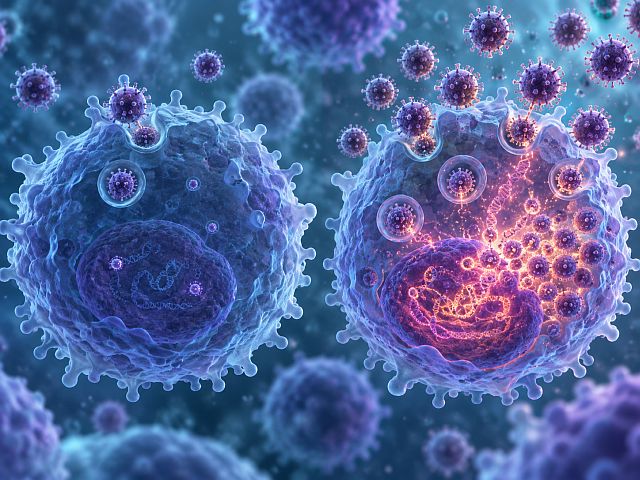
Weizmann Institute researchers have discovered that the outcome of human cytomegalovirus (HCMV) infection of a single cell is largely determined by the number of viral particles that manage to penetrate. If their number is below a certain threshold for the cell, the virus can go into a latent state; exceeding this threshold promotes the development of an active infection, the PNAS publication explains.
HCMV belongs to the herpesvirus family and, once infected, remains in the body for life. It usually does not cause serious problems, but can be reactivated when the immune system is weakened. In addition, cytomegalovirus can be transmitted from a pregnant woman to her fetus and, in some cases, lead to severe developmental disorders and hearing loss. One of the places where the virus can hide in the body is monocytes – cells of the immune system. Once monocytes transform into macrophages, they become significantly more susceptible to active infection.
Professor Noam Stern-Ginosar’s group showed that the first stage of infection already plays an important role. Significantly more viral particles penetrate macrophages than monocytes. When scientists, using genetic modification, added effective HCMV receptors to monocytes, the number of viral particles penetrating into them increased by an average of 15 times, and at the same time, the proportion of cells with an active infection also sharply increased. The researchers also identified β3 integrin, one of the surface proteins that facilitates HCMV entry into macrophages.
In additional work, the scientists examined the viral proteins IE1 and IE2, which are turned on immediately after infection. IE1 destroys intracellular structures that suppress the viral genome, and IE2 increases the supply of building blocks necessary for DNA synthesis. Moreover, activation of IE1 was sufficient to bring the latent virus out of hibernation. Understanding the cellular threshold for infection could help identify unknown reservoirs of latent HCMV and develop ways to prevent its reactivation, the researchers say.