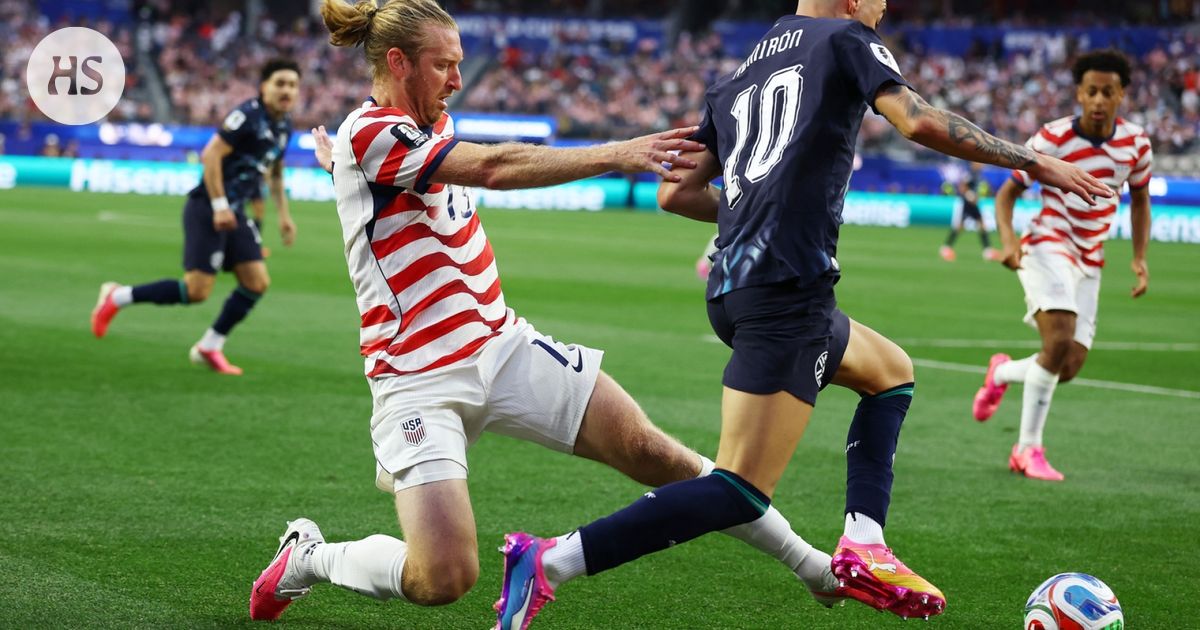
Paraguayan speedster Miguel Almiron regulate Tim Reamin past. The defender tries to slide onto the ball but is too late.
Ream notices the situation himself and does not complete the sliding tackle. Almiron gets a small touch on the toe of his shoe, but continues forward without wavering.
After two steps, Almiron sees the ball go over the end line. He hooks his knees and twists his face into a grimace. Then he falls screaming and rolls onto the surface of the grass holding his leg.
The film is so obvious that you can see it with the naked eye from a live TV broadcast. Referee Danny Makkelie however, it fails. He gives Paraguay a free kick and Ream a caution.
The game is about to start when Makkelie receives new information from the video referee in his earlobe. The referee rushes to the screen to check the situation, and the verdict is changed. Makkelie cancels Ream’s warning and gives Almiron a yellow card for filming.
Referee Danny Makkelie checks the situation on the monitor.
Filming is in football, a whistling scourge that is difficult to deal with.
The main problem is that filming is really profitable. When a player falls, he can get a free kick or a penalty kick for his team, as well as a warning or even a send-off for the opponent.
Even if the film doesn’t go through, the consequences of falling are non-existent. Even the most diligent filmers only get a couple of warnings about falling during the season. It is too small a price for the cards acquired for the opponent and for the special situations achieved by cunning wrongdoing.
That’s why the verdict seemed like a small victory for football justice to many viewers. For once, the film did not reward its creator, but punished him.
Kind of var has already made the work of the crashers more difficult.
Unjustified red cards and penalty kicks can be overturned by video review. In the latter cases, the fallen player can be warned if the filming is blatant.
However, the players are cunning. Crashers have adapted to video surveillance in new alleys.
– During the season, seeking and exaggerating contacts has become even more profitable than before, referee expert Jan-Peter Aravirta says.
In such situations, for example, an attacker who has reached the penalty area with the ball may estimate where the foot of the defender who is chasing the ball will land. Then the attacker moves his foot to the same spot, makes contact and falls.
If the referee whistles a penalty for the situation, the var will probably not change the verdict because there was contact in the situation.
The judgment changes. Makkelie cancels Ream’s warning and shows a yellow card to Almiron.
Almiron’s warning for those who are excited, Aravirra has both bad and good news. Let’s take the bad ones first.
– The verdict was right, but the situation was judged wrongly, says Aravirta.
He means that Almiron’s film was indeed worth warning. However, according to the letter of the rules, the jury is not allowed to act as they do.
The rules of football live forever. New articles are often created when a situation is encountered in a match for which no solution can be found.
– In this case, the original kimkomke has been a situation where players from different teams slide into the same ball at the same time. If the referee has seen the situation incorrectly and the offender is the opponent, the var could have changed the verdict.
The article related to the Var protocol is so new that it has not been translated into other languages.
– In the original text, it means that a personal punishment can be changed for the same offense.
The distinction is made very subtly by using the form “the offense” instead of “an offense”.
– It is likely that the design will not open properly to everyone who does not speak English as their mother tongue, says Aravirta.
“I doubt if the referee Danny Makkelie was even the one who made the original decision. The situation happened right in front of the assistant referee’s eyes. He could have given a tip,” pundits expert Jan-Peter Arajuuri.
Then the good news will come. The reaction to Almiron’s warning has been so unanimously positive that it may lead to a rule change.
– The jury opened the door for change with its actions, says Aravirta.
No radical change would even be needed. The wording could be something like this: “If there is no foul at all in the situation leading to a yellow or red card, the var can check the situation and suggest a warning to the player filming.”
If this were to happen, rule evolution would work again in the familiar way: encountering a new problem would result in a solution either to a completely new section or to refining the existing section.
This would not be the first time that a wrong way of operating has been made right on the basis of value competitions. Legendary Pierluigi Collina kicked out a substitute player at the summer 2000 men’s European Championships by showing him a red card.
At that time, cards could only be shown to the players on the field. However, Collina was the most famous and officially the best referee in the world. He couldn’t make such a big mistake.
Therefore, the powers of the referees in using the cards were increased. The expansion is still known as “Lex Collina”.
Makkelie is not necessarily doing as well.
– The original verdict went so badly that Makkelie’s team might be sent home before the playoffs, Aravirta estimates.
From a football point of view, however, the most interesting thing is what happens next. Filmmakers have now been warned – literally.
The near future will show whether Almiron’s case will also trigger a new regulation.
https://staves.si/
https://stave.eu.com/
https://staxino.com.nl/
https://staxino.eu/
https://stonevegascasino.de.com/
https://supraplay-fr.fr/
https://supraplay.fr/
https://tastevegas-casino.com.se/
https://tastevegas.eu.com/
https://tastevegas.se.net/
https://totalcasino-demo.pl/
https://totalcasino-online.pl/
https://tsars.eu.com/
https://tsarscasino.eu.com/
https://vavadacasino-hr.org/
https://vavada-pl.eu.com/
https://vegaz-casino.eu/
https://vegazone-au.org/
https://vegazoneau.com/
https://vegazone.hu/
https://westace.co.de/
https://westace.com.gr/
https://westace.lv/
https://westace.lt/
https://westace.pt/
https://westace.com.ro/