New crystals researched by China allow the creation of super-accurate nuclear clocks, helping submarines and spacecraft navigate without GPS.
Scientists from Xinjiang University of Technology (China) have developed a new type of ultraviolet (UV) generating crystal that can help make extremely accurate thorium nuclear clocks. This type of watch is considered essential for tasks such as navigation, especially in the military and aerospace fields when it can help navigate devices such as submarines or deep space probes without the need for a Global Positioning System (GPS) in the future.
On a smartphone, smartwatch or laptop, GPS positioning is usually through receiving signals from satellites, then using a set of algorithms, measuring the time needed for each signal to arrive. This information is then used to triangulate locations on a world map based on precise time data.
But systems like GPS are facing many problems. For example, they are subject to jamming or signal spoofing, and do not work well underwater or underground. For war machines like submarines, GPS is a nightmare because to use it effectively, the ship needs to surface to locate.
To overcome this problem, modern submarines use atomic clocks, an extremely precise time measuring device. This type of clock works by using the vibrations of electrons around atoms to keep time. Current atomic clocks mainly use cesium or strontium.
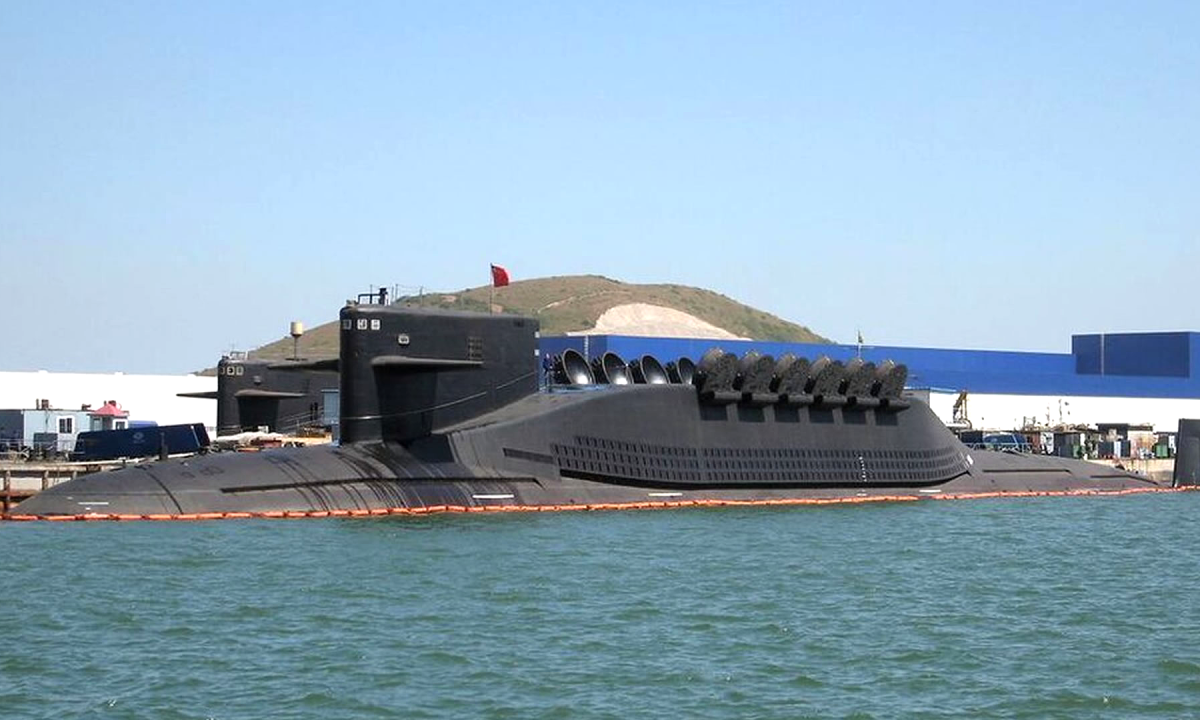
China’s Type-094 submarine. Image: Navy Office of Legislative Affairs
However, nuclear clocks are even more accurate than that, using vibrations in the atomic nucleus, thereby being 10-1,000 times more accurate than atomic clocks. The reason is because the atomic nucleus is more stable than electrons and is less affected by many factors such as temperature, as well as less affected by external vibrations and other factors such as magnetic fields.
Normally, to make a nuclear clock, an extremely precise UV laser with a wavelength of 148.3 nm is needed. Making this type of laser is very difficult, which is why there has been no system with similar capabilities before. Previously, potassium beryllium fluororoborate, a crystal developed in the 1990s and being widely used, only reached a wavelength of 150 nm, lower than the standard number mentioned above.
Nuclear clocks use thorium atoms, a laser to probe them, and a detector to read the signal. To make the “core” work, the laser must be tuned to a very specific wavelength (below 148.3 nm). The response time is determined by its response frequency.
The Chinese research team used Thorium-229. This element is especially prized, because its nucleus oscillates at very low energy levels, making it relatively easy to monitor and measure.
With Thorium-229, the system can convert laser light into ultraviolet light with very short wavelengths, even shorter than 148.3 nm with 145.2 nm. “A borate-fluorinated compound can enhance laser light to a record wavelength of 145.2 nm, short enough to meet an important requirement for ultra-precise nuclear clocks being developed in the US, China and other countries,” the team explained in a blog post.
When crystals are used in nuclear clocks, they provide an extremely precise method of “position estimation” by comparing speed, direction, and travel time. If completed, systems equipped with this technology can help vehicles no longer depend on GPS and satellite positioning solutions.
Theo Interesting Engineeringmilitary purposes are the greatest potential of this type of watch, for example helping submarines move freely without having to surface, or applying to missiles to help “immune” to jamming systems. For spacecraft, it can also help them navigate in deep space without needing correction from Earth.
However, even if successfully built, the team says these watches do not make GPS redundant. Instead, it is considered to only help reduce dependence on existing navigation systems as well as serve specific devices. In addition, the technology is in the early stages of development and is still far from practical application.
GPS is just one of a number of satellite “positioning, navigation and timing” tools used around the world, including Russia’s Glonass, the European Union’s Galileo, Japan’s QZSS or China’s Beidou. However, GPS is currently considered fragile as it constantly faces the risk of interference and is easily attacked.
https://alaskalicenseplate.org/car-title-transfer
https://arizonalicenseplate.org/car-title-transfer
https://arkansaslicenseplate.org/car-title-transfer
https://californialicenseplate.org/car-title-transfer
https://coloradolicenseplate.org/car-title-transfer
https://connecticutlicenseplate.org/car-title-transfer
https://delawarelicenseplate.org/car-title-transfer
https://floridalicenseplate.org/car-title-transfer
https://hawaiilicenseplate.org/car-title-transfer
https://idaholicenseplate.org/car-title-transfer
https://illinoislicenseplate.org/car-title-transfer
https://indianalicenseplate.org/car-title-transfer
https://iowalicenseplate.org/car-title-transfer
https://kansaslicenseplate.org/car-title-transfer
https://kentuckylicenseplate.org/car-title-transfer
https://louisianalicenseplate.org/car-title-transfer
https://marylandlicenseplate.org/car-title-transfer
https://michiganlicenseplate.org/car-title-transfer
https://minnesotalicenseplate.org/car-title-transfer
https://mississippilicenseplate.org/car-title-transfer
https://missourilicenseplate.org/car-title-transfer
https://montanalicenseplate.org/car-title-transfer