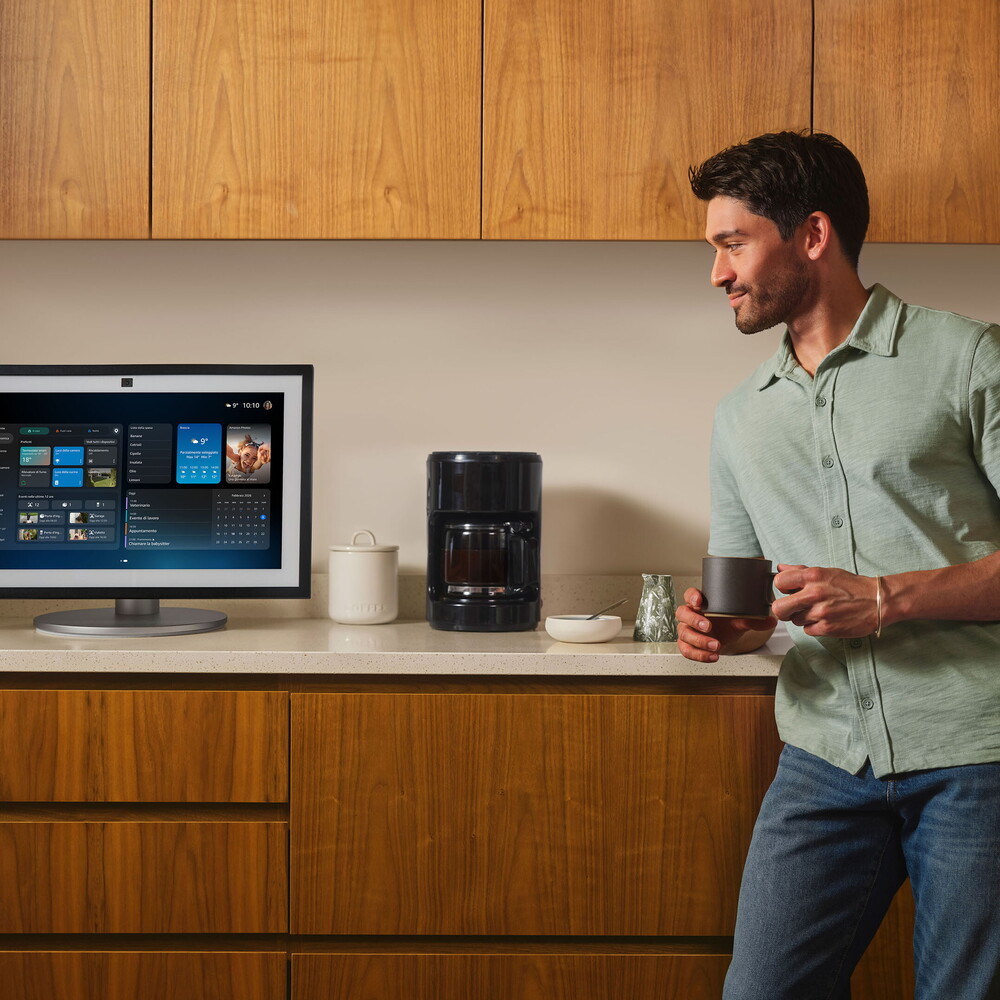
Alexa+ arrives in Italy and promises to bring Amazon’s voice assistant into a new phase: more conversational, more personalized, more capable of acting concretely in everyday life.
From smart home management to purchases, from reservations to reminders, the leap compared to the previous version it’s clear. But together with the new functions, the theme that remains central is that of domestic privacy, especially for a system designed to listen, remember preferences, distinguish family members and accompany the user between devices, apps and integrated services.
Privacy and security
Amazon insists that “privacy and security” are “at the core” and reminds that the Alexa dashboard allows you to review and manage interactionslisten to what has been recorded, change the retention time of voice recordings and delete them at any time. A reassurance that accompanies the debut of an assistant who is increasingly present in the domestic space and increasingly capable of collect information on habitstastes, routine and family context.
Michele Butti himself, VP Alexa International, recognizes the centrality of the topic. “We were the first to introduce a smart speaker into customers’ homes. We put a microphone and we knew from the beginning that it was essential that they had trust,” he tells Agi. For this reason, he explains, Amazon has focused on two levers since its debut: “We have created a series of services for make what is recorded very visiblewhat is sent by Alexa” and “we gave control because from the beginning you could see and delete everything”.
“Italians are less suspicious”
According to Butti, in Italy the initial distrust would have eased over time: “Italian customers, however, have gotten used to it and perhaps we have even deserved a bit of trust”, he observes, adding that “there has been much less” concern “compared to the initial experience of 8 years ago”.
The most sensitive point however concerns the use of data in the age of artificial intelligence generative. Alexa+, explains Amazon, is based on advanced linguistic models integrated into a new architecture capable of connecting services and devices and transforming requests into real actions. But one of the main questions focuses precisely here: do the contents shared with Alexa also serve to train models?
Butti’s answer is clear: “Alexa uses many language models and LLMs that are available on Bedrock”, but “we use customer data not to drive our model, but only to personalize the customer experience”. And he cites the example of the user who shares the condominium bill with Alexa in order to remember the installment to be paid: the document “but is not used by any model, by any partner to improve performance”.
It is a crucial step, because the added value of Alexa+ lies precisely in the ability to become more personal and more contextual. Amazon explains that the system learns musical preferences, books read, foods avoided, distinguishes family members thanks to voice and visual recognition and adapts responses based on habits and context. A customization that makes the service more useful, but which inevitably also expands the amount of information processed within the domestic ecosystem.
What changes compared to the ‘original’ Alexa
In terms of user experience, Butti insists on the paradigm shift compared to the “original” Alexa. “The benefit of generative AI is that it is much more capable of understanding the intent or heart of customer needs,” he explains. “Right now, using Alexa is like asking a friend or expert questionswhereas with the original Alexa you had to know how to ask a question or how to use a certain service.” And he gives a very concrete example: “Now I tell Alexa that I’m cold and it turns on the heating. I don’t have to give a specific command.”
The strengthening of the assistant also passes throughintegration with third-party devices and services. Amazon underlines that Alexa+ will be able to communicate with the smart home, with music services, and, in the coming weeks, also with TheFork to book restaurants by voice.
Butti confirms that the compatibility with the already existing ecosystem was a priority: “We have ensured that all devices that work on the original Alexa also work on Alexa Plus”, because “the customer who now manages dozens of home automation products at home and must be sure that when he switches from Alexa to Alexa Plus it continues to work”.
The localization node
Finally there is the issue of localization, which Amazon considers a strategic element also in competition with other major artificial intelligence players. The press release highlights the work of the Turin Research and Development center to build an assistant capable of understanding linguistic nuances, cultural references and Italian idioms. Butti forcefully claims this: “We want Alexa as a personal assistant to have a personality that is profoundly Italian.” And he adds: “If I ask for advice on how to explain certain things to my children or how to negotiate a salary increase or how to do a job interview, I don’t want to have American culture translated into Italy.”
The debut of Alexa+ in Italy thus marks an important transition for Amazon: from an assistant that executes commands to a platform that listens, interprets, remembers and acts. And this is precisely why the issue of privacy remains decisive. Because the more the assistant enters everyday life, the more user trust becomes the true test of its success.
https://dodgerecords.us/arrest-records
https://dodgerecords.us/court-records
https://dodgerecords.us/criminal-records
https://dodgerecords.us/divorce-records
https://dodgerecords.us/inmate-search
https://dodgerecords.us/property-records
https://dodgerecords.us/warrant-search
https://donaanarecords.us/
https://donaanarecords.us/arrest-records
https://donaanarecords.us/court-records
https://donaanarecords.us/criminal-records
https://donaanarecords.us/divorce-records
https://donaanarecords.us/inmate-search
https://donaanarecords.us/property-records
https://donaanarecords.us/warrant-search
https://dorchesterrecords.org/
https://dorchesterrecords.org/arrest-records
https://dorchesterrecords.org/court-records
https://dorchesterrecords.org/criminal-records
https://dorchesterrecords.org/divorce-records
https://dorchesterrecords.org/inmate-search
https://dorchesterrecords.org/property-records
https://dorchesterrecords.org/warrant-search
https://douglasrecords.us/
https://douglasrecords.us/arrest-records