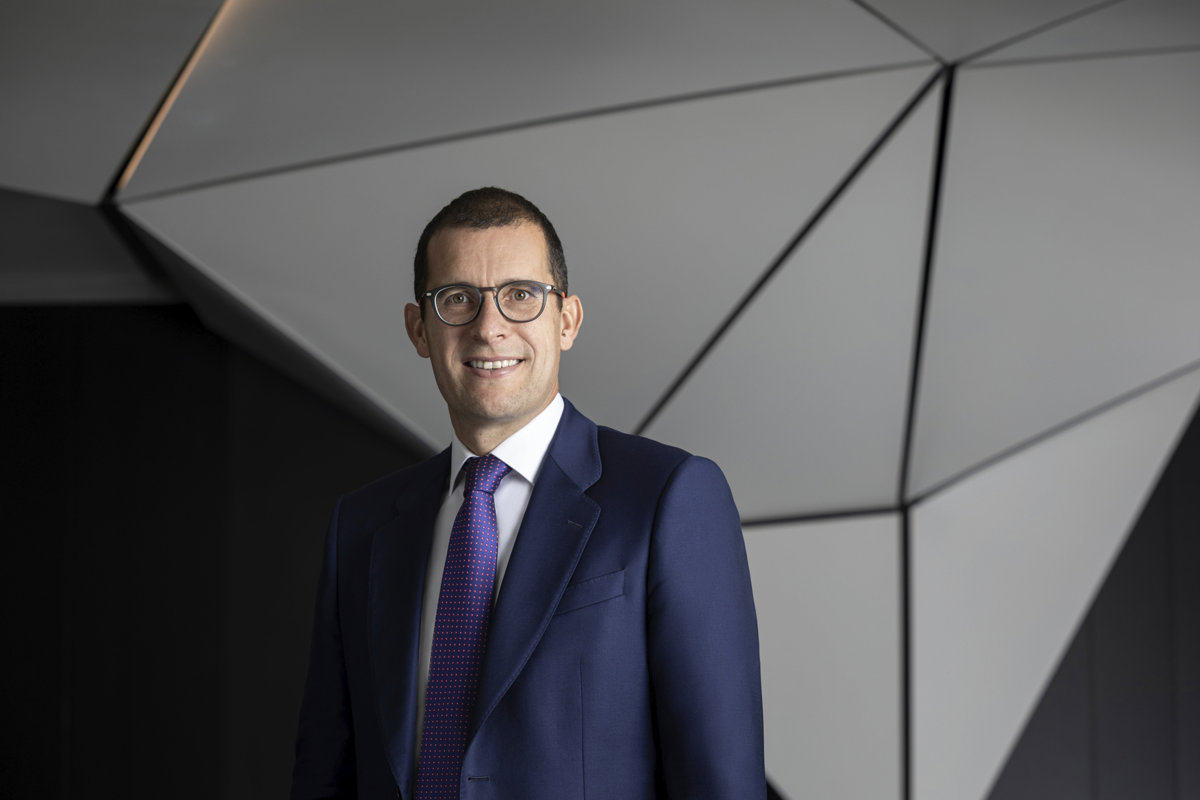
IBM Spain this celebrated a century of history in Spain and its president, Horacio Morell, after reviewing the company’s milestones, has advocated for quantum computing as an “opportunity” for the country, with San Sebastian as a spearhead as it is one of the candidate cities for host one of three fault-tolerant quantum computers that IBM has committed to having ready in 2029.
In a meeting with the specialized media held in the IBM Innovation Studio de Madrid, The manager explained that, in addition to the already confirmed locations in the United States and Tokyo, the third quantum computer of this type – with those who wait lay the foundation for practical and scalable quantum computing on a commercial scale– will be located in Europa and that your ambition is “to be in Spainin collaboration with the Basque Government and with the governments that want to join”.
At the moment, San Sebastian has the first IBM System Two operational in Europe and the third in the worldso both parties will work to host that improved version. “We believe that this year we will be able to solve some problem with supercomputing and by 2029 there will be a computer with error correction on a commercial scale,” adds Morell, emphasizing that this leap “is no longer science fiction.”
In this context, he emphasizes that both Europe like Spain “can play a role” in this new market. It recognizes that the continent has a strong tendency towards regulation and fragmentation and that it has been able to lag behind – compared to other regions – in Artificial Intelligence and other technological advances. However, he believes that the Quantum computing represents “an opportunity.” For this reason, he urges “to provide incentives, including fiscal ones, to attract talent”.
“Now we have to develop an industry around supercomputingcreating hardware, software and algorithms. And our partners, the ecosystem, are doing it, from San Sebastián to the rest of the computing centers around the world (…) Open strategic autonomy means joining forces to build something better with people who share Western values,” he added.
IBM currently has 80 quantum computers around the worldof which more than a dozen are open free of charge to individuals, companies and organizations through the cloud. “We have taken the technology out of the laboratories and we are open to the ecosystem and collaboration,” defends the Spanish manager.
Morell explains that innovation “is part of the company’s DNA” and that IBM is always reinventing itself. For this, it has 4,000 scientists and 16 laboratorieswhose focus is now on “extending the boundaries of the world of computer design.” semiconductorsthe hybrid cloudthe Artificial intelligence and the “quantum computing.”
Finally, and tying in with the history of IBM in Spain and the great technological paradigm shift that is being experienced with the emergence of technologies such as Artificial Intelligence, Morell has concluded that technology companies must have the commitment “to leave no one behind” and “train people in digital skills” so that these technological leaps expand human capabilities and do not displace certain groups.
A TOUR THROUGH THE HISTORY OF IBM IN SPAIN
On this day, IBM has reviewed these hundred years of history in Spain and the great technological transformations in which it has participated. Its history in the country started in 1926, when he King Alfonso XIII showed interest in tabulating machines that promised to revolutionize business management. That moment marked the beginning of IBM’s implementation in Spain and the arrival of a new way of understanding technology and efficiency.
Shortly after, Telefónica became the first IBM client in Spainincorporating tabulating technology to modernize its operations. Decades later, the arrival of the first computers and large mainframe systems It allowed banks, industries and administrations to manage information on a large scale and accelerate the modernization of the country.
Beyond technology, IBM celebrates having contributed to “becoming part of Spanish digital talent”. The company has collaborated with universities and research centers, promoting the development of generations of engineers and specialists that would be key in the digital transformation of Spain. He has also participated in industrial projects and the expansion of personal computingbringing technology closer to thousands of companies, as they explain in a statement.
IBM also left its mark on some of the country’s great milestones. Was technological partner of the 1992 Barcelona Olympic Games and of the Universal Exhibition of Seville 1992, demonstrating the capacity of Spanish technology to manage critical infrastructures and global events with reliability and precision.
In recent decades, the company has reinforced its commitment to strategic areas such as supercomputing, the hybrid ‘cloud’ and artificial intelligence, with a direct participation in the creation of the Barcelona Supercomputing Center and, more recently, the inauguration of the first Quantum Computing Center in Spain in San Sebastián, that places the country “in the “European avant-garde” of a technology destined to transform entire industries.
“IBM has accompanied every major technological transition of the last century,” summarizes the company. One hundred years after his arrival in Spain, he maintains the same ambition: “to promote innovation, talent and the technological and economic progress of the country.”