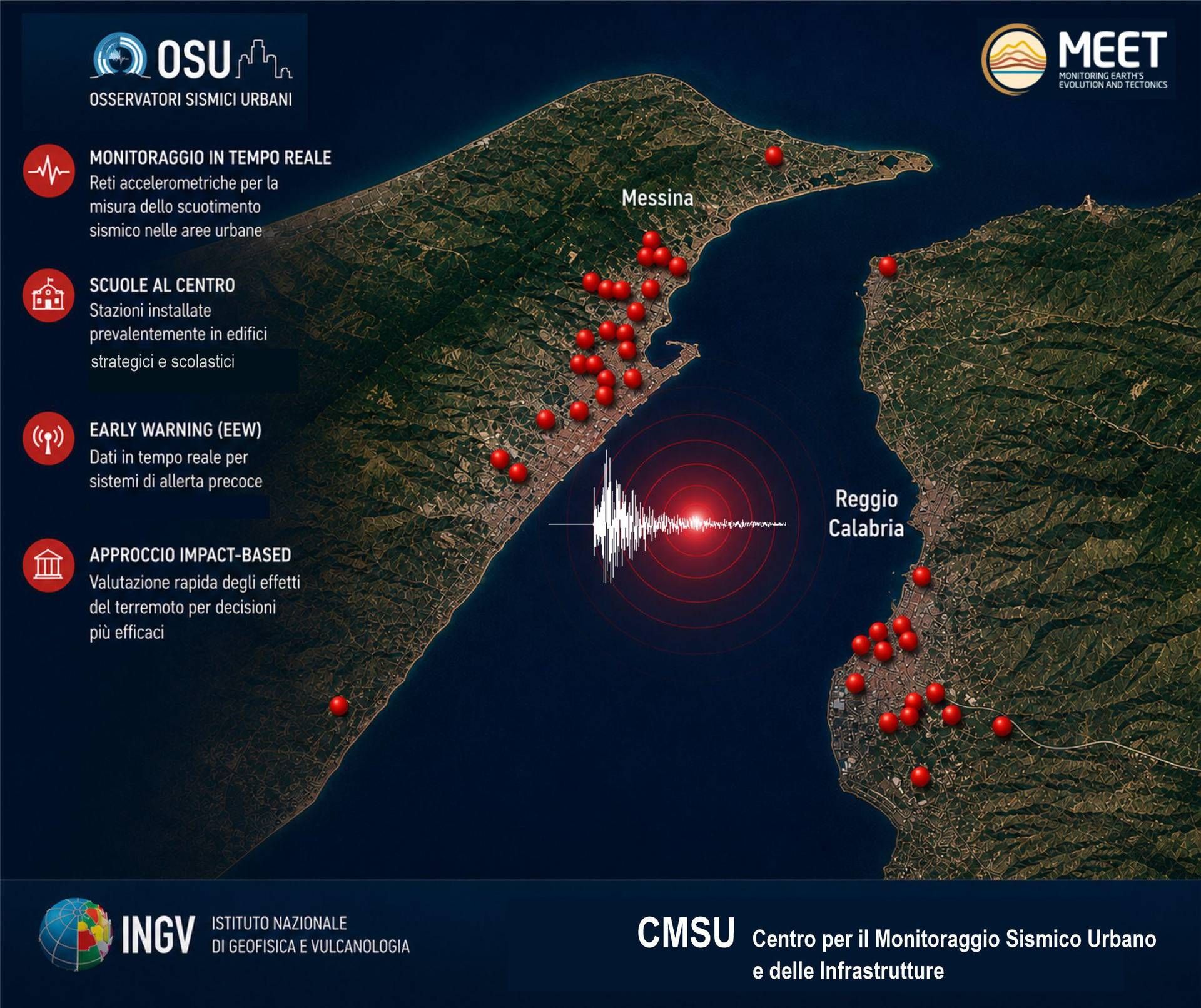
The installation of the new Urban Seismic Observatories (OSU) has been completed in the municipalities of Messina and Reggio Calabria, coordinated by the Urban Seismic and Infrastructure Monitoring Center as part of the MEET project financed by the PNRR. The intervention led to the deployment of 38 high-dynamic accelerometer stations, distributed with 23 units in the Messina area and 15 in the Reggio Calabria area. The devices were positioned mainly within school complexes of various types and levels, thanks to a memorandum of understanding with the local administrations and territorial bodies of the Strait, an area historically characterized by a high seismic danger in the Mediterranean basin.
Unlike traditional seismic networks, which focus on epicentral localization and magnitude quantificationthe technology applied in Urban Seismic Observatories allows us to analyze the distribution of shaking on a micro-scale within the urban fabric. The sensors transmit data continuously to the operations rooms, allowing local variations connected to the geological specificities of the subsoil and site effects to be highlighted.
Fabio Florindo, President of INGV, specified that “Urban Seismic Observatories represent a new generation of infrastructures capable of observing ground motion directly within cities and, if integrated with structural monitoring systems (Structural Health Monitoring, SHM), also analyzing the response of buildings during seismic events“. The integration of these information flows aim to support civil protection through the development of rapid assessments based on the real impact of stresses on infrastructures.
This technological development is part of a scientific strategy which saw the first permanent applications in the historic center of Catania, and then extended to the Campi Flegrei and finally to the two banks of the Strait. Despite the high technological level of the instrumentation, experts highlight that detection systems do not replace the necessary structural construction works.
Domenico Patanè, Research Director of the institution, clarified: “The networks and installations developed by INGV do not solve the problem of the structural safety of schools, which requires systematic programs of verification, maintenance and improvement or seismic adaptation of strategic structures”.
However, continuous monitoring acts as a fundamental complementary tool for prevention, providing useful elements for planning emergency interventions. The accumulated experience highlights the need for a national programmatic design that connects the maintenance of the vulnerable building heritage to advanced observation systems spread across the territory.
https://www.freeboard.com.ua/forum/viewtopic.php?id=145575
https://gdevkievezhithorosho.com/forums/topic/%d1%96%d0%b3%d1%80%d0%b8-4/#post-537138
http://forum.ua-vet.com/viewtopic.php?f=13&t=69135&p=943033#p943033
https://1b.app/ua/forum/integration-with-cashier-and-software-ppo/20093-vchasno-kasa-yak-zrobiti-integratsiyu-1-v-onebox-os-ta-pripiniti-kasovi-viyni/
https://rmmedia.ru/members/182922/#about
https://biomolecula.ru/authors/139266
https://pikabu.ru/@patne.wm
https://3dtoday.ru/blogs/patnewm
https://illustrators.ru/users/patne-wm/about
https://gitflic.ru/user/patnewm
https://teletype.in/@patnewm
https://acomics.ru/-patnewm
https://golosknig.com/profile/DavidTate/
https://saumalkol.com/forum/%D1%80%D0%B0%D0%B7%D0%BD%D0%BE%D0%B5-1/35270-k%D0%B0%D0%B7%D0%B8%D0%BD%D0%BE-%D0%BD%D0%B0-%D0%B4%D0%B5%D0%BD%D1%8C%D0%B3%D0%B8.html#53309
https://astana.forum24.ru/?1-0-0-00000875-000-0-0
https://atbasar.forumotion.eu/t89-topic#158
https://kazakhstan-kz.ahlamontada.com/t87-topic#145
https://qazaqstan-kz.forumotion.asia/t167-topic#314
https://my-qazaqstan.forumotion.me/t1058-topic?highlight=%D0%BA%D0%B0%D0%B7%D0%B8%D0%BD%D0%BE
https://assa0.myqip.ru/?1-4-0-00009533-000-0-0-1776158611
https://almaty-kz.forumotion.asia/t287-topic?highlight=%D0%BA%D0%B0%D0%B7%D0%B8%D0%BD%D0%BE
https://my-astana.actieforum.com/t673-topic
https://24-ok.ru/topic/775683?
http://rkiyosaki.ru/discussion/3089/vulkan-kazino-i-igrovye-avtomaty/#Item_0
https://vld.best-city.ru/forum/thread84048/#reply84763