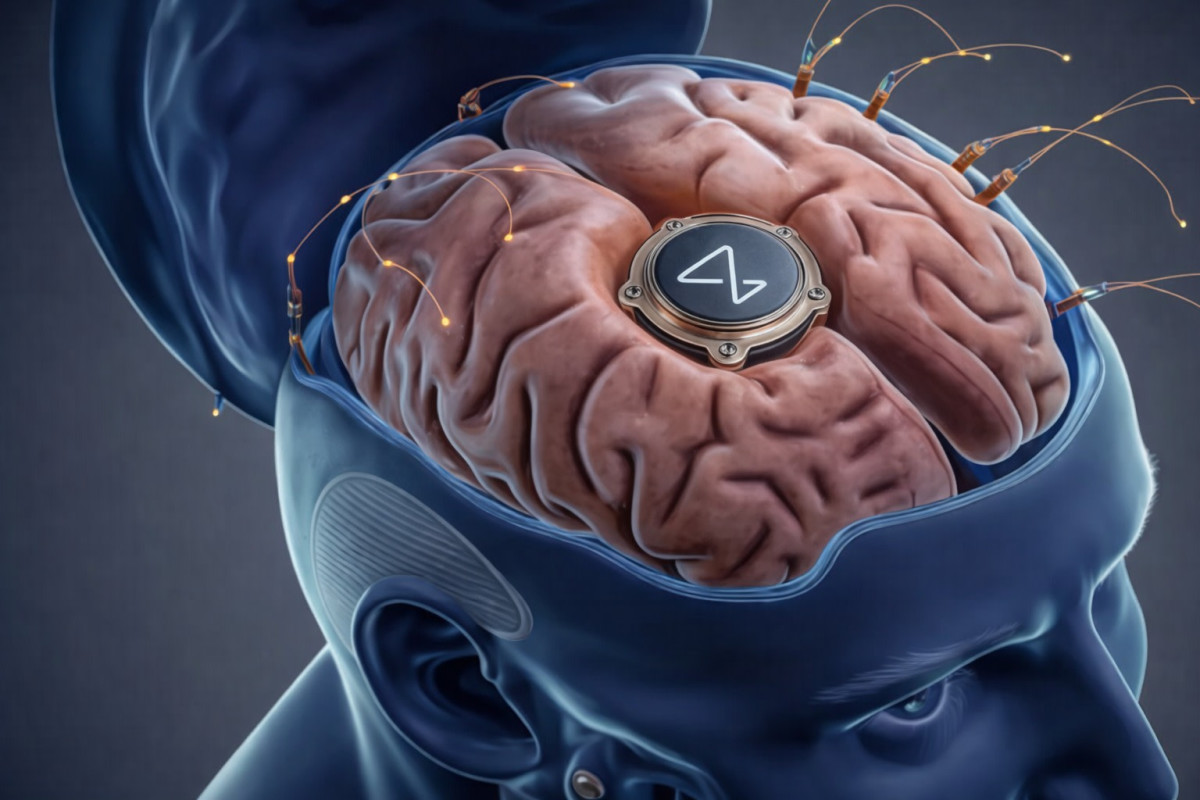
The painting that was waiting in the mind: for 20 years Audrey could not move her body at will, but the thought of movement remained intact. Once the Neuralink chip was implanted in her brain, that thought became a digital command: a cursor moved across the screen, where it was rewritten, and a robotic arm dipped a roller in paint and moved it across the canvas. “Art is a form of power,” she says in the video, “it doesn’t just move us, it makes us move.” In her case, this sentence took on an almost literal meaning.
Audrey was 16 years old when her life changed in a serious car accident. The injury left her paralyzed in four limbs, a medical condition known as quadriplegia. Over the years she had to rely on others for almost every day-to-day activity. In the documentation, she describes the difficult feeling of constant dependence, and the gap between the thoughts that remain active, sharp and free, and a body that does not respond to commands. “Relying on someone 24/7 makes you feel like a burden,” she says, adding: “In my mind I could still do everything, but the body just didn’t respond.”
For her, the choice to participate in the Neuerlink trial was not just a personal experience to improve the quality of life. Audrey also presented it as a mission. She knew she was entering a groundbreaking medical trial, one that was still in the research stages, but she saw it as an opportunity to open a door for others. “I, little Audrey from a small town, am making a difference for the future,” she says excitedly. Later on, she explains that the meaning for her is broader than the personal story: “If it helps others not to go through the mental agony I went through for 21 years, it was all worth it.”
The first moments after the transplant were focused on learning and adapting. The Neuralink system does not “read minds” in the simplistic sense of the term, but perceives electrical activity in areas of the brain associated with movement intention. When the patient imagines a movement, for example moving a hand or moving a marker, certain nerve cells in the brain change their activity pattern. The electrodes in the implant pick up these patterns, and dedicated software translates them into commands for the computer.
In Audrey’s case, this first meant controlling a cursor on a screen. After training and calibration, she was able to move the cursor and write her name in digital handwriting. “I haven’t written my name in 20 years,” she says as she looks at the name that appeared on the screen. For a healthy person, writing a name is an almost automatic action. For someone who has not moved her hands for two decades, this is the moment when a small action becomes a statement of existence. “It felt like I got a piece of myself back,” she describes.
The next step was even more dramatic: connecting the system to a robotic arm. In the documentary, Audrey is seen operating an arm of the Kinova company, which is used in research and assistance systems for people with disabilities. Using the brain interface she not only moves a virtual marker, but activates a physical object in the world. The arm moves, dips a vessel in paint and touches the canvas. Thus her thought becomes an external movement, and the movement becomes a painting.
“The transition from digital control to robotic control was surreal,” she says. “It felt like it was my arm.” This sentence is the heart of the story: not just a technology that is able to move a device, but a system that begins to give a person a sense of ownership of an action. The robotic arm is not her biological arm, but in the moments of control it feels close to it, almost as part of the body. For those who lost the ability to move during adolescence, the very possibility of influencing the physical world again, choosing a direction, touching a color, leaving a mark, is more than a technological achievement. This is a partial return to independence, and also a return to identity.
Audrey not only operates a medical system, she paints. Painting allows her to express something that hasn’t passed through her body for years: “It doesn’t matter if people like my art or not,” she says with a smile, “because it’s mine. I wanted to paint, and now I can.”
The Neuralink chip, known as N1, is a tiny brain implant that is inserted into an area of the brain associated with movement direction. According to company publications, the implant includes 1,024 electrodes spread over 64 ultra-thin wires, thinner than a human hair. These wires are inserted into the brain tissue with the help of a surgical robot, whose goal is to place them with high precision and to avoid damaging blood vessels as much as possible. After implantation, the implant receives neural activity and transmits it to an external system, where algorithms try to decipher the user’s movement intent.
The main idea is simple to understand but very complex to execute: even when the body is paralyzed, the brain may still generate movement commands. In people with a spinal cord injury, the problem is not necessarily in thinking about movement, but in transferring the command from the nervous system to the muscles. A brain-computer interface bypasses the damaged pathway. Instead of the command passing from the brain through the spinal cord to the hand, it is received directly from the brain, decoded by the computer, and translated into an external action: moving a cursor, selecting a letter, opening an application or activating a robotic arm.
At this point, it is an experimental technology and not a routine treatment. Neuralink operates clinical studies approved by the FDA, the purpose of which is to test the initial safety and effectiveness of the system in people with paralysis, including people with spinal cord injury or muscular dystrophy. The participants are required to be monitored for a long time, for repeated training and continuous calibration of the system. In other words, even in the most exciting stories, progress is not instant magic but a lengthy medical, engineering and rehabilitation process.
Neuralink has previously presented patients who were able to control a computer, play games, surf the net and communicate through thought. In the first published case, Noland Arbo, paralyzed after a diving accident, demonstrated control of a computer cursor and digital games. Later, technical difficulties were also reported, including the withdrawal of some of the implant wires from the desired position, a problem that required software adjustments.
Elon Musk said in his vision that he hopes that in the near future the chip will help the paralyzed to conduct themselves with complete independence with the power of thought and recently he even predicted that in the coming years it will also make it possible to restore sight to the blind. Meanwhile, Odi with the help of a chip, algorithms and a robotic arm, while not yet out of the wheelchair, can create action with intention and re-sign her name.
https://my-astana.actieforum.com/t702-topic
https://24-ok.ru/topic/767611
http://rkiyosaki.ru/discussion/3105/vulkan-stavka-na-udachu/#Item_0
https://vld.best-city.ru/forum/thread84450/#reply84512
https://subscribe.ru/group/workerssss/19480193/
https://agropravda.com/forum/topic8787-de-podivitis-reitingi-kazino-z-realnimi-vdgukami-gravtsv.html
https://www.audar-info.ru/bbii/forum/topic/id/17119/
https://bittogether.com/index.php/topic,21235.msg59317.html#msg59317
https://illustrators.ru/illustrations/1481408
http://banki.tomsk.ru/forum/viewtopic.php?t=8527&highlight=%EA%E0%E7%E8%ED%EE&sid=24a0956238482812d9a2c4d76955408b
https://chimba.ru/forums/thread/3723/%D0%A1%D0%B8%D1%81%D1%82%D0%B5%D0%BC%D0%BD%D1%8B%D0%B9-%D0%BF%D0%BE%D0%B4%D1%85%D0%BE%D0%B4-%D0%BA-%D1%83%D0%B4%D0%B0%D1%87%D0%B5
https://elcontacto.ru/journal/novosti/bost-vin-kazino_27674.html
https://yar.best-city.ru/forum/thread100323/#reply100329
https://www.b-uchet.ru/forum/messages/forum22/topic5846/message138062/?result=reply#message138062
https://mamuli.club/forum/topic/35272/
https://che.best-city.ru/forum/thread101364/#reply101364
https://www.verbling.com/thread/69e317fbc11cdab744d4d881
https://forum.meta-gta.com.ua/index.php?threads/pershij-dosvid-v-kazino.6111/#post-14733
https://journals.hnpu.edu.ua/index.php/literature/comment/view/4159/8718/49708
http://sharypovo.today/forum/showtopic-2850
https://www.polosedan-club.com/threads/1xbet-%D0%9F%D1%80%D0%BE%D0%BC%D0%BE%D0%BA%D0%BE%D0%B4-2026-1x200big-%D0%91%D0%BE%D0%BD%D1%83%D1%81-32-500-%E2%82%BD.37541/#post-378257
https://forum.i.ua/topic/4099?p=3#c34
https://www.freeboard.com.ua/forum/viewtopic.php?id=145525
https://gdevkievezhithorosho.com/forums/topic/%d1%8f%d0%ba%d1%96-%d0%bf%d0%bb%d0%b0%d1%82%d1%84%d0%be%d1%80%d0%bc%d0%b8-%d0%bd%d0%b0%d0%b9%d0%ba%d1%80%d0%b0%d1%89%d1%96-%d0%b4%d0%bb%d1%8f-%d0%b5%d0%ba%d1%81%d0%bf%d1%80%d0%b5%d1%81-%d1%81%d1%82/
http://forum.ua-vet.com/viewtopic.php?f=13&t=69143