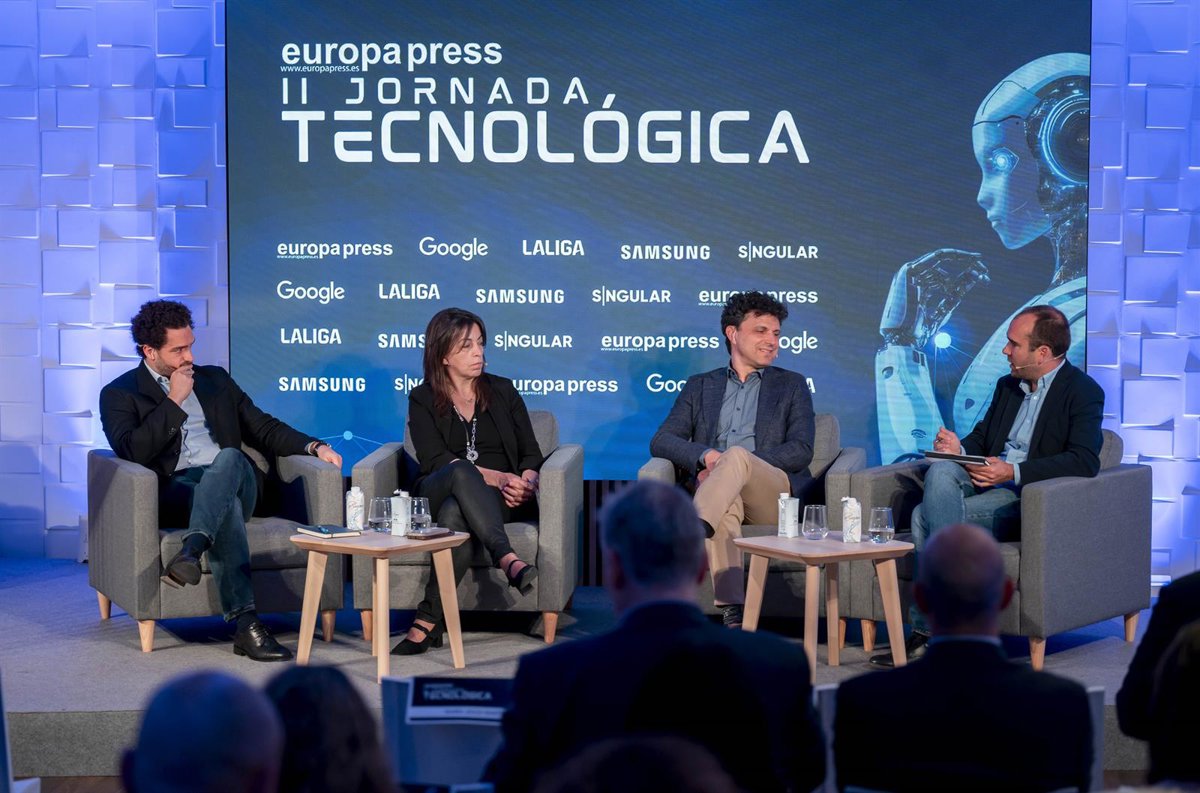
The Government Affairs and Public Policy Manager at Google Spain, Josetxo Soria, from the Ministry for Digital Transformation, María Jesús García Martín, the Head of Mobile Business Iberia of Samsung David Alonso, and the EP journalist Sergio Alonso – Alberto Ortega – Europa Press
Innovation in artificial intelligence (AI) requires regulation, but a regulation that promotes the responsible use of this technology and has at its center the protection of people’s fundamental rights, without this representing a brake on innovation, as experts from the Public Administration and private companies have agreed, who have also highlighted the challenges and opportunities presented by the adoption of this technology.
AI has ceased to be a technology of the future and has become a tool that is already transforming the economy, society and people’s daily lives; an advance that opens the debate around its regulation and technological sovereignty.
This is precisely the topic that occupied the round table entitled ‘Sustainability, security and governance in a world dominated by AI’, framed in the Second Europa Press Technology Day held this Tuesday, in which experts from the public and private sectors have shared their vision.
“Technology is not the problem, but rather the use made of it,” stated the director of the Artificial Intelligence Governance and Planning division of the Ministry for Digital Transformation and Public Service, María Jesús Martín, who cited the work that has been done with the AI Regulation of the European Union, which regulates the uses of this technology and classifies and prohibits certain practices.
Martín has stressed that “neither in Spain nor in Europe is it necessary to choose between innovation and fundamental rights”, since it is understood that they must “go hand in hand”, an intention with which Google’s Manager of Institutional Relations and Public Policies, Josetxo Soria, has agreed, although he has insisted that the regulations must be “made useful and operational for companies and innovation”.
“We are lucky to live in the European Union, where the person is being put at the center and regulation is being done to protect people,” added the vice president and business director of Mobile Experience at Samsung Spain, David Alonso, who compared it with the other two major regulatory models: that of the United States, which promotes the development of AI with a regulatory moratorium, and that of China, more controlled by the government.
NEED AND DEMAND FOR AI TRAINING
To use AI in the most appropriate way possible, the work must be joint, as María Jesús Martín has pointed out when saying that it is “an ecosystem in which institutions, citizens and technological platforms participate”, given the challenge of addressing the speed at which this technology advances and the speed with which a critical culture needs to be created.
This critical culture is what makes it possible to identify inappropriate content, such as ‘deepfakes’, and incorporate traceability to determine where they come from and watermarks so that they can be identified by any system, as tools such as the Synth ID watermark or Likeness ID already do, which identifies the ‘deepfakes’ of content creators and celebrities, both from Google.
And working on it is presented as a pressing objective since AI is already part of our daily lives. Experts have highlighted public-private collaboration to train citizens and companies so that they can make good use of AI, or at least conscious use of this technology, with a focus on data security.
In this sense, the Samsung manager has highlighted the Knox security platform, present in the brand’s smartphones and other connected devices, which protects against sophisticated threats and gives users controls to decide where and how they want their data to be managed, under a hybrid approach that encompasses the cloud and the device.
This tool responds to the needs of users. According to Samsung’s own study, 93 percent have shown concern about controlling security and privacy on their personal devices and nearly 69 percent will demand training in that regard.
Beyond personal use, public-private collaboration is also proposed to close a training gap that affects workers and companies. “We are facing a structural change that requires a joint effort to reflect on job offers and training for the future,” indicated the Google manager.
The technology company already works with partners such as Banco Santander and public universities, such as Seville, Zaragoza or Salamanca, to “try to train as many people as possible.”
“At the beginning of this new wave of artificial intelligence, large companies used approximately 40% of artificial intelligence expert systems in all their processes, while SMEs only used 8%,” he noted.
For his part, David Alonso has pointed out that “artificial intelligence has to contribute, not to creating new gaps, but to closing them.” To do this, they develop programs such as ‘Samsung Innovation Campus’, together with different universities and organizations; and ‘Developers’, to facilitate the incorporation of women into STEM.
From the General Directorate of Artificial Intelligence, the Government has launched training, mentoring and connecting companies programs, as well as technological challenges such as the one that has allowed citizens to participate in the alignment of the AI models that they are developing, so that they incorporate “our linguistic heritage, our ethical values, our culture”, María Jesús Martín has completed.
ECONOMIC AND SOCIAL IMPACT
The round table has also addressed the opportunities that artificial intelligence poses in society, as a technology capable of advancing it. At Google they quantified this advance in economic terms, in such a way that if there were mass adoption of this technology in Spain, it would have an impact of between “8,000 and 12,000 million euros in the next ten years,” the manager indicated, which they see as “approximately, a boost to the gross domestic product of 8%.”
Experts have also highlighted its impact on a social level. At Samsung “we do not conceive of technology without it serving to improve people’s lives,” said David Alonso. This goal is articulated through the ‘Technology with Purpose’ program, which has already deployed projects such as The Mind Guardian ‘app’, which uses AI to help raise awareness about brain health and prevent the onset of 40 percent of Alzheimer’s cases.
Google has recalled its AI AlphaFold, which has already revolutionized the study of more than 200 million proteins, and which in Spain uses the CSIC to study diseases such as sleeping sickness in sub-Saharan Africa, and the Niño Jesús Hospital to help children with cerebral palsy draw scenarios that help them in recovery.
In closing, the director of the Artificial Intelligence Governance and Planning division has addressed the importance of technological sovereignty to avoid dependence on suppliers, as well as to achieve a “rapid, efficient and agile adoption” of AI “without losing sight of fundamental rights” and “to achieve is to democratize” its use, so that it does not become a brake for companies.
https://ubet.kz/line/handball
https://ubet.kz/line/hurling
https://ubet.kz/line/ice-hockey
https://ubet.kz/line/olympic-games
https://ubet.kz/line/pool
https://ubet.kz/line/rally
https://ubet.kz/line/sailing
https://ubet.kz/line/snooker
https://ubet.kz/line/speedway
https://ubet.kz/line/table-tennis
https://ubet.kz/line/tennis
https://ubet.kz/line/volleyball
https://ubet.kz/line/water-polo
https://ubet.kz/line/water-sports
https://ubet.kz/line/weightlifting
https://ubet.kz/line/wrestling
https://ubet.kz/line/rugby-union
https://ubet.kz/line/rugby-league
https://ubet.kz/line/martial-arts
https://ubet.kz/line/auto-racing
https://ubet.kz/line/beach-volleyball
https://ubet.kz/line/cross-country-skiing
https://ubet.kz/line/e-football
https://ubet.kz/line/e-basketball
https://ubet.kz/line/e-icehockey