Experts at the Vietnam Atomic Energy Institute said that the Ninh Thuan 1 Project will come into operation in the period 2030-2035, needing to train a force of engineers ready to master the technology in the long term.
Discussing the issue of human resources for nuclear power plants, Dr. Tran Chi Thanh, Director of Vietnam Atomic Energy Institute (Vinatom), Ministry of Science and Technology said on June 9 that preparations for the Ninh Thuan 1 and Ninh Thuan 2 nuclear power plant projects are underway. According to the proposed schedule, the project will complete site clearance in the second quarter of this year, Ninh Thuan 1 will go into operation in the period 2030-2035.
According to the Project on training and fostering human resources to serve nuclear power development until 2035 approved in May 2025, the goal by 2030 is that Vietnam needs to meet the need for 4,000 personnel to serve Ninh Thuan 1 and Ninh Thuan 2 nuclear power plants, of which more than 2,000 personnel have university and postgraduate degrees.
“In Vietnam today, it is very difficult to find hundreds of personnel who meet the requirements of key operating engineers,” said Dr. Le Chi Dung, former Deputy Director of the Department of Radiation and Nuclear Safety. The reason is that this is a field that requires deep expertise in many areas.
According to Dr. Le Van Hong, former Deputy Director of Vinatom, the most basic foundation of a nuclear power engineer is to understand the reactor operating mechanism, based on nuclear physics, neutron physics and hydrothermal – the processes of heat generation, heat transfer and flow of coolant inside the reactor. Then comes the auxiliary knowledge related to an actual nuclear reactor such as material strength, related physicochemical processes and a series of systems and equipment including turbines, pumps, and automatic control systems.
Vinh Truong village, Phuoc Dinh commune, Thuan Nam district, Ninh Thuan province (now Khanh Hoa), where the Ninh Thuan 1 nuclear power plant will be built. Photo: Vietnam
Experts recommend that training should only be concentrated in a few facilities, using a standard program, in the sense that it is referenced and modeled after the programs of leading training facilities that have been recognized around the world. The training of engineers should follow the programs of developed countries on nuclear energy and be concentrated at some of the strongest training facilities today instead of being spread out. Training is not focused and spread evenly in facilities that do not have enough professional resources, risking creating human resources that cannot meet the actual operating needs of factories in Vietnam.
Dr. Thanh said that some schools in Vietnam have high-quality teams in technical fields to be able to start participating in training human resources to operate nuclear power, but what is lacking is a team with deep expertise in nuclear energy.
Dr. Le Chi Dung acknowledged that the engineer force serving the Ninh Thuan 1 and Ninh Thuan 2 projects is not a major barrier, because the country that transfers factories and technology to Vietnam can provide the key operating engineer force in the early stages. But in the long run, it doesn’t stop at just one or two factories. “It is necessary to train human resources for Vietnam’s long-term nuclear power program,” he said.
According to experts, each nuclear power plant in the current technological generation has a lifespan of over 60 years, which can be extended to 80 years or more, creating a need for successive generations of human resources from the beginning of operation to dismantling without depending on foreign countries.
“If you want to build a good training program with long-term value on nuclear power, it is necessary to have the participation of a team of experts in the field,” Dr. Thanh recommended. “The team of experts from the Atomic Energy Institute is always ready to provide human resources and expertise for the construction of this program.”
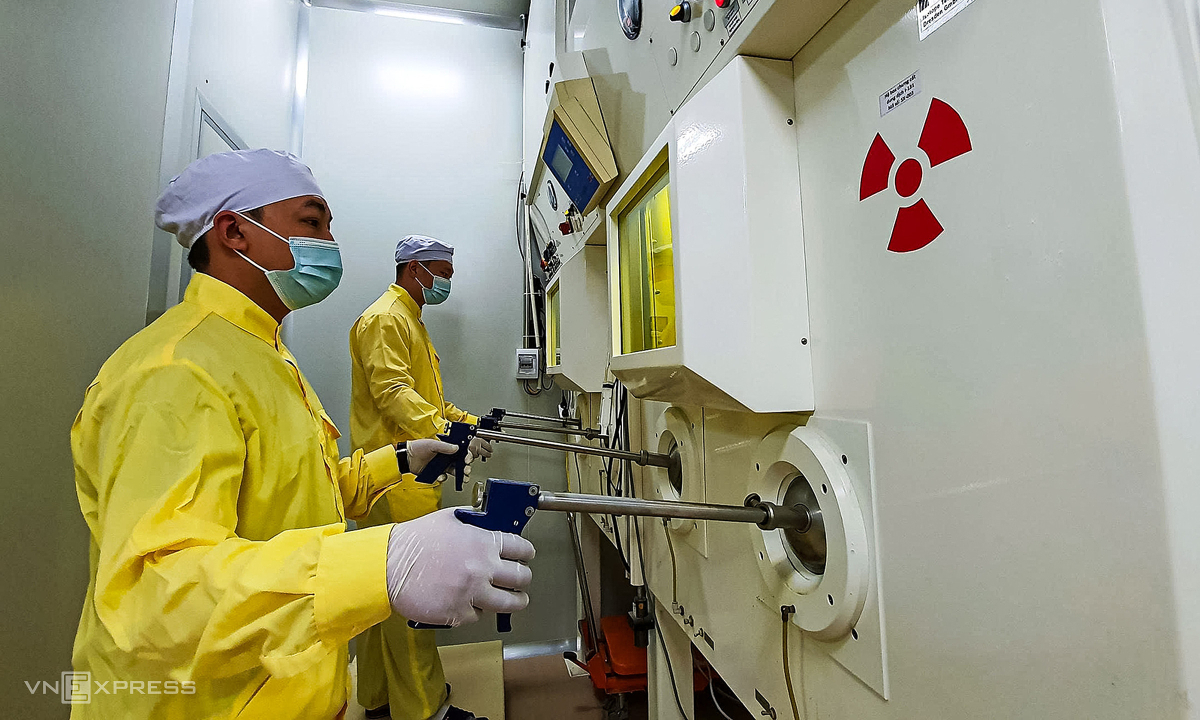
Technicians work at the Da Lat nuclear reactor. Image: Truong Ha
Vietnam is gradually preparing for a nuclear power program. At the end of 2024, the National Assembly approved the policy of restarting the Ninh Thuan nuclear power project. After that, the Government issued directions to strengthen the management apparatus, complete the legal framework and prepare the necessary conditions to implement the national nuclear power program.
According to the plan, Vietnam’s first nuclear power plant is expected to be located in Khanh Hoa province, in the former Ninh Thuan province, including two projects Ninh Thuan 1 and Ninh Thuan 2. Vietnam has basically agreed with Russia on a draft cooperation agreement to build Ninh Thuan 1 Nuclear Power Plant. The project is invested by EVN, located in Phuoc Dinh commune, former Thuan Nam district.
Nam Nguyen
- Vietnam wants to master small module nuclear reactor technology
- The National Assembly passed the Atomic Energy Law