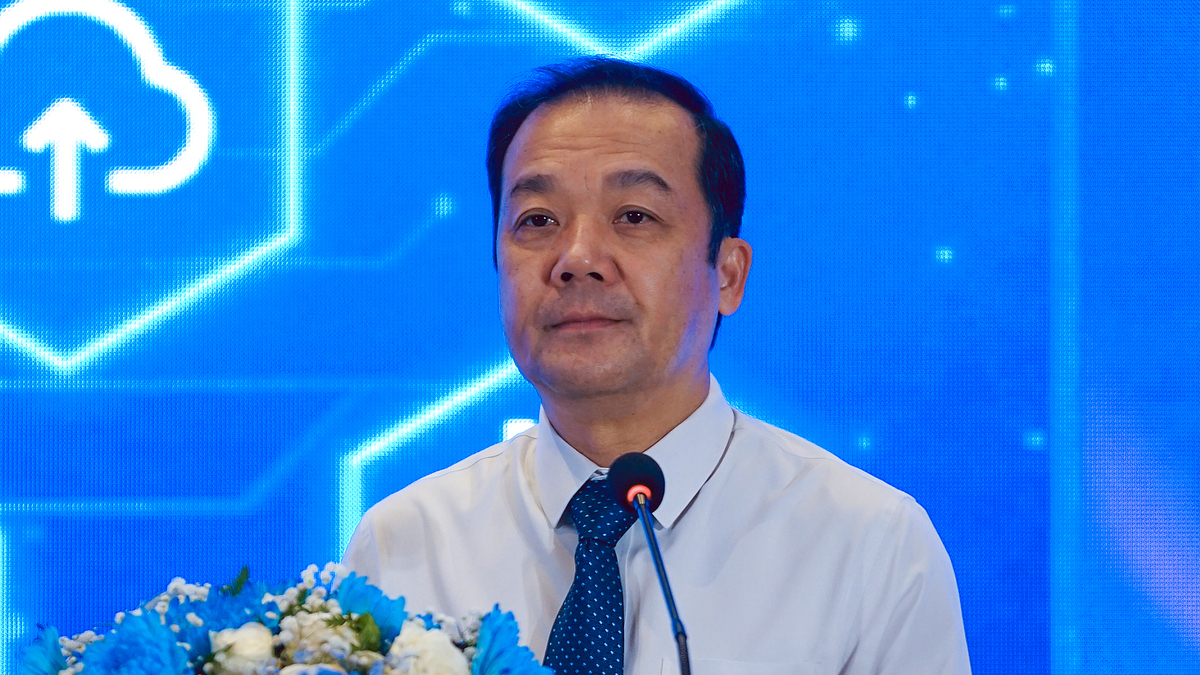
According to Deputy Minister Pham Duc Long, Vietnam is one of the countries that successfully deployed IPv6, aiming to be a pioneer in the region and the world in deploying IPv6 Only.
Speaking at the VNNIC Internet Conference 2026 event with the theme IPv6 Only Deployment – Motivation for national digital infrastructure development taking place on the morning of June 19, Deputy Minister of Science and Technology Pham Duc Long assessed that over the past 30 years, the Internet has become one of the achievements with the most profound impact on humanity by changing the way humans communicate, study, work, do business and create.
IP is understood as the identification number or address of a device on the Internet. During use, packets will be routed and moved from one IP to another. With the IPv4 protocol, the address space is more than 4 billion, which has been used up since 2021, requiring a move to IPv6 with a larger address space.
According to Deputy Minister Long, the digital future of each country is increasingly closely tied to the future of the Internet. “If data is the new resource, AI is the driving technology, the Internet is the core connection infrastructure of the digital world,” he said. All activities of the Digital Government, digital economy, digital society, from online public services, e-commerce, digital finance, smart manufacturing to artificial intelligence systems are built and operated on the Internet platform.
Deputy Minister of Science and Technology Pham Duc Long spoke at the event on June 19. Image: Bao Lam
From this context, the Deputy Minister said that using pure IPv6, or IPv6 Only (a network that only uses IPv6 instead of running in parallel with IPv4), is an inevitable development step of the new generation Internet. IPv6, with its advantages of large address space, high speed, performance and security, not only solves the problem of running out of Internet addresses but also opens up new space for the digital economy. With the ability to directly connect on a large scale, simplify network architecture, improve operational efficiency and enhance safety, IPv6 Only is becoming the Internet infrastructure foundation of the era of AI, Cloud, IoT, 5G/6G and Industrial Internet.
He said that after more than a decade of promotion, Vietnam has risen to the group of leading countries globally in IPv6 application, forming important infrastructure. The next goal is to become a pioneer country in the region and the world in deploying IPv6 Only.
Accordingly, the Ministry of Science and Technology wants organizations, businesses, and units to jointly promote the deployment of IPv6 Only, leading a comprehensive transformation according to the national roadmap, making Vietnam a leading model in the region and the world, aiming to turn off IPv4 addresses by 2030.
Next, it is necessary to build a synchronous IPv6 Only conversion ecosystem from network infrastructure, data centers, cloud computing, digital platforms, Internet businesses to digital applications and services.
Finally, effectively exploit Internet resources, develop modern, safe, and reliable digital infrastructure, creating a foundation for digital government, digital economy, digital society and innovation.
Mr. Nguyen Truong Giang, acting director of VNNIC, said that more than 67% of Internet users in Vietnam currently access via IPv6, with tens of millions of regular users every day. Network carriers, service providers, technology businesses and international Internet organizations are gradually eliminating their dependence on IPv4, moving towards a simpler, more efficient infrastructure model and are ready to meet the development needs of the Internet in the future.
Ms. Nguyen Thi Thu Thuy, Head of VNNIC Cooperation – Resource Management Department, evaluated the deployment of IPv6 Only as a core driving force for developing national digital infrastructure. According to her, the historic mission of IPv4 has ended. Although IPv4 has built the current Internet foundation, this infrastructure is becoming too complex and expensive due to the need to use address translation technology (NAT) and there is no space left to develop new services.
In fact, since 2016, international organizations such as the Internet Engineering Task Force (IETF) and the Interactive Advertising Association (IAB) have stopped supporting new features on IPv4.
Ms. Nguyen Thi Thu Thuy, Head of VNNIC Cooperation – Resource Management Department. Image: Bao Lam
Mr. Tony Smith, Deputy Director of the Asia-Pacific address management organization (APNIC), highly appreciated Vietnam’s ambitious IPv6-Only conversion roadmap. Citing data, he said Vietnam has an average IPv6 application rate of 64%, ranking 7th globally and one of the bright spots in Southeast Asia next to Malaysia and Thailand.
However, Mr. Smith also believes that this success is largely driven by four major carriers including Viettel, VNPT, FPT and Mobifone. According to him, the toughest challenge in the remaining 36% journey is the “long tail” problem, including small businesses and Internet service providers, when most have not yet begun the process of converting to IPv6.
Based on international experience, APNIC representatives believe that to achieve the IPv6 Only goal, every network operator, large or small, must go through a three-step technical process: Run two IPv4 and IPv6 networks in parallel, combined with the “Happy Eyeballs” algorithm to automatically prioritize IPv6 connections; assigning terminal devices instead of the network to handle data translation itself, devices only need to receive IPv6 addresses and still be able to run applications that require IPv4; The final step is to completely use IPv6 combined with translation technologies to keep in touch with the remaining IPv4 network.
In April, VNNIC said it had set a target for the IPv6 conversion rate in Vietnam to reach nearly 70% this year, which requires a minimum of 95% of broadband Internet subscribers to use IPv6 for large telecommunications enterprises such as VNPT, Viettel, FPT Telecom and MobiFone. Other groups of Internet providers need to achieve at least 65% IPv6 subscribers.
The above moves are considered a premise for converting to IPv6 Only. According to the plan, this model will be piloted on the broadband network of telecommunications businesses and internal networks. The access network of state agencies will also deploy IPv6 Only. Vietnam Internet Center said it will support the promotion, deployment and conversion of IPv6 Only for units through monitoring tools, measurement data and technical training programs.
https://winairlines-no.com/app
https://winairlines-no.com/bonus
https://winairlines-no.com/casino
https://winairlines-no.com/deposit
https://winairlines-no.com/download
https://winairlines-no.com/faq
https://winairlines-no.com/legal
https://winairlines-no.com/login
https://winairlines-no.com/mirror
https://winairlines-no.com/mobile
https://winairlines-no.com/payments
https://winairlines-no.com/problems
https://winairlines-no.com/promocode
https://winairlines-no.com/review
https://winairlines-no.com/slots
https://winairlines-no.com/support
https://winairlines-norge.com
https://winairlines-norge.com/apk
https://winairlines-norge.com/app
https://winairlines-norge.com/bonus
https://winairlines-norge.com/casino
https://winairlines-norge.com/deposit
https://winairlines-norge.com/download
https://winairlines-norge.com/faq
https://winairlines-norge.com/legal