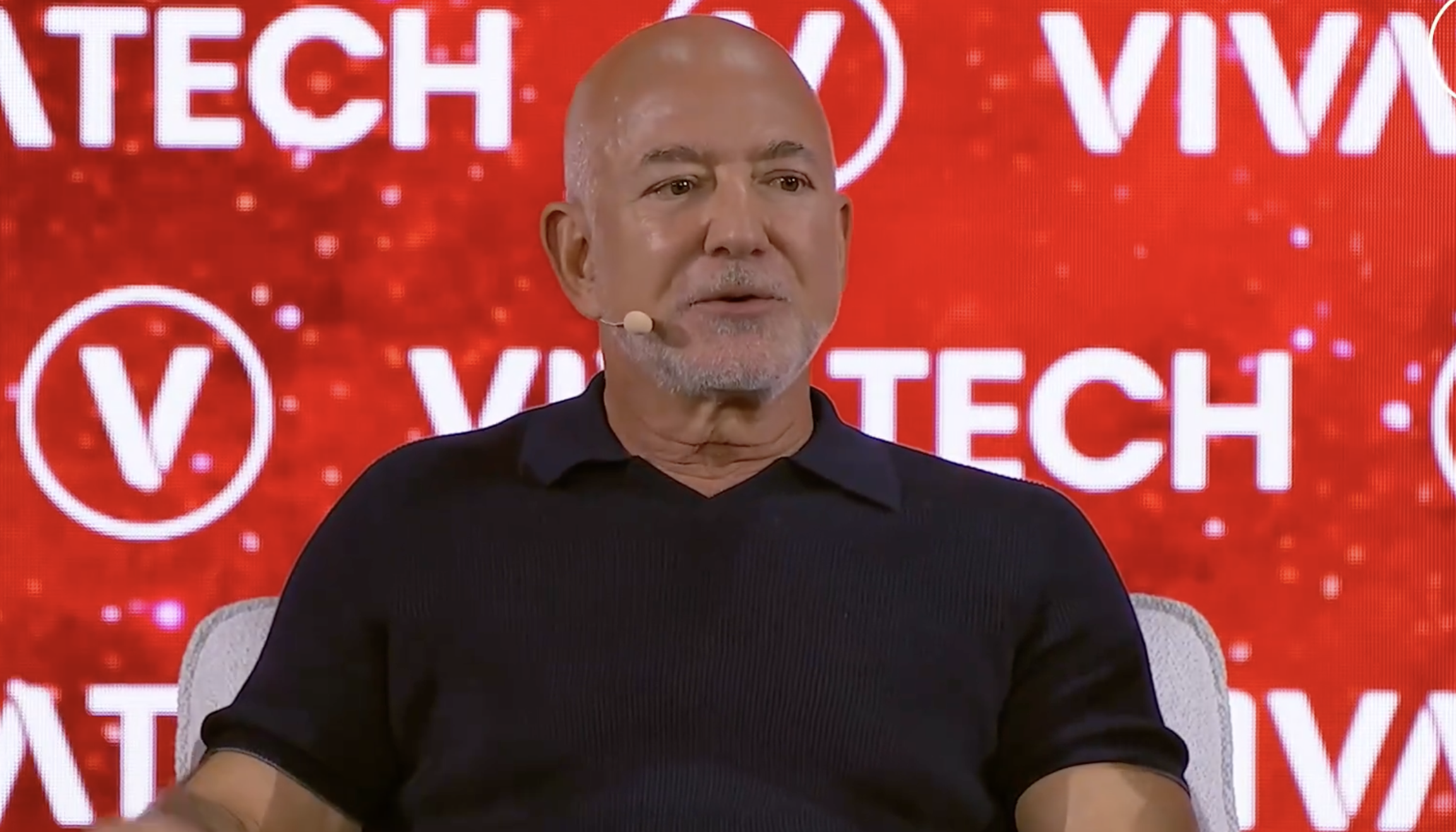
Jeff Bezos was the absolute protagonist of the inaugural day of VivaTech, the Parisian fair dedicated to startups and technology. In front of a packed audience, the Amazon founder shared the stage with Blue Origin CEO Dave Limp and former NASA astronaut Mike Massimino, outlining the next stages of the new space race. Despite the recent technical unexpected events, marked by the ground explosion of the New Glenn launcher at Cape Canaveral just three weeks ago, the US entrepreneur’s plans for lunar exploration remain concrete and ambitious, positioning themselves on a direct collision course with the activities of Elon Musk and his SpaceX.
Blue Origin’s long-term strategy does not envisage a simple institutional move to the satellite, but the start of a stable settlement. “This time we are going to the Moon to stay there, not just to visit it,” Bezos said, identifying the Earth satellite as the necessary launching pad for future missions to Mars. The industrial plan initially focuses on the exploitation of in situ resources, with particular reference to the ice present in polar craters, convertible through electrolysis into oxygen and liquid hydrogen.
The goal is to create refueling stations directly in space, a vision that aims to relocate the most polluting production sectors out of the atmosphere to preserve the planet. According to Bezos, the state of suffering of the environment is the only global indicator that has worsened compared to five centuries ago: access to raw materials from asteroids and celestial bodies would therefore allow Earth to return to the status of “garden planet” of the pre-industrial era. This model is part of the same competitive trend as Elon Musk’s Terafab project, aimed at installing data centers and high-power computing infrastructures in orbit.
In addition to space trade routes, the debate touched on the impact of artificial intelligence systems on the job market, an area in which Bezos is also active through the startup Prometheus. Far from considering automation a fatal threat to employment, the perspective presented in Paris frames technology as an accelerator of creativity and a stimulus for the birth of new businesses.
Rejecting widespread skepticism, the manager urged the new generations to take advantage of the current historical context, defined as the best time to start an independent business. “We are limited not by our imagination, but by what we can actually do. There is an infinite range of things to invent”, concluded Bezos, confirming how technological evolution must operate as a factor in enhancing human capabilities rather than as an element of social exclusion.
%C2%Bfque Hace Que Una Plataforma Online Sea Comoda Para Usar Durante Mucho Tiempo
Por Que La Variedad De Entretenimiento Es Clave En Los Casinos Online Modernos
13351502 Que Hace Mas Comoda Una App De Apuestas Deportivas En El Uso Diario
@tonowo-269783 – AppTuts.bio
54563 Mensaje De Visitante De Xifere
Caner Arman | ReverbNation
Atan | newline
69582 Raleye
Political Science Rumors – Forum for Political Scientists
ratrin (@ratrin) | AllMyLinks
Image post by japof | Civitai
GatChat, Gatling Gun Discussion Forum: Casino Online Review Features, Games and User Experience
Profile – Hanson
Onlayn Kazinoda Uğurlu Başlanğıc: Yeni İstifadəçilər Nələrə Diqqət Etməlidirlər? — Paper.wf
Kisoba (kisoba8437) – Profile | Pinterest
Profile – Hanson
sarik | newline
Pinco tətbiqi nə ilə fərqlənir? — rorop
Azərbaycan oyunçuları üçün müasir onlayn kazino platformalarının üstünlükləri
Nadirmirkhanov
Sejet21159
raminarifov (@raminarifov) | AllMyLinks
@vobifok-270392 – AppTuts.bio
Fazil Ganbarov | IEEE DataPort
Sejet21159Aratrin Com