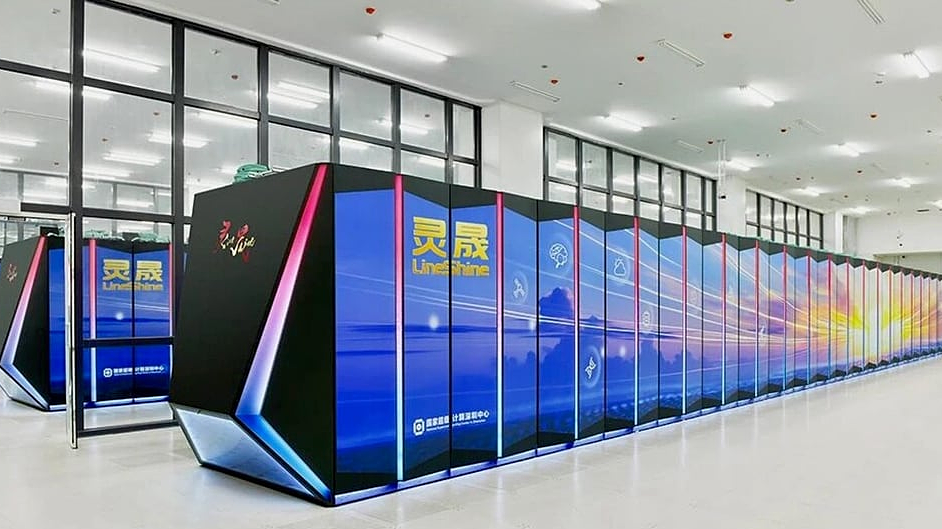
The LineShine system uses self-developed chips to become the world’s fastest supercomputer, demonstrating China’s semiconductor autonomy.
In the TOP500 ranking published on June 23, LineShine, located at the Shenzhen National Supercomputing Center, ranked first, surpassing El Capitan of the US, marking the first time China has returned to the top position since 2023.
TechCrunch According to the assessment, this comeback is different from three years ago when LineShine completely used the central processing unit (CPU) developed by China instead of foreign components. The system also does not depend on graphics processing units (GPUs) like most AI supercomputers today.
According to information published on the TOP500 website, LineShine is equipped with more than 2.4 million Armv9 processing cores, achieving a performance of 2.19 exaflops, which can perform more than two trillion calculations per second. LineShine does not contain any advanced AI chips, is the first system to exceed the 2 exaflop threshold using only CPU, and is the fifth supercomputer to exceed the exascale threshold (capable of performing one billion billion calculations per second or more).
LineShine supercomputer. Image: China Media Group
China first took first place in the TOP500 in 2010, but was continuously surpassed by the US and Japan. In 2023, the country had another flagship supercomputer, but then stopped sending its system information due to US export controls related to semiconductors. Experts assess that the new move with LineShine shows that China wants to show off its technological autonomy.
“I’m not surprised that it’s the number one system. What I’m surprised about is that they submitted it and wanted to be recognized,” Addison Snell, CEO of supercomputing company Intersect360 Research, told Reuters. “China is hoping to convince the world that export controls are useless.”
5 supercomputers surpass the Exascale threshold:
| Ranking | System | Location | Nation | HPL (Exaflop/s) |
|---|---|---|---|---|
| 1 | LineShine | National Supercomputing Center, Shenzhen | China | 2.198 |
| 2 | The Captain | Lawrence Livermore National Laboratory | America | 1.809 |
| 3 | Frontier | Oak Ridge National Laboratory | America | 1.353 |
| 4 | Aurora | Argonne National Laboratory | America | 1.012 |
| 5 | Jupiter Booster | Jülich Supercomputing Center | Virtue | 1.000 |
TOP500 is a ranking of the 500 most powerful supercomputers in the world, established in 1993, published twice a year in June and November. The list is used by the High Performance Computing (HPC) community as a measure to evaluate the processing capacity of supercomputers globally.
However, TOP500 is not synonymous with the most powerful machines for artificial intelligence. The list mainly lists traditional supercomputers, which are designed to solve extremely complex scientific problems, requiring high precision at each step such as simulating interactions between atoms, mainly belonging to national laboratories and universities. Meanwhile, AI supercomputers are like “data processing factories” when optimized to perform billions of matrix multiplications at the same time – the core work when training large language models (LLM), creating images or videos with AI. In fact, LineShine ranked fourth in several benchmark tests designed for AI job simulations.
In recent years, companies such as Microsoft, Amazon, Alphabet, and SpaceX have raced to build supercomputers, but mainly focused on the field of artificial intelligence. They also did not submit their system to the TOP500 project. A study published last year, conducted by a group of US AI policy experts including Konstantin Pilz, James Sanders, Robi Rahman and Lennart Heim, showed that if xAI and SpaceX’s Colossus applied, this system would be more powerful than El Capitan – currently used by the US government to develop and maintain a nuclear arsenal.
“If large-scale cloud computing providers announced their supercomputer performance, perhaps the existing ‘world’s fastest’ systems could not make it into the top 5,” commented Jimmy Goodrich, senior researcher at the Institute for Global Conflict and Cooperation at the University of California (USA).