The Large Hadron Collider (LHC) will stop operating on June 29 for a 4-year upgrade, helping to increase the possibility of particle collisions.
Theo AFPthe Large Hadron Collider (LHC), a 27 km long circular tunnel located at a depth of about 100 m below the French-Swiss border, is the largest and most powerful particle accelerator in the world. In the tunnel, superconducting magnets and accelerator structures push protons to extremely high energy levels, then collide them at extraordinary speeds. The machine, operated by the European Organization for Nuclear Research (CERN), is famous for proving the existence of the Higgs boson, or “God particle”.
“From June 29, we will enter a new phase,” commented Markus Zerlauth, head of the LHC upgrade project. The goal is to increase the “brightness”, which is the total number of collisions that occur in a given period of time. After improvements, the machine has a new name, the High Luminosity Large Hadron Collider (HL-LHC), expected to start operating in June 2030 and continue to operate for about a decade.
The total upgrade cost is expected to be up to 1.5 billion USD, extracted from CERN’s membership fees and in-kind contributions from countries such as the US, Japan, Canada, and China.
The upgrade process requires a complete replacement of equipment in a 1.2 km long tunnel section. New superconducting magnets, better able to focus particle beams, will be installed to increase the number of collisions. Ultimately, about 140-200 collisions will occur every time two groups of particles meet, a sharp increase from 60 today. Zerlauth said an increased number of collisions, possibly several billion per second, would allow them to collect 100 times more data.
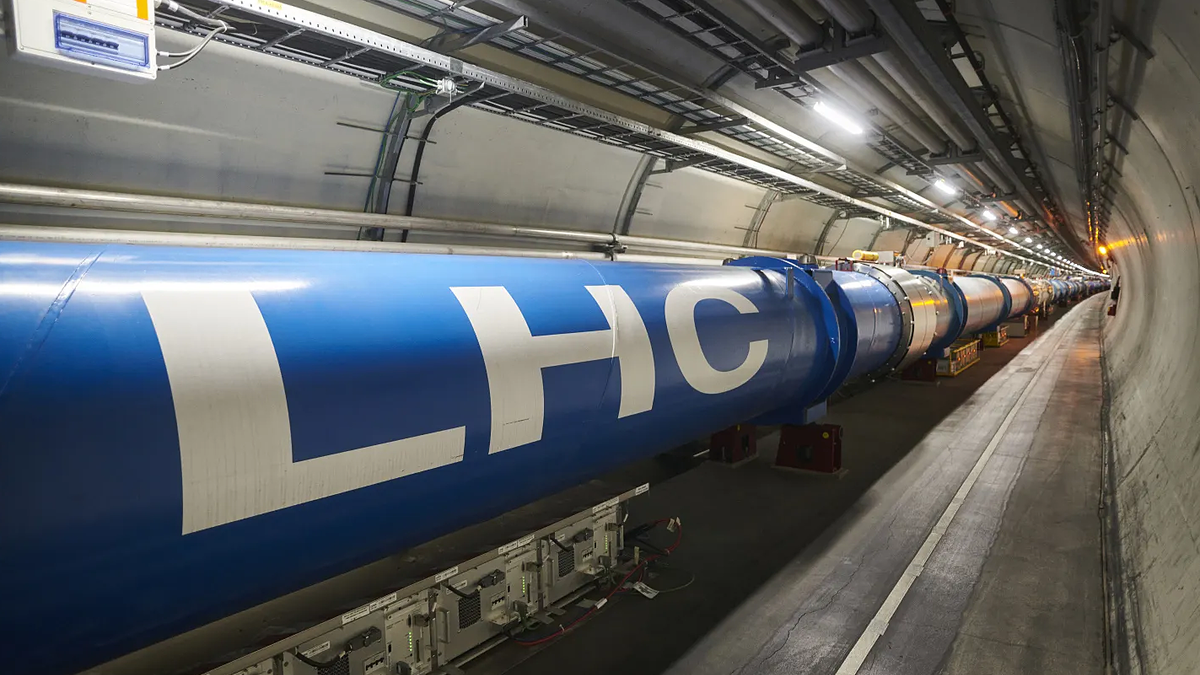
Large Hadron Collider (LHC) in the France-Switzerland border area on April 22, 2022. Image: CERN
The discovery of the Higgs boson in 2012 expanded our understanding of how particles acquire mass, and earned physicists Peter Higgs and Francois Englert the Nobel Prize in Physics in 2013. Since its operation, the LHC has found 55 million particles. The upgraded machine is expected to produce about 380 million Higgs boson particles during its operation, helping scientists understand more about this type of particle.
In addition, CERN hopes to create two Higgs bosons simultaneously for the first time and observe them interacting. According to Nedaa-Alexandra Asbah, a physicist at CERN, this could provide clues about how the universe evolved immediately after the Big Bang.