China is increasing the application of AI to increase production efficiency and reduce costs, ensuring factories operate smoothly in all stages.
Theo CGTNartificial intelligence (AI) does not stop at laboratory breakthroughs but is rapidly revolutionizing China’s production system from decision-making, assembly, coordination with humans to supply chain coordination.
Large-scale industrial applications
At a rubber company in Hangzhou, a technology hub in Zhejiang province, a virtual car runs on a screen at 120 km/h while the intelligent agent controlling the car performs 300 durability tests per second.
“With the intelligent agent, we can achieve results that satisfy automakers in just a few days,” Guo Leilei, an engineer at Zhongce Rubber Group in Zhejiang, told People’s Daily Online. Previously, they needed to create tire prototypes and send them to auto companies for field testing. This process usually takes at least 6 months. According to Jiang Zhiqiang, vice president of the group, AI allows them to carry out complex processes in “virtual factories”, thereby finding optimal solutions before production.
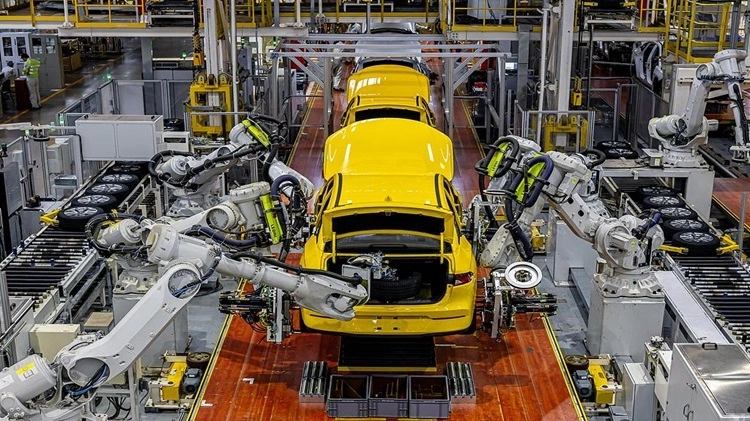
In Guangzhou, Guangdong province, the smart ecological factory of GAC Aion New Energy Automobile, a subsidiary of Guangzhou Automobile Corporation (GAC Group), uses more than 600 industrial robots in stamping, welding and assembly processes. In the final assembly workshop, cars go through more than 200 processing stations, many of which are fully automated and operated by robots. Every 53 seconds, the car moves to the next station and a new car is completed.
Aion’s factory integrates AI, big data, robotics technology, advanced processing techniques, quality management and smart logistics systems, allowing the supply of more than 100,000 vehicle configuration options. As a result, production efficiency increased by 50%, vehicle delivery time shortened by 33%, the rate of products meeting standards for the first time increased by 8% and production costs decreased by 58%.
Aion’s production line in Guangzhou. Image: VCG
Similarly, at Procter & Gamble’s factory in Huangpu, Guangzhou, technologies such as AI, automation and an integrated digital twin system across the supply chain contributed to reducing inventory by 30% and logistics costs by 15%, while maintaining a 99% on-time delivery rate for three consecutive years.
Unlike traditional factories with always bright lights and busy workers, Robam Hangzhou’s factory, a leading company in the kitchen appliance industry, is famous as a “shadow factory” because its production lines operate with little human presence. At this factory, self-propelled vehicles move back and forth automatically while the conveyor belt operates continuously. An intelligent platform that integrates real-time data of orders, production lines and warehouses, allowing for production instructions and remote tracking of order progress. Since building the factory, Robam’s product development cycle has been shortened by 48%, production efficiency has increased by 45% while costs have decreased by 21%.
Flexible production
In China’s Yangtze River Delta region, AI is developing in a more flexible and autonomous direction.
At a textile factory in Taicang, Suzhou City, Jiangsu Province, more than 500 air-jet looms are connected to an AI system that continuously monitors yarn tension, insertion speed and motor temperature. Through digital twin modeling and real-time optimization of 128 process parameters, the manufacturer was able to control fabric weight deviation to 1.2%, while order response speed increased by 40%. The factory also uses AI to optimize the sizing process (chemical coating on the warp surface before weaving), reducing steam consumption by 300 kg per ton of yarn produced.
Sany Group’s heavy machinery factory in Con Son. Image: Number
In high-end equipment manufacturing, Sany Group’s smart factory in Kunshan builds a flexible manufacturing system in which an AI-based scheduling department divides global orders into thousands of process nodes and distributes work across multiple lines. Autonomous vehicles connect to a cloud-based production execution system, automatically plotting routes according to priority orders.
According to China’s Ministry of Industry and Information Technology (MIIT), by the end of 2025, more than 30% of manufacturing enterprises with annual revenue of at least about 3 million USD have applied AI technology. According to Global TimesChina has built more than 35,000 basic level smart factories, more than 8,200 high level smart factories and more than 500 excellent level smart factories nationwide. Last year, the city of Shanghai in eastern China announced a three-year plan called “AI combined with manufacturing” to achieve breakthroughs in industrial intelligence technology. Meanwhile, Hebei province in the north of the country is strengthening its “AI+” action plan, deploying innovative AI applications in 15 industries.