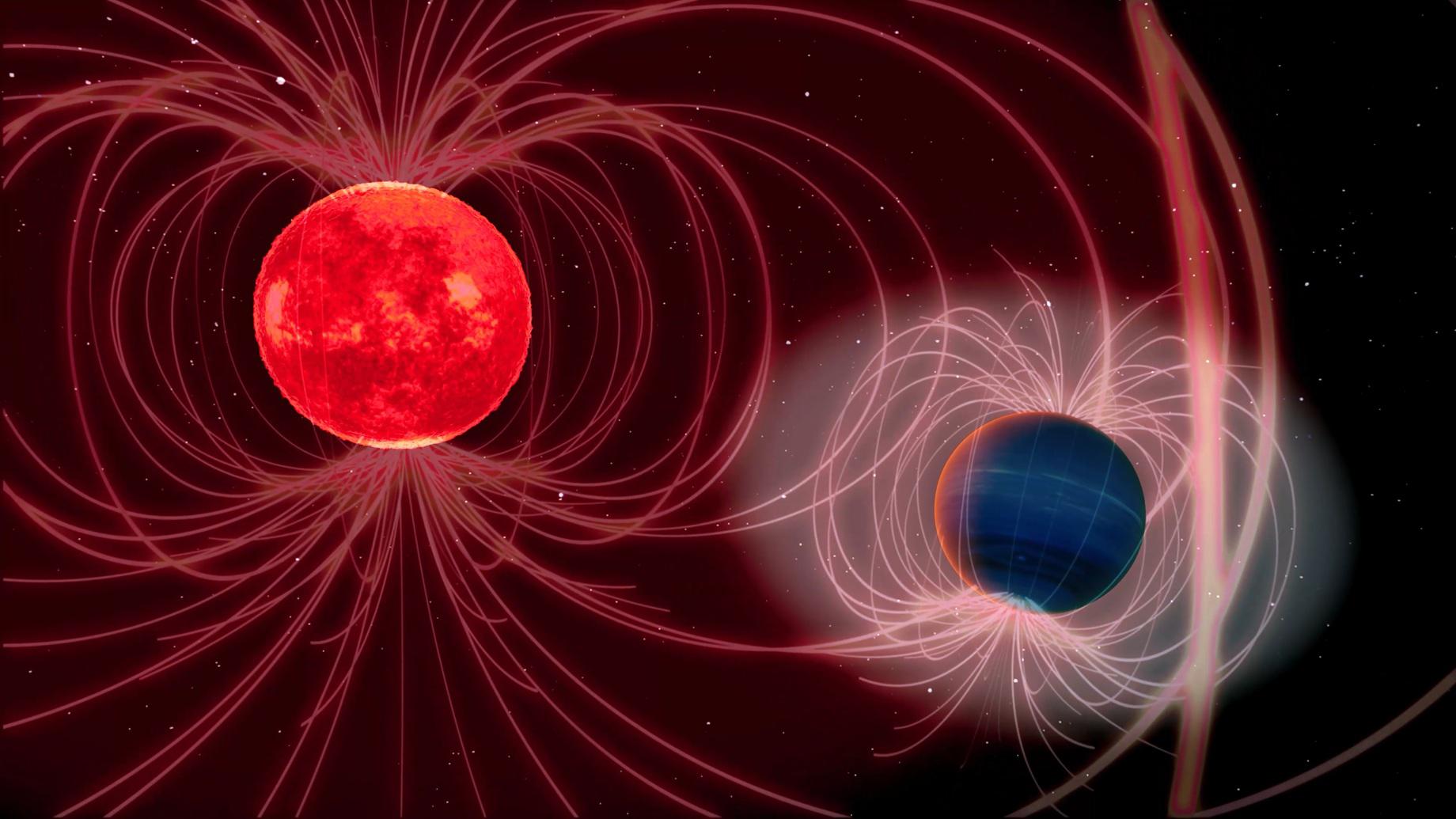
The study, published in the scientific journal Science and coordinated by the Instituto de Astrofísica de Andalucía (IAA-CSIC) with the collaboration of the National Institute of Astrophysics (INAF), highlights how the magnetic field of a planetary body outside the Solar System can alter the atmospheric activity of the star around which it orbits.
The investigation focused on the objective system GJ 436, analyzing sixteen years of high-resolution spectroscopic observations collected by the CARMENES instruments, operating at the Calar Alto Observatory in Spain, and HARPS, active at ESO’s La Silla Observatory in Chile.
At the center of the findings is GJ 436 b, an exoplanet with mass characteristics similar to those of Neptune which moves in an extremely close orbit to its reference star, a positioning that overturns the classical paradigm according to which physical interactions would be driven solely by the radiation and gravity of the star towards the planet.
Artist’s impression of the star-exoplanet interaction between GJ 436 and GJ 436 b. Credit: IAA-CSIC/LampScience
Daniel Revilla, an IAA-CSIC researcher and lead author of the study, described the discovery: “In particular, we observed that GJ 436 b, a Neptune-like exoplanet orbiting very close to its star, produces regular variations in the star’s emission at specific wavelengths” The interaction between the two celestial bodies manifests itself through the injection of energy into the stellar chromosphere, a phenomenon similar to the terrestrial polar auroras but projected on a stellar scalefound specifically in the years 2008, 2016 and 2024. This precise eight-year periodicity coincides with the natural cycle of GJ 436’s magnetic activity, indicating that the action of planet becomes detectable by spectrographs only when the star goes through certain magnetic phases.
The application of advanced mathematical models has made it possible to quantify the intensity of this invisible force, as confirmed by Antonino F. Lanza, INAF researcher and co-author of the publication: “By analyzing the spectroscopic signals using theoretical models developed at INAF, we were able to estimate the magnetic field intensity, an extremely complex property to measure on an exoplanet“Physical estimates indicate that, despite its small size compared to gas giants, the magnetic field of GJ 436 b has an intensity between 2.33 and 27 times that recorded on Jupiter.
Artist’s impression of Jupiter’s magnetic field and planet-satellite interaction. Credit: IAA-CSIC/LampScience
This data extends the effectiveness of Italian calculation tools to a new class of celestial bodies, overcoming the limits of previous sampling which were limited only to large planets, so much so that Lanza himself added: “This specific work contributes to the debate by demonstrating that the theoretical models developed at INAF can be successfully applied not only to giant planets the size of Jupiter, but also to smaller planets, with dimensions comparable to those of Neptune”.
The determination of the planetary magnetic shield constitutes a crucial factor for astrophysical models that study the evolution and conservation of planetary atmospheres with respect to the erosive action of stellar winds, a mechanism also evident in our solar system where the Early loss of global magnetism on Mars resulted in desertification of the planet.
In the conclusions of the research, Daniel Revilla reiterated the methodological value of the results obtained: “Until now, measuring the magnetic field of an exoplanet was a very difficult undertaking. This property is instead the key to understanding whether a planet is able to protect its atmosphere and, ultimately, whether it can support conditions favorable to lifeThe new methodology therefore opens up new perspectives for the cataloging of habitability criteria in future deep space exploration programs.