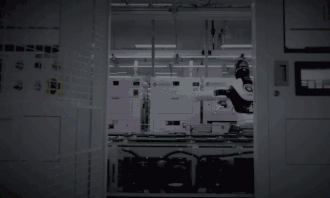
Livestream recorded the humanoid robot working for 6 days in a real factory, producing 17,625 tablets but with very small errors.
Theo Interesting Engineering, To demonstrate the operating capabilities of humanoid robots in real environments, Chinese company Agibot conducted a 6-day livestream series recording scenes of G2 humanoid robots working in an electronics factory.
On a Longcheer Technology line, its Agibot G2s inspect tablets, classify defects and transport materials. The livestream series is divided into 6 parts, each part lasting more than 10 hours in which the robot works non-stop.
The humanoid robots accumulated more than 64 hours of operation, completed 64,828 tasks on the production line, a task success rate of 99.99%, and contributed to the production of 17,625 tablets. Far from controlled laboratory demonstrations, the G2 robots worked on an actual mass production line, adapting to factory operations in real time.
G2 is a robot about 1.6 m tall, weighing nearly 70 kg, with a lower body on wheels and a humanoid upper body, designed for industrial applications such as material handling, product inspection and production line support.
Humanoid robot working on a tablet production line. Video: Agibot/Youtube
Agibot said the livestream aims to demonstrate that humanoid robots can operate reliably in real industrial environments, performing large volumes of work consistently, rather than just in a staged setting.
“By putting multiple humanoid robots on a real production line and publicizing that process for 6 consecutive days, we want to demonstrate in a more transparent way the industrialization of AI,” Agibot representatives said in a statement posted on Interesting Engineering. The company also said it has shipped the 15,000th robot to partners in the manufacturing industry.
Theo International Federation of RoboticsRobots are one of the central technologies of China’s 15th Five-Year Plan, considered the next step of automation and economic growth driver. This country currently has the most industrial robots in operation, about 2 million units, about 4.5 times more than the second-ranked country, Japan. Each year China continues to account for 54% of industrial robots installed.
By the end of 2026, key humanoid robot products will complete the process of proving their applicability and enter the practical working stage, SCMP citing information from Chinese regulatory agencies.
Beijing is promoting the creation of more than 100 high-value applications, aiming to push the industry from demonstration to real-world tasks, and from demonstrating individual capabilities to building integrated systems that can perform real-world tasks, according to Shao Hao, senior manager of Vivo’s robotics laboratory.