The new generation lead-cooled reactor developed by Newcleo can significantly reduce the risk of meltdown in the event of an accident.
Theo Popular ScienceItalian technology company Newcleo is developing the new generation Precursor reactor, using lead as a coolant instead of water, helping to reduce the risk of reactor meltdowns. Traditional reactors often rely on cooling water, which can evaporate in the event of an accident, leaving the core exposed and vulnerable to overheating.
When developing Precursor, Newcleo’s engineering team thought that simulating the operation of a nuclear reactor without actually using fission could yield similar results but with the risk of an incident. Both the Precursor and the company’s upcoming fueled reactor model use lead for cooling. The only difference is that thanks to the electric heater, Precursor is safer for testing before switching to a 30 MW fuel reactor. According to Stefano Buono, CEO and founder of Newcleo, what makes Precursor unique is that it produces electricity using a turbine built by partner company Fincantieri.
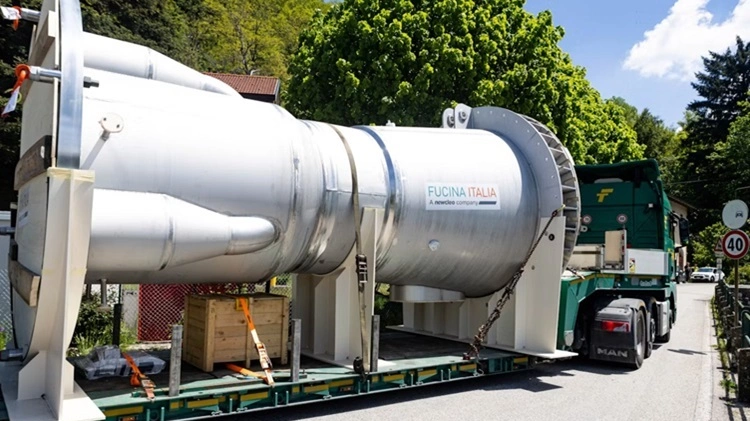
When the reactor was put into position at the ENEA Brasimone Research Center near Bologna, Italy, it weighed about 20 tons. The weight of the furnace increased to 115 tons when filled with lead. In April, Newcleo began installing Precursor with 3 main parts. First is the melting tank, where lead ingots are placed and melted. The second part is a storage compartment for molten lead during initial loading or reactor maintenance. Finally, there is the transfer chamber, which helps exchange molten lead between the storage chamber and the main chamber of the reactor, according to Interesting Engineering.
The main compartment of the Precursor reactor was moved to the Brasimone research center in Italy. Image: Newcleo
Using lead for cooling offers many advantages. Because lead needs to be heated to 1,743 degrees Celsius to start boiling, the reactor does not need extremely high pressures like using coolant in a fueled reactor. Molten lead is so dense that it can circulate on its own without the aid of a pump but can easily solidify if there is a fuel leak.
Because it uses no fuel, Precursor is not at risk of reaching a supercritical state during testing. Critical mass is the minimum amount of fuel needed for the furnace to maintain a continuous chain of nuclear reactions, with the neutrons produced from each fission reaction causing a similar reaction in another atom. When the furnace reaches the supercritical threshold without control, the reaction increases rapidly, causing the nuclear fuel to spontaneously combust and cause an explosion. But in the Precursor, the fuel tank is empty. Instead, electric heaters heat the lead so that the lead transfers heat to the steam generator, which powers the turbine.
The 10 megawatt thermal capacity Precursor is under construction and will be completed by the end of 2026, becoming a testament to the company’s ability to integrate all processes from engineering, manufacturing, transportation to installation. Newcleo is working to build a 30 MW reactor in the French towns of Savigny-en-Véron and Beaumont-en-Véron, expected to be operational by 2031.
As the world searches for solutions to meet energy needs without carbon emissions, nuclear energy is becoming increasingly popular. While some countries like China build large-scale nuclear power plants, Western countries are looking for safer ways to transition to nuclear energy using new technology. Modular reactors (SMRs) and microreactors provide nuclear power on a smaller scale, while sodium or lead-cooled reactors improve the safety and efficiency of electricity production.