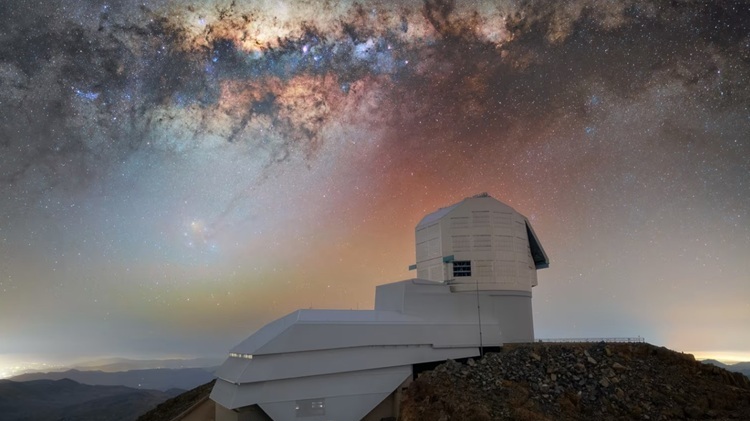
The LSST camera at the Vera C. Rubin Observatory is in operation, promising to provide the clearest footage of stars and galaxies in the universe.
Theo New York Timeson June 30, the Vera C. Rubin Observatory, the world’s largest digital camera facility on the edge of the Atacama Desert, Chile, began the Legacy Survey of Space and Time (LSST) project. In the next 10 years, at night, every 40 seconds, a camera as large as a small car and weighing nearly 3 tons will take detailed photos of the southern sky. A series of color filters will help the LSST camera record the transformation and movement of celestial bodies from asteroids to supernovae. The huge data set from the device will help increase understanding of the solar system and the Milky Way galaxy, and help researchers explore the mystery of dark matter through observing distorted light from distant galaxies.
Theo Spacethe LSST camera has a resolution of 3,200 megapixels and a diameter of 1.57 meters, making it the largest lens camera ever made. The device uses a system of 189 ultra-sensitive CCD sensors, cooled to -100°C to reduce electronic noise. Each image from the LSST camera will contain more than three billion pixels, enough to fill 400 4K TV screens. The LSST camera does not operate alone but in combination with a complex mirror system, including an 8.4 m main mirror and a 3.5 m secondary mirror. They collect and direct light through the camera lens, focusing it on the CCD detector.
Vera C. Rubin Observatory in northern Chile. Image: NSF
With funding from the National Science Foundation and the US Department of Energy, the $800 million Rubin Observatory was built atop the 2,682 m high Cerro Pachón mountain in northern Chile. Clear skies and dry air make this area one of the world’s best places to conduct astronomical observations.
The Rubin Observatory released its first images last year, including color images of the Trifid and Lagoon nebulae thousands of light years from Earth (one light year is equivalent to about 9.46 trillion kilometers). According to CNNduring imaging to optimize the new system, the observatory discovered 11,000 new asteroids and dozens of other solar system objects. In the future, researchers will use AI and machine learning to sift through data and look for clues about the origins and evolution of the universe.
Theo Live Sciencein its first year of operation, the Rubin observatory will collect more data than all current optical observatories combined. It is expected that over a decade of operation, the facility will generate about 20 terabytes of data per night. By the end of its life, the observatory will have imaged about 40 billion celestial objects and made trillions of measurements.
South Carolina Inquiry
Stocks.Php
Stocks.Php
Settlement Agreement Explained: Hull Expert Guide to Your Legal Rights | lifestyle.ucconnection.org
Stocks.Php
Washington Headlines
Settlement Agreement Explained: Hull Expert Guide to Your Legal Rights
1781961609 hosted at ImgBB
Markets – Financial Advisors
B. Riley Financial | Diversified Financial Services Platform
Settlement Agreement Explained Hull Expert Guide To Your Legal Rights
Settlement Agreement Explained Hull Expert Guide To Your Legal Rights
Settlement Agreement Explained Hull Expert Guide To Your Legal Rights
Business – Malaysian Talks
Settlement Agreement Explained: Hull Expert Guide to Your Legal Rights | http://lifestyle.matomyseo.com/
Arizona News Today
5 Stars Discovery – Luxury Travel News
Stomp The City – Malaysia Trending News
Stocks.Php
Settlement Agreement Explained: Hull Expert Guide to Your Legal Rights
Stocks.Php
Minnesota Headline
Stocks.Php
Settlement Agreement Explained: Hull Expert Guide to Your Legal Rights | lifestyle.microcapnews.com
Settlement Agreement Explained Hull Expert Guide To Your Legal Rights