Many countries around the world are testing strange solutions such as liquefied gas batteries, molten salt batteries, sand batteries… to effectively store renewable energy.
Theo Guardianwhile traditional lithium-ion batteries are approaching the limits of size and scale, alternative batteries could play an important role in harnessing clean energy without using essential minerals such as lithium, cobalt and nickel, which are harmful to the environment. Unlike lithium-ion batteries, which have a finite number of charge/discharge cycles, many breakthrough battery technologies can operate indefinitely and be recycled. Developers have turned to several types of materials to store available renewable electricity and power everything from wearable technology to heating networks and factories.
Liquefied gas battery
Late last year, at the old coal plant in Trafford, England, the Greater Manchester county government started construction on the Carrington energy storage project developed by startup Highview Power. The project’s goal is to capture renewable energy when it is abundant and store it in liquid gas form. The Carrington project uses excess renewable energy to cool air to -196 degrees Celsius, turning it into a liquid 1/700th its volume. This state will be maintained until renewable energy becomes scarce and market prices begin to rise. The liquid is then converted back to gas, and the rapid expansion turns a turbine to generate electricity without creating emissions.
The project has faced some delays, but when it becomes operational later this year, it will provide 300 MWh of storage and 50 MW of six-hour output, enough to power 500,000 homes with clean energy.
Molten salt battery
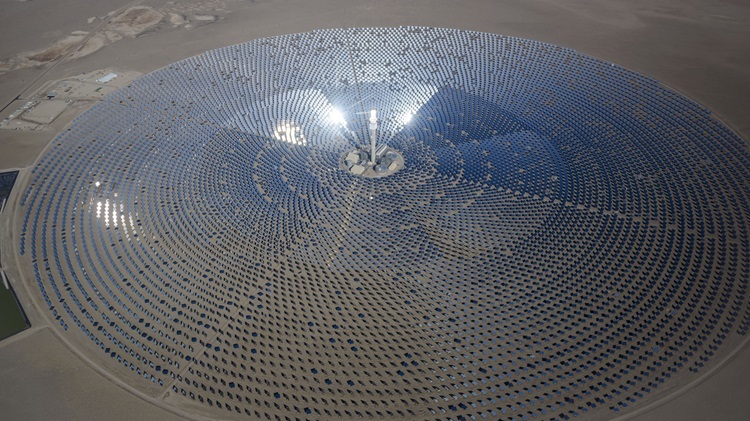
In the desert in Nevada, USA, 10,000 solar panels generate electricity for the Crescent Dunes project. Over the past 10 years, this project has harnessed the power of the Sun to heat a reservoir of potassium and sodium nitrate to 560 degrees Celsius. This temperature can be maintained for 10 hours after sunset before converting the stored heat into electricity using the heat to drive turbines.
Crescent Dunes project in the Nevada desert. Image: Wikipedia
Theo solar energyearlier this year, Denmark, a world leader in wind energy, announced a large-scale 1 GWh molten salt battery project, which can store clean electricity for up to two weeks by heating the salt to about 600 degrees Celsius. When needed, the hot salt circulates through a generator, creating high-temperature steam that can be used directly in industrial processes. The system, developed by Danish thermal storage company Hyme Energy in cooperation with Swiss engineering company Sulzer, can supply electricity to 100,000 households for 10 hours and achieve an efficiency of up to 90%.
Sand battery
Similar to molten salt batteries, sand can also become a clean energy storage solution. In the town of Pornainen in southern Finland, thousands of tons of energy-storing sand are used to heat the school, library and town hall, helping to end the use of oil in the local heating network and reduce the use of wood chips by about 60%.
2,000 tons of crushed soapstone were used in the sand battery project in Pornainen, Finland. Image: Polar Night Energy
The sand battery is about 13 m high and 15 m wide, using about 2,000 tons of crushed soapstone to store clean energy in the form of heat, providing 1 MW of thermal capacity and 100 MWh of storage capacity. The sand battery can meet Pornainen’s heat needs for nearly a month in the summer and nearly a week in the winter.
Sweat battery
According to Green Matters, researchers at Tokyo University of Science developed a thin patch that generates electricity directly from human sweat. The research team led by associate professor Isao Shitanda used a unique enzyme ink to capture chemical compounds, especially lactate, in sweat and convert it into energy. When sweat comes into contact with the biofuel cell, enzymes embedded in the patch trigger a biochemical reaction, releasing electrons, which power sensors on the wearable device, eliminating the need for batteries that need to be constantly charged.