Chinese businesses propose to cooperate with Vietnam on data centers, computing infrastructure, as well as applications and scenarios using AI.
“We will build AI factories in Vietnam together,” Mr. Yang Xin, Director of Industrial Research, Hong Kong Chamber of Commerce in Shenzhen, said at the Vietnam-China Dialogue Forum on AI and Digital Economy, on the afternoon of August 27.
According to Mr. Yang, investment demand for AI is increasing exponentially. Citing Gartner data, he said global AI spending is expected to reach about 2.59 trillion USD this year, an increase of 47%, of which spending on infrastructure accounts for 55%.
He said that Vietnam’s data center market is characterized by being “small, but fast and cheap”. “Small” because the total capacity of data centers operating in Vietnam is about 148 MW, but has a “fast” expansion rate. According to planning, the total expected capacity can exceed 870 MW, 6-7 times the current rate, with an increase rate of 20% each year from now until 2031.
“Cheap” construction costs or investment prices are an advantage of Vietnam. According to the data Mr. Yang cited, the median cost to create 1 MW of data center capacity in Vietnam is 7.2 million USD, lower than Singapore (14.4 million USD), Malaysia (9.6 million USD) and Thailand (8.8 million USD).
However, Vietnam still has limitations in power sources and computing capacity. He said it would take Vietnam 2-3 years to add 100 MW of new power sources. Regarding computing capacity, overall, Vietnam only has 10,000-15,000 GPUs, while Korea has about 50,000-60,000 GPUs. Land fund and project implementation capacity are also other weaknesses. “This is an opportunity for China to help you,” he said.
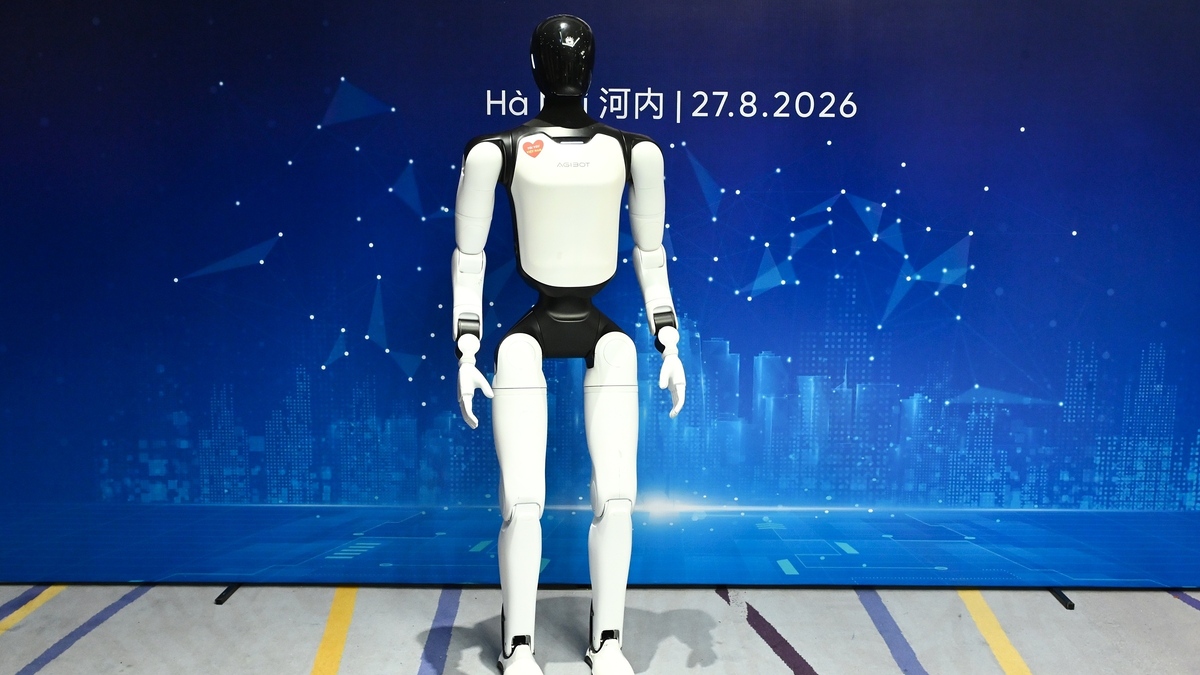
Humanoid robots were introduced by Chinese businesses at the AI and Digital Economy Forum. Image: Trong Dat
Mr. Yang proposed some directions for cooperation between China and Vietnam. The first is to jointly develop computing infrastructure and data centers. “Vietnam can contribute land, electricity and licenses; capital can come from Hong Kong, while China provides equipment, energy solutions and GPU computing systems.”
The two sides can also develop localized open source AI models and AI Agents for production, cross-border logistics, smart border gates, and traceability of agricultural products.
Sharing the same opinion, Mr. Jonathan Choi, Chairman of Sunwah Group (Hong Kong) said that Vietnam and China have their own advantages and closely support each other. After many years of development, China has accumulated a lot of experience in AI research and development. Meanwhile, digital transformation in Vietnam is creating many rich scenarios and applications for artificial intelligence.
“Chinese businesses rely on their technological advantages, application scenarios and characteristics of the Vietnamese market, to work with Vietnamese partners to develop solutions suitable for the local market,” Mr. Choi commented.
Sharing his perspective, Mr. Nguyen Khac Lich, Director of the Department of Digital Technology and Artificial Intelligence, Ministry of Science and Technology, said that Vietnam and China have a “large cooperation space” that can complement each other in AI, digital economy, semiconductors, smart manufacturing, research and development and human resource training…
According to Mr. Lich, this relationship needs to shift “from economic connection to technology connection, from simple transfer to co-creation, from attracting investment to jointly developing the ecosystem and talent”.
Director of the Department of Digital Technology and Artificial Intelligence – Nguyen Khac Lich, spoke at the forum. Image: Trong Dat
He proposed that Chinese and Vietnamese businesses “co-create the AI ecosystem and digital economy”. Businesses from both countries can research, localize and develop solutions. At that time, “Vietnam is both a market, a place to test and perfect products, and a springboard for China’s AI solutions to expand to ASEAN and the world,” he said.