Iran once held an advantage thanks to controlling the Hormuz oil and gas artery, but now finds itself in a dilemma when its economy is strangled by the US blockade.
“Iran has complete control over the Persian Gulf, as well as the waters off the coast of Oman and the Strait of Hormuz. Thanks to our superiority and superior strength, we do not need to lay mines in the Persian Gulf and will use all possible measures to ensure security when necessary,” Iranian military spokesman Ebrahim Zolfaghari declared on March 23, expressing confidence in the country’s superiority in the conflict with the US and Israel.
Mr. Benoit Faucon also emphasized that the Iranian armed forces and regional partners “can protect the Persian Gulf against threats from the US – Israel”. “External powers have no right to interfere,” he said.
According to Benoit Faucon, Middle East commentator for WSJsuch statements show that Iran once believed it had the upper hand by closing the Strait of Hormuz and stalling the maritime artery that holds 20% of global oil and gas supplies.
Meanwhile, Iran’s oil exports are largely unaffected by the conflict, with its tankers still able to travel freely through the Strait of Hormuz. As a result, Iran’s oil exports averaged about 1.85 million barrels per day in March, exceeding the 1.7 million barrels in previous months.
However, six weeks after the conflict broke out, that advantage ended when the US responded by blockading all Iranian seaports.
IRGC speedboats approached a cargo ship in the Strait of Hormuz on April 21. Image: AP
This measure has choked the operations of Iran’s oil export fleet, which is an important source of revenue for the country. Now, Iran’s fleet of oil tankers cannot penetrate the barrier of American warships, which have pursued them all the way to the Indian Ocean.
“At Hormuz, Iran was able to create a crisis of market confidence. But disruption does not mean control. With the US blockade, Iran is suffering the consequences,” said David Des Roches, former director of Gulf policy at the US Department of Defense.
When the seaport blockade caused import and export activities to stagnate, Iran is trying to overcome the situation by shipping part of its oil via rail to China, while importing food by road from the Caucasus and Pakistan. However, the Iranian Shipping Association said on April 30 that only 40% of the country’s trade turnover can be diverted from blockaded ports.
The Pentagon said that since the seaport blockade began on April 13, the US military has forced more than 40 ships transporting oil and other goods to change direction when trying to overcome the US blockade. 31 tankers containing 53 million barrels of Iranian oil are stuck in the Gulf with a value of at least $4.8 billion. Two ships were captured by the US.
The key to the US pressure campaign is to push Iran to a situation where it has no place to store oil, leading to the closure of wells, according to Marc Caputo, a commentator for the US. Axios. This scenario could happen in the next few weeks.
Iran faces the risk of running out of oil storage space
“They are probably only a few weeks or maybe a month away from running out of space,” Gregory Brew, an analyst at Eurasia Group, shared with Axios.
Saeid Golkar, an Iran researcher at the University of Tennessee at Chattanooga, believes that Iran’s leadership currently has two options. They can restrain action and push to negotiate a favorable deal with President Donald Trump, who they say is eager to get out of this chaotic war as soon as possible.
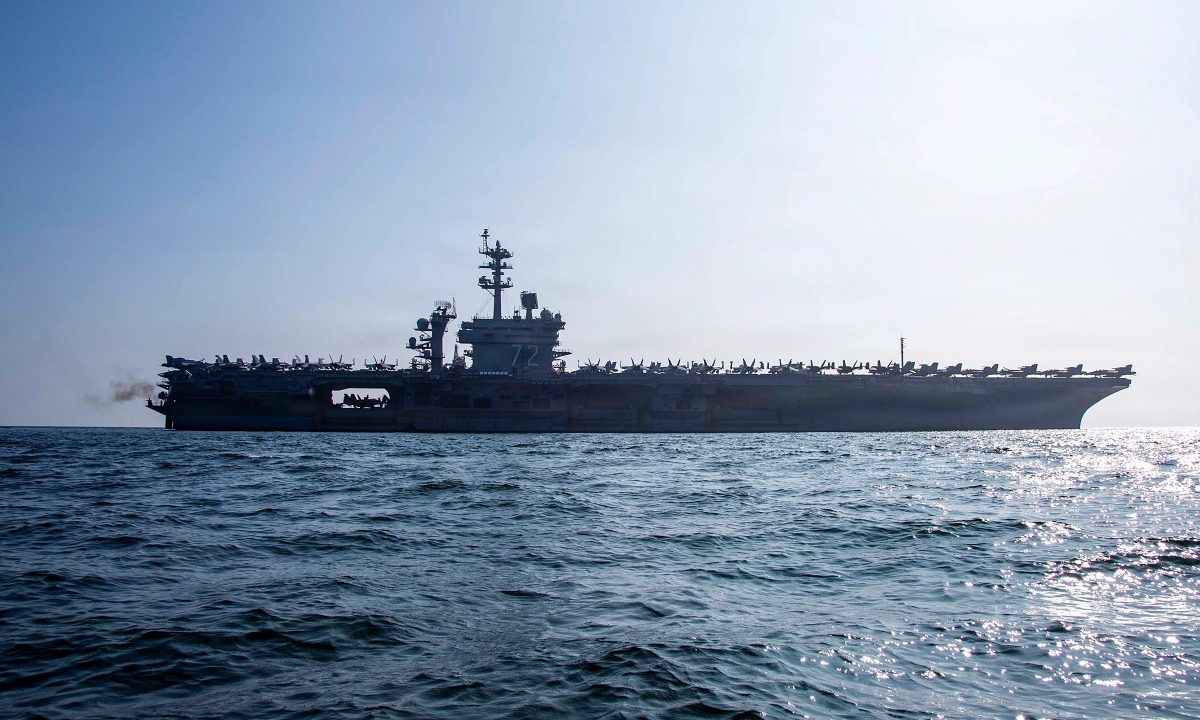
The US aircraft carrier USS Abraham Lincoln moved in the Arabian Sea on February 11. Image: US Navy
The second option is for Iran to resume the war to push up oil prices and increase pressure on Mr. Trump.
Iran’s Supreme Leader Mojtaba Khamenei issued a new threat on April 30, saying that “foreign forces that commit hostile actions have no choice but to lie at the bottom of the sea”. Mr. Mojtaba has not appeared in public since succeeding his father, Ali Khamenei, who was killed on February 28 in the initial Israeli raid.
Two days later, General Mohammad Jafar Asadi, deputy commander of the Iranian army’s Khatam al-Anbiya Central Command, warned that conflict with the US would likely flare up again after the ceasefire, when the two sides still could not find common ground.
This shows that Iran’s leadership seems increasingly inclined to take drastic action with the US, as efforts to negotiate for Washington to lift the blockade have not yielded results, according to Golkar.
“The blockade is increasingly seen by Tehran not as a substitute for war, but as another manifestation of war. Therefore, Iranian policymakers may soon consider that re-igniting conflict will be less costly than continuing to endure a prolonged blockade,” said Hamidreza Azizi, a visiting researcher at the SWP Institute in Germany.
Iranian officials said Tehran could launch new tactics and use never-before-used weapons, from submarines to dolphins carrying explosive devices, to attack US warships if hostilities recur. Iran’s Islamic Revolutionary Guard Corps (IRGC) threatened to cut telecommunications cables in the Strait of Hormuz, which could cause global Internet disruption.
Over the weekend, Tehran passed on to regional intermediaries an offer to stop attacks in the Strait in exchange for a complete end to the war, lifting the blockade and postponing nuclear negotiations. However, the US President seems not satisfied with this proposal.
Mr. Trump earlier this week directed his aides to prepare for an extended blockade. “This blockade is effective and has almost no loopholes,” he said.
Seaports in the Persian Gulf and the Gulf of Oman. Graphics: WSJ
Iran bets that the US will have to make concessions first to cool gasoline prices. On the contrary, US officials believe that Iran will have to step down due to the increasingly serious economic crisis.
Iranian Foreign Minister Abbas Araghchi recently announced that Tehran would seek to “neutralize the restrictions”. However, Miad Maleki, a former sanctions expert at the US Treasury Department and currently a senior researcher at the Foundation for Defense of Democracies (FDD) in Washington, said that the longer this situation lasts, the greater the consequences for Iran will be.
“They have been under sanctions and isolation for the past 47 years. Those oil wells are not well maintained, nor are their machinery,” he said, adding that once closed, the wells will not be able to easily “recover immediately after just a few months”.
However, Iran’s Supreme Court Chief Justice Gholamhossein Mohseni Ejei said on May 1 that Tehran “has never avoided negotiations”, but will not accept “being imposed” on peace terms.