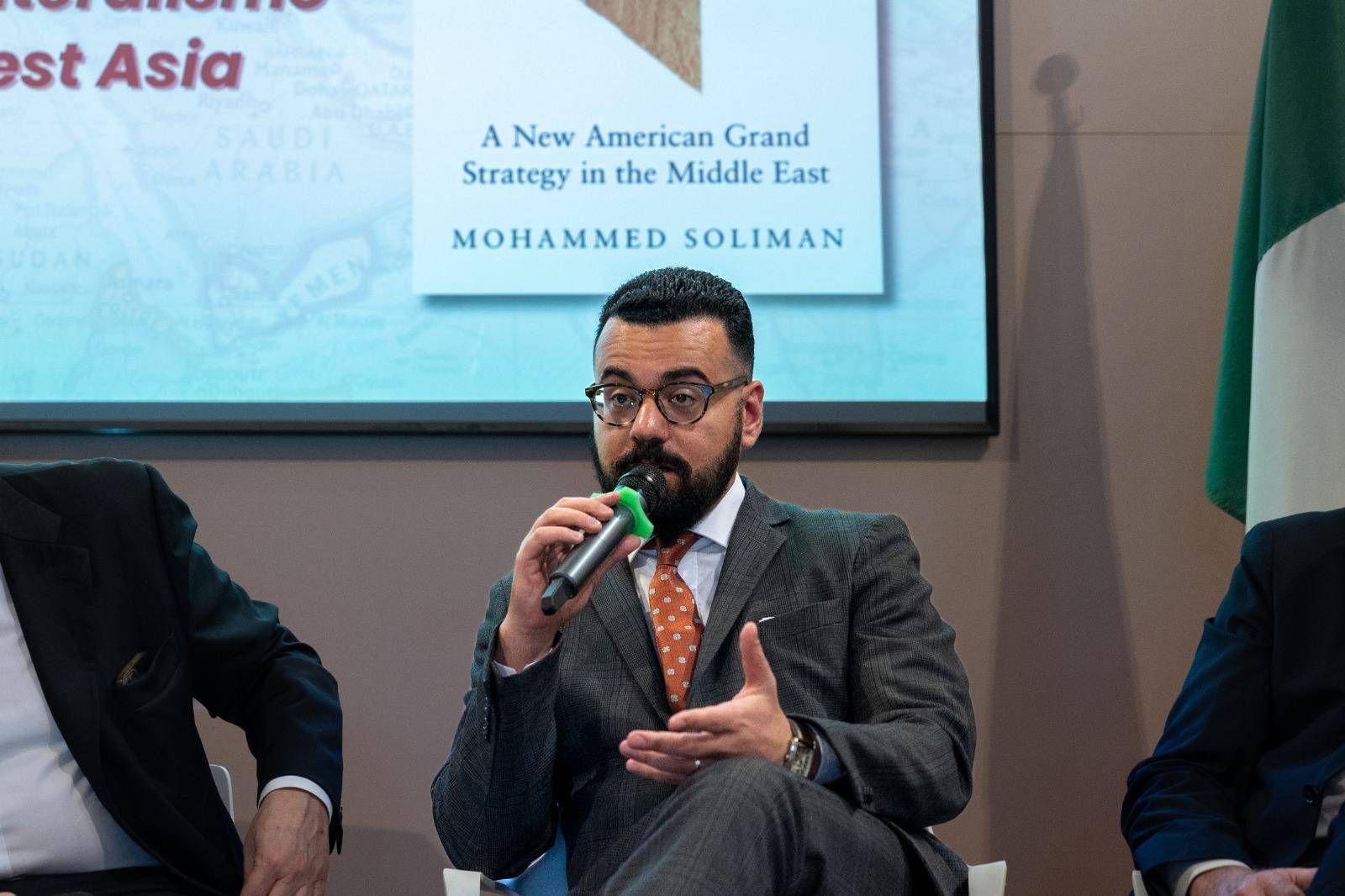
The presentation of. took place at the Center for American Studies West Asia: A New American Grand Strategy in the Middle Eastthe book with which Mohammed Soliman tries to redefine one of the most consolidated (and, according to him, most obsolete) categories of contemporary geopolitics.
This was no ordinary event. Giampiero Massolo and Alessia Melcangi gathered around the same table in the first part, and then Karim Mezran, Gabriele Natalizia, Nicola Pedde and Mario De Pizzo, moderated by Flavia Giacobbe, together with academics, diplomats and analysts among the most attentive observers of the wider Mediterranean. A parterre called to compete with an intellectual provocation capable of questioning the very architecture with which Europe reads its strategic neighborhood.
Soliman, senior fellow at the Middle East Institute and director of McLarty Associates, belongs to that increasingly rare category of policy intellectuals capable not only of interpreting the world, but of trying to redefine the categories with which it is interpreted. His work intersects classical realism, political economy and technological transformations, moving along a trajectory that, not surprisingly, is described as “Kissingerian” in its approach.
On the sidelines of the meeting, Adnkronos interviewed him.
You cite Italy, France and Greece as three countries particularly well positioned to engage with West Asia. What are the Italian characteristics that make it easier for Italy to engage with the region? And which sectors should it focus more on?
Italy is a great maritime power. It is a country with a very long horizon on geopolitics, it is no coincidence that you have developed this concept of an enlarged Mediterranean. The true border of Italian engagement is the Indian Ocean. This is why Italy is at the center of the West Asia thesis that I support in the book.
The priority sectors? First, defense and security, because what happens in the Gulf does not stay in the Gulf will have an impact on Italy on migration, on national security, on terrorism. Giorgia Meloni was right to visit the Gulf after the first days of attacks in Iran, and she was one of the few leaders to do so. Also good for the supply of ammunition and for the Italian naval assets deployed in the area. Second, energy security, which remains extremely important. Third, new technologies: collaborating with Emiratis, Saudis, Qataris on AI infrastructure is central to Italy’s industrial and technological transformation. And these agreements don’t have to be transactional or fragmented: they need to be institutionalized.
Returning to Saudi Arabia, the Emirates and Qatar. Italy has good relations with all three. And yet at the moment relations between Riyadh and Abu Dhabi, for example, are in a critical phase. Is it possible that in light of their tensions, Rome too is called to choose which side to take? Or does the mini-lateral logic dictate that one can be a partner with everyone, even if they are not close partners with each other?
I believe in the second of the two hypotheses. We are in an era where all countries have understood that the idea of 100% alliance and 100% enmity no longer exists. Today there are always overlaps. We are no longer in the post-1991 Pax Americana, where America had won the Cold War and everyone was trying to fall in line. If you are Saudi Arabia, you have a strong relationship with Pakistan and an important economic relationship with India. If you are the Emirates, you have strong relations with India and also relations with Pakistan. Differences in the Gulf exist, but I don’t think they will be the main factor determining how these countries relate to European countries. There will be some spillover effect, yes, but it will not be the primary driver. Saudi Arabia and the Emirates will engage with European countries based on what matters to their national security and economic development.
“West Asia”: Burying the Middle East
The book’s starting point is an intellectual provocation: the term “Middle East” is a terminological fossil of British imperial cartography, a label shaped by the geopolitics of oil that has exhausted its analytical usefulness.
“The term Middle East cannot explain to us why India is increasingly present in the Mediterranean, with Cyprus, with Greece, with Israel,” Soliman said during the debate at the Center for American Studies. “It cannot explain to us why Turkey is a central player in the politics of South Asia, with Pakistan, the Maldives, Bangladesh. It cannot explain to us the role that the Gulf states play as a hub of the global economic system: supplier of capital, energy, logistics, aviation. To fly from London to Tokyo, you have to transit through one of the Gulf hubs.”
What Soliman proposes is to rethink the region as an integrated system stretching from the eastern Mediterranean to the Indian Ocean, in which the boundaries that separated South Asian politics from those of the Arabian Gulf and the Mediterranean no longer exist.
Europe is an island
Soliman’s geopolitical reasoning has a direct implication for Europe, which finds a strategic reason for survival in the West Asia thesis: “After the 2022 Russian invasion of Ukraine, Europe is an island“. The post-1991 Eurasian integration project (which united the post-Soviet space to Europe) is definitively closed, at least for the next twenty years. And in this scenario, West Asia is the “strategic breathing space” that the continent needs.
Three European nations are, for Soliman, already in the West Asian system: Italy, France and Greece. Not by choice, but by position, strategy and structural interests. Rome is described as the “Roman Naval Backstop” of the West-Asian geopolitical coalition: with the expected contraction of the presence of the American Sixth Fleet in the Mediterranean, the Italian navy (FREMM, Cavour aircraft carrier, F-35B) is called to fill a real void of deterrence.
Pax Americana minus: the new security architecture
The second panel delved into the consequences of the war between Israel and Iran, a conflict that Soliman had largely anticipated in the book, published before the full escalation. “There was no strategic discussion in Washington when the decision was made to go to war.”he said bluntly. “I’m an American, I want America to win. But I’m absolutely against this decision. It’s a war of choice, and my book was all about ‘containment,’ about curbing Iranian power instead of waging war on it.”
His prediction for the post-war period is that of a hybrid architecture, the “Pax Americana minus”: the American security umbrella remains formally intact but is cracked, and regional security sub-structures emerge within it. Soliman identifies two main competing ones:
• The Indo-Abrahamic coalition: Israel, India and the United Arab Emirates, converging on shared security goals
• The Indo-Islamic Quadrilateral: Pakistan, Türkiye, Saudi Arabia and Egypt, building their own alternative vision of the regional order
Both coalitions operate within an American security framework, competing for Washington’s support. Without contradicting each other, but without fully integrating.
Iran and Türkiye: two opposite reading errors
On the Iranian dossier, Soliman is clear: “This is a country of 90 million people, with a difficult geography. It will not be Saddam Hussein’s Iraq of the 1990s.” The result of the war, in his opinion, is not a victory for American power: we will emerge with an ideologically more intransigent regime in Tehran, led by a younger generation (the forty- and fifty-year-olds who fought in the Syrian civil war) and with an Islamic Republic that has transformed the crisis into a geopolitical opportunity, including weapons in the Strait of Hormuz.
On Türkiye, the message is the opposite: equating it with Iran is a dangerous mistake, especially for Europe. “Turkey is a nation that knows how to play tough geopolitics. It has achieved success against Russia, in Armenia-Azerbaijan, in Syria. It is active in the Horn of Africa and South Asia. But it is not wise, especially for Europe, to think of Turkey as a new Iran. It is a very dangerous narrative, with huge implications for European security post-Ukraine.”
The great American strategy: consolidate and then reorient
The ultimate goal of the book is to construct an argument for a grand strategy American. Soliman supports the “constellation” approach: consolidating American resources in the Western hemisphere (where the Chinese presence has grown in the vacuum left by Washington), managing the European dossier through a more autonomous and militarized Europe, and building a security architecture in West Asia that allows the United States to do more with less. Freeing up resources for the real pivot towards the Indo-Pacific and the Taiwan issue.
Classic multilateralism, for Soliman, is in crisis: “Large organizations are no longer able to give nations what they are looking for. The new norm will be agile mini-lateral formats, aimed at specific objectives.” The same logic applies to Ukraine, around which a framework has been built that includes Europe, Turkey, Poland, the United Kingdom and the USA — not the traditional NATO structure, but something more flexible and functional.
The warning about China and Italy
A final note that Soliman was keen to underline concerns Italy directly: Beijing has invested in the ports of Savona, Trieste, Genoa and Naples, establishing a structural presence on the Adriatic and Ligurian coasts. In a time of strategic competition, this presence could be used in ways that are difficult to anticipate and even more difficult to reverse.
The window to fit into the emerging West Asian order is open, but it is not unlimited. As Soliman concluded while addressing the audience at the Center for American Studies: “Italy is one of the main players in the West Asian system. Your strategic interests in this region will be determined by how you choose to structure your posture”. (by Giorgio Rutelli)