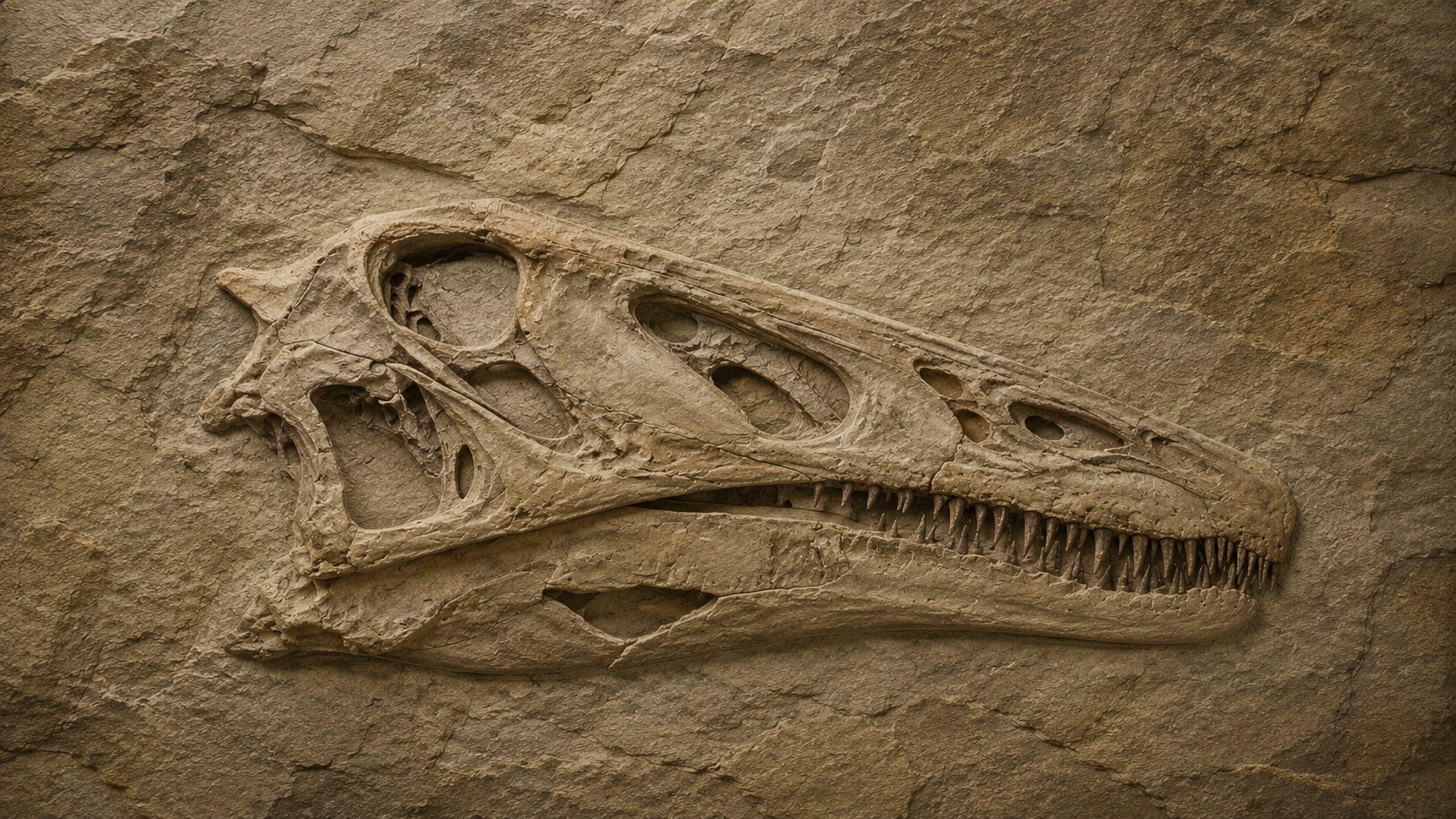
The governments of Brazil and Germany jointly announced the return of the dinosaur fossil to Brazil Irritator challengericonsidered one of the most important paleontological specimens ever found in the country. The fossil had been in the State Museum of Natural History in Stuttgart, Germany, for more than three decades, after having left Brazil irregularly.
The decision was received with enthusiasm by the Brazilian scientific community. In a statement, the Brazilian Society of Paleontology classified the restitution as a “historical milestone” that goes beyond the scientific field and reinforces principles of sovereignty and international cooperation.
According to the entity, the return of the fossil represents not only the recovery of a national heritage, but also an advance in global discussions about the permanence of cultural and scientific assets in their countries of origin.
The coordination involved Brazilian researchers, federal universities and Brazilian government bodies, such as the Ministry of Foreign Affairs. Specialists from the Plácido Cidade Nuvens Museum of Paleontology, the Regional University of Cariri (URCA), as well as researchers from the Federal University of Piauí (UFPI), the Federal University of Rio Grande do Norte (UFRN) and the Brazilian Society of Paleontology participated in the negotiations. An open letter signed by around 260 experts was sent to German authorities, while an online petition gathered approximately 35,000 signatures in support of repatriation.
There is still no official date for the return of the specimen, but the expectation is that it will be taken to Ceará, where it will form part of the collection of the Plácido Cidade Nuvens Museum of Paleontology, in Santana do Cariri.
The case reignites the debate about the presence of Brazilian fossils abroad. According to researchers, hundreds of holotypes – fossils used to officially define a species – remain outside the country, many of them removed irregularly.
The repatriation of Irritator challengeri occurs a few years after the return of the Ubirajara jubatusanother Brazilian dinosaur illegally taken abroad and returned to Ceará in 2023.
Who was the Irritator challengeri
O Irritator challengeri was a carnivorous dinosaur from the spinosaurid family that lived approximately 110 million years ago, during the Early Cretaceous period, in the Chapada do Araripe region, in Ceará.
The animal was between 6.5 and 8 meters long, with an estimated height of between 2 and 3 meters and a weight that could reach two tons. Its elongated and narrow skull had conical and straight teeth, characteristics adapted to capturing fish and other aquatic prey.
The dinosaur’s name came from an unusual episode. When foreign paleontologists analyzed the fossil in 1996, they discovered that parts of the skull had been adulterated with plaster and other materials by illegal traders to make the piece appear more complete and valued on the market.
The discovery provoked irritation among researchers, giving rise to the name “Irritator”. The term “challengeri” refers to Professor Challenger, a character created by Arthur Conan Doyle in The Lost World.
The fossil was acquired by the German museum in 1991 through a private dealer, contrary to Brazilian legislation from 1942, which establishes that fossils found in the national territory belong to the State and cannot be sold.
Importance of the fossil
O Irritator challengeri It has exceptional scientific importance because it is a holotype – that is, the physical specimen used as an official reference for the description of a new species.
In paleontology, holotypes have unique value. They serve as an international scientific standard for future studies on that species. Therefore, Brazilian legislation determines that national holotypes cannot remain permanently stored abroad.
In addition to its taxonomic value, the fossil is also relevant for understanding the Chapada do Araripe ecosystem during the Cretaceous. In Paleontology, the geological context in which a fossil is found is almost as important as the specimen itself, as soil layers preserve information about climate, fauna, flora and environmental conditions from millions of years ago.
In the case of Irritatorpart of this information was lost because the material would have been removed without adequate scientific records, possibly during limestone mining activities in the Araripe region, on the border of Ceará, Pernambuco and Piauí.