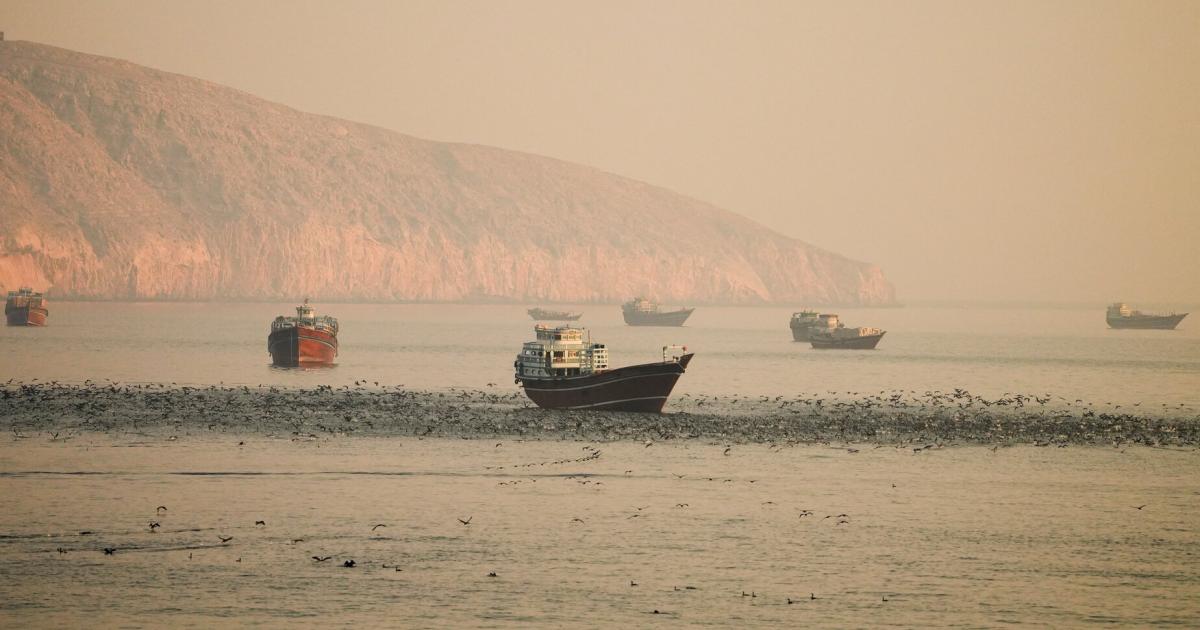
The Europeans’ offer to take part in a “purely defensive” mission to secure the Strait of Hormuz to participate suggested. Donald Trump energetically at the G7 summit in Évian-les-Bains. This help will not be needed, he said alongside the host Emmanuel Macronthe strait is already partially open, and on Friday, when the US and Iran want to sign an agreement to end the war, “it will be fully open,” the US president promised.
The price for Brent crude oil fell on Sunday to its lowest level since the start of the war (80 US-Dollar per barrel) even before Trump’s announcement was even remotely confirmed.
Several ships passed through the strategically important strait on Tuesday, including individual Iranian oil tankers and at least three container ships. However, there were no more than in the last few 108 days since the beginning of the US and Israeli attacks on Iran.
The ship tracking site Portwatch According to around February 28th and June 1st 670 ships crossed the strait – between six and seven per day, whereas before the start of the war there were up to over 100. Both Iran and the USA announced on Tuesday that they would no longer block free passage. However, that by no means means that the economic crisis, triggered by the oil shortage and the resulting skyrocketing global energy prices, will be over on Friday.
Destroyed trust
Over 400 cargo and tank ships sit in Persian Gulf firmly. They are all waiting to cross the strait. But the shipowners will only start transit when they are sure that the agreement between the USA and Iran will hold, it quotes Financial Times Jotaro Tamurathe head of Mitsui OSK Lines (MOL), one of the largest shipping companies in the world based in Tokyo. Safe passage is currently anything but guaranteed. Too often, Trump announced ceasefires – which were then broken by both sides. Other shipping companies are similarly cautious. The Hamburg container shipping company Hapag-Lloyd called the agreement “encouraging”; one hopes loudly FT that the stuck ships could leave “on the weekend”.
Still others spoke of wanting to wait at least a few weeks. This is also due to the still extremely high priceswhich shipping companies favorable to Iran have been able to charge in recent weeks for a risky passage. According to experts, it will take at least two to four weeks of trouble-free transit before trust is restored and prices begin to fall significantly again.
Fear of mines
And then there is also the worry Semiticwhich Iran may have laid in the strait. This is contradicted by the fact that ships passing through the strait in recent weeks have not encountered any mines. However, Tehran has both minelayers and at least 5,000 mines of various kinds, US intelligence agencies estimated before the start of the war: from small variants that float just below the surface of the water to booby traps that are anchored to the sea floor and use sensors to detect targets. Modern mines in particular are much more difficult to find and clear.
The USA uses drones in the air and under water, unmanned minesweepers, diving robots, but also divers; Trump has rejected help with the evacuation offered by France, Great Britain and Germany.
Ultimately, other essential questions will only be addressed in the 60 days after signing negotiated – for example whether Iran, which announced its demand on Sunday through the spokesman for its Foreign Ministry, will have regulatory sovereignty over the bottleneck together with Oman, and in future instead of tolls Dues may charge for “maritime services”. No matter what you call the fees, they are “a dangerous precedent for sea routes that are very difficult to navigate,” legal expert Marc Weller from the London think tank Chatham House is quoted as saying.
Oil will not flow quite as quickly as the US President promised “on both sides for the region and the world.”
https://spinpolo.eu.com/
https://spinpolo.casino/
https://spinpolo.org/
https://polospin.eu.com/
https://polospin.org/
https://gangbob.bet/
https://gangbob.casino/
https://gangbob.eu.com/
https://gangbob.gb.net/
https://kenspin.gb.net/
https://kenspin.eu.com/
https://kenspin.casino/
https://spinkings.eu.com/
https://spin-kings.gb.net/
https://spin-kings.eu.com/
https://solverde1.com/
https://zoccer.biz/
https://zoccer-casino.eu.com/
https://zoccercasino.us.com/
https://duff-spin.gb.net/
https://duff-spin.gb.net/login/
https://duff-spin.gb.net/bonuses/
https://duff-spin.gb.net/app/
https://duff-spin.gb.net/casino/
https://duff-spin.eu.com/