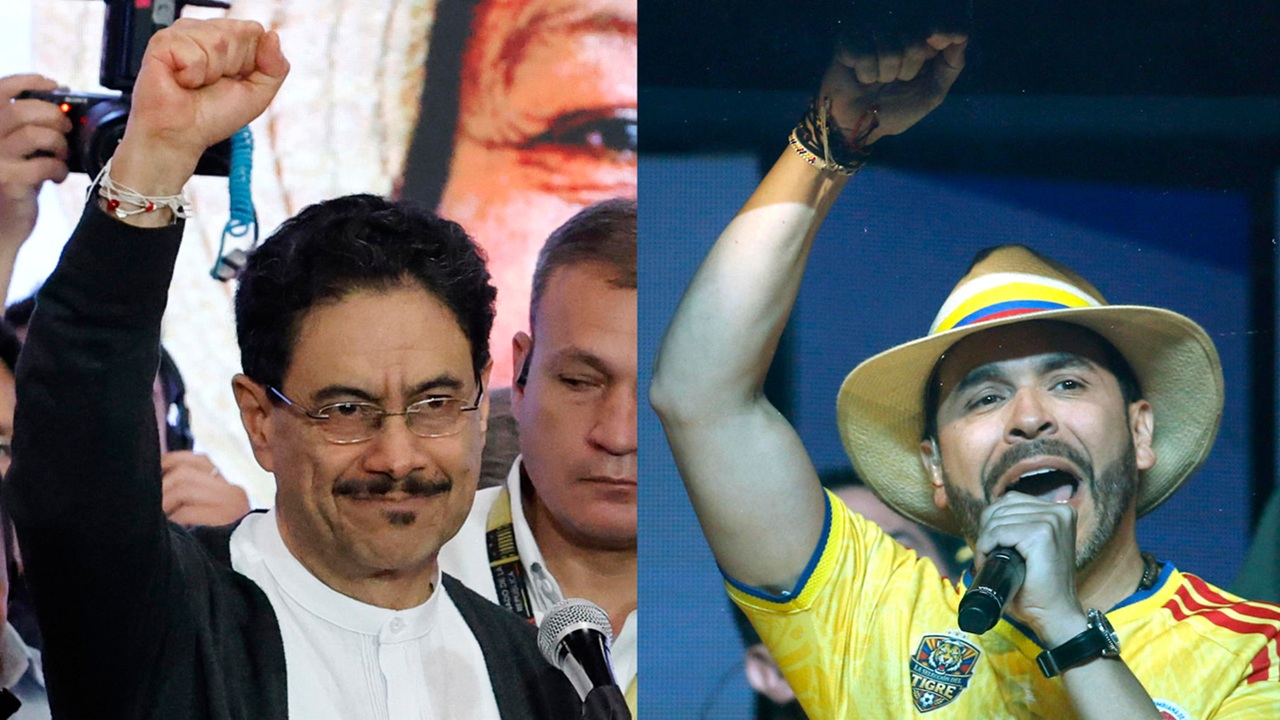
This Sunday (21), Colombia holds the second round of its presidential election, with left-wing senator Iván Cepeda, a candidate supported by President Gustavo Petro, and right-wing nationalist lawyer Abelardo de la Espriella in the race.
Although the two candidates have wide divergences on almost everything, from foreign policy to the economy, polarization at an unprecedented level in elections in Colombia is fueled mainly by public security, the main concern of the Colombian population.
In this sense, the Colombian government’s peace pact with the guerrilla group Revolutionary Armed Forces of Colombia (FARC), which celebrates its tenth anniversary in 2026, has great influence.
Cepeda, who was a human rights activist before entering politics, worked in peace negotiations with the FARC and the National Liberation Army (ELN) – these, without results for now – and defends the continuity of Petro’s Total Peace plan, which seeks agreements with other guerrilla groups.
Espriella, on the other hand, is totally against other commitments with the guerrillas, as he understands that they do not solve Colombia’s security problems.
In a statement, his political movement, Defensores da Pátria, said that the only action that yielded results was confronting these groups.
“As for the rest, what came after — from the pact with the FARC to concessions disguised as dialogue — was a parade of impunity,” he argued.
“Colombians cannot continue paying with their own blood for the failed experiments of weak governments. The time for pacts with criminals is over. The time has come to impose order, to recover honor and to protect the millions of citizens who only ask to live without fear”, added Defensores da Patria.
As proof of this polarization, the Colombian right accuses Cepeda of links with the FARC and guerrilla dissent that did not adhere to the 2016 agreement, while the left alleges Espriella’s links with the paramilitary groups that face the guerrillas.
Judging by the right-wing leadership in the polls, a large part of the Colombian population agrees with the view that the agreements with the guerrillas have not yielded results.
According to data from the World Bank, although the homicide rate per 100,000 inhabitants in Colombia is no longer in the 70 range recorded in 2001, when the guerrillas were at the height of their power, the country has stagnated at the very high rate of 25 murders per 100,000 inhabitants in recent years.
The World Health Organization (WHO) considers that rates above ten constitute epidemic violence.
SEE ALSO:
-
Petro disobeys Colombian court order prohibiting him from carrying out electoral propaganda
-
Right-wing candidate denounces threat from armed groups against his voters in Colombia
Another factor is that high-profile crimes attributed to guerrillas have once again frightened the Colombian population.
Senator and presidential candidate Miguel Uribe Turbay, from the conservative Democratic Center party, was shot in June last year in Bogotá and died from his injuries two months later.
The execution was attributed to guerrilla groups, as was a bomb attack in the department of Cauca in April, which killed 20 people and injured 36 others.
“The peace process (with the FARC) opened up a lot of ground for the left. In this sense, inevitably, it also opens up for the right,” said political scientist Sandra Borda, professor at the University of the Andes, in an interview with CNN en Español.
“Security is one of the clearest dividing lines in the campaign. The opposition points out that the deterioration of the security situation is the responsibility of the government, which allowed the strengthening and expansion of illegal actors, since, according to it, (the Total Peace plan) is a disjointed, disorganized peace effort”, said the analyst.
Analyst says that the election in Colombia is a “plebiscite on security”
In an interview with People’s GazetteAdriana Melo, an expert in finance and taxation, stated that the Colombian election “has become a plebiscite on security: negotiate or repress”.
“Iván Cepeda represents the continuity of the logic of Petro’s Total Peace, with negotiations with armed groups and a focus on reintegration, social reforms and the presence of the State. Abelardo de la Espriella, on the opposite extreme, transformed public security into the axis of the campaign, defending a harsh offensive against guerrillas and criminal groups, including mega-prisons”, said the expert.
“The problem is that, ten years after the agreement with the FARC, the promise of pacification was incomplete. Dissent, ELN, drug trafficking and illegal economies continued to occupy spaces where the State did not reach”, added Melo.
The expert stated that American President Donald Trump’s support for Espriella – denounced by Petro as an attempt at “interference” – also reflects this polarization regarding negotiations with the guerrillas, as Colombia must choose between “remaining closer to Petro’s agenda or returning to a tougher, pro-security route closer to Washington”.
“Security, in Colombia, is not just an electoral agenda. It is part of the people’s memory, a shared trauma, synonymous with drug trafficking and now adds geopolitics and dispute over what type of country should emerge from the post-FARC”, said Melo.
Also to People’s GazetteVictor Missiato, history professor at Mackenzie Tamboré and political analyst, stated that the issue of security has become “something very sensitive for the (Colombian) population given the increase in attacks, given an election in which we had the death of a candidate for the presidency of the Republic during the process of forming the tickets” – in reference to Uribe Turbay.
“And in light of this, the more (there is) a speech (by Espriella) aimed at non-negotiations with guerrilla groups, towards an intensification, towards a strengthening of State power in relation to this, especially with the example of what has been happening above Colombia, in El Salvador (with President Nayib Bukele), this makes this polarization more latent in a second round, where there are two very different projects for negotiation, for the transformation of public security in Colombia”, added the expert.
URSTYLE
Cc7H1629I
13352923 Tendencias Actuales En Juegos De Casino Online Lo Que Mas Interesa A Los Jugadores Hoy
Hilo | Verbling
Como Descubrir Nuevos Deportes Puede Hacer Mas Interesante Una Plataforma De Apu
3Kjxihka
Political Science Rumors – Forum for Political Scientists
Political Science Rumors – Forum for Political Scientists
Hilo | Verbling
How intuitive navigation improves the experience on online sports platforms – El Cuaderno
¿Por qué algunos usuarios permanecen años en la misma plataforma online? – Huayra
Forum Thread
User Desjardins
gojowe (@gojowe) | AllMyLinks
Cómo la personalización mejora la experiencia – Simpson Fly Fishing
54587 Mensaje De Visitante De Xifere
Online Platforms
Experiencia de apuestas deportivas con enfoque más estratégico – Simpson Fly Fishing
Como La Rapidez De Carga Influye En La Comodidad De Juego En Casinos Online
Political Science Rumors – Forum for Political Scientists
Qué hace interesante una plataforma de apuestas deportivas en el mercado digital actual
Probando https://doradobetappnicaragua.com/me en…
Por que la informacion en tiempo real es clave en las apuestas deportivas modernas – Champ – Forums for Shopify
after | newline
13351501 Como La Variedad De Juegos Influye En La Experiencia De Los Usuarios En Casinos Online