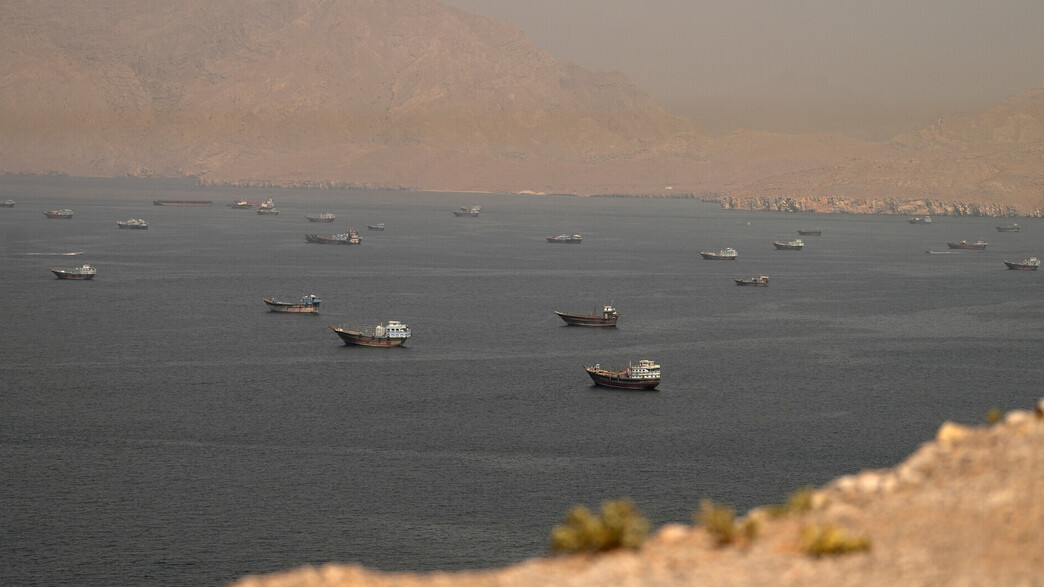
The hundreds of ships that have been stuck in the Persian Gulf for 3 and a half months will begin to make their way out
The International Maritime Organization of the United Nations (between Tuesday and Wednesday) announced a plan to evacuate the 11,000 sailors trapped in the Persian Gulf following the war between the United States and Iran. The announcement comes against the background of the agreement between Washington and Tehran, which includes the opening of the Strait of Hormuz three and a half months after it was closed to traffic by the Iranians.
Secretary General of the organization Arsenio Dominguez said that the “large-scale operation” will be carried out in cooperation with Iran, Oman, the USA, and the shipping industry. “We have obtained the necessary safety guarantees and conducted a comprehensive review of the conditions for safe sailing to support these operations,” Dominguez added. The announcement signals that the UN and the countries of the region will increase traffic in the Strait of Hormuz, which remained scarce in the first days after the signing of the memorandum of understanding.
According to the UN’s estimate, about 600 ships are stuck in the area following the war, while according to the data of the maritime surveillance company Kpler, at least 172 vessels have passed through the Strait of Hormuz, which has been reopened to traffic. As part of the UN’s plan, it will be possible to use two shipping lanes through the Strait of Hormuz, in coordination with Oman.
The coordination meeting between Iran and Oman
The Strait of Hormuz is indeed open now, but its future is still shrouded in fog. According to the memorandum of understanding between the US and Iran, the strait will be open to traffic without fees for only 60 days, after which Iran and Oman will determine the future of transit through it, in coordination with the countries of the region. However, President Trump made it clear in a public post after the signing of the agreement that “there will be no fees in the Strait of Hormuz even after 60 days, unless the US collects them.”
Against the background of the apparent dispute regarding the future of the strait, Oman and Iran agreed yesterday to continue discussions on the management of future shipping in the region, including the maritime services in the strategic passage and the costs involved. The two countries, between which the Strait of Hormuz passes, emphasized in the official statement their commitment to ensure safe passage through the strait in accordance with international law, and at the same time emphasized their sovereignty over their territorial waters.
In a joint statement issued after the talks in Muscat, the two countries said that a joint working group would be established with the participation of their foreign ministries to continue the discussions, and that they would hold consultations with other coastal states in the Gulf and with other relevant parties. In recent weeks it has been reported that Oman is also open to the idea of collecting money for crossing the Strait.
Collecting payment from ships passing through the Strait of Hormuz is contrary to international law and is expected to arouse strong opposition from many countries. Also, such a move is expected to increase the prices of goods, and to mark Iranian control of the strategic sea passage.
The Prime Minister of Qatar was present in Muscat today to promote the continuation of talks between Iran and Oman and the Gulf countries. A diplomatic source told Reuters that the Gulf countries are expected to push for a situation where tolls will not be charged for crossing the strait, but according to him Iran is expected to propose collecting an environmental and security toll.
The same diplomat emphasized that the talks between Iran and the Gulf countries and Iraq regarding Hormuz are separate from the talks between it and the US – and focus on the operation of the strait in the future. He emphasized that there are already plans to hold separate regional reconciliation talks between Iran and the Gulf countries – and they will be held in Riyadh, the capital of Saudi Arabia.
aifootballpredictions | Portfolium
Issuedetail.Aspx
Page5
The best football matches – Kenzer & Company
The Role Of Machine Learning In Modern Football Forecasting
Note : Assessing the Reliability of AI-Generated Football Predictions
football/soccer – Sports Forum | SpaceHey
Ai And The New Frontier
Bella (@[email protected])
Decoding the Pitch: The Rise of Data in Football Match Previewing
Are.na
Beyond Guesswork – How AI Is Changing Football Predictions Football has alwa…
Smarter Football Insights – The Role of AI in Modern Predictions
Football Predictions in the Age of AI A Different Perspective by Stan
Evernote
deck: Slides
HedgeDoc – Collaborative markdown notes
Impartiality as the Supreme Value in Sports Forecasting
DisplayLink Feature Suggestions: Hot (626 ideas) – DisplayLink Support
The Intellectual Duelist: AI Against the Bookmaker's Margin
Issuedetail.Aspx
Beyond Intuition: Why Algorithms are Winning the Football
Home.Php
Guliatra's Blog – Community – The Sims 3
Guliana's Profile – wallhaven.cc