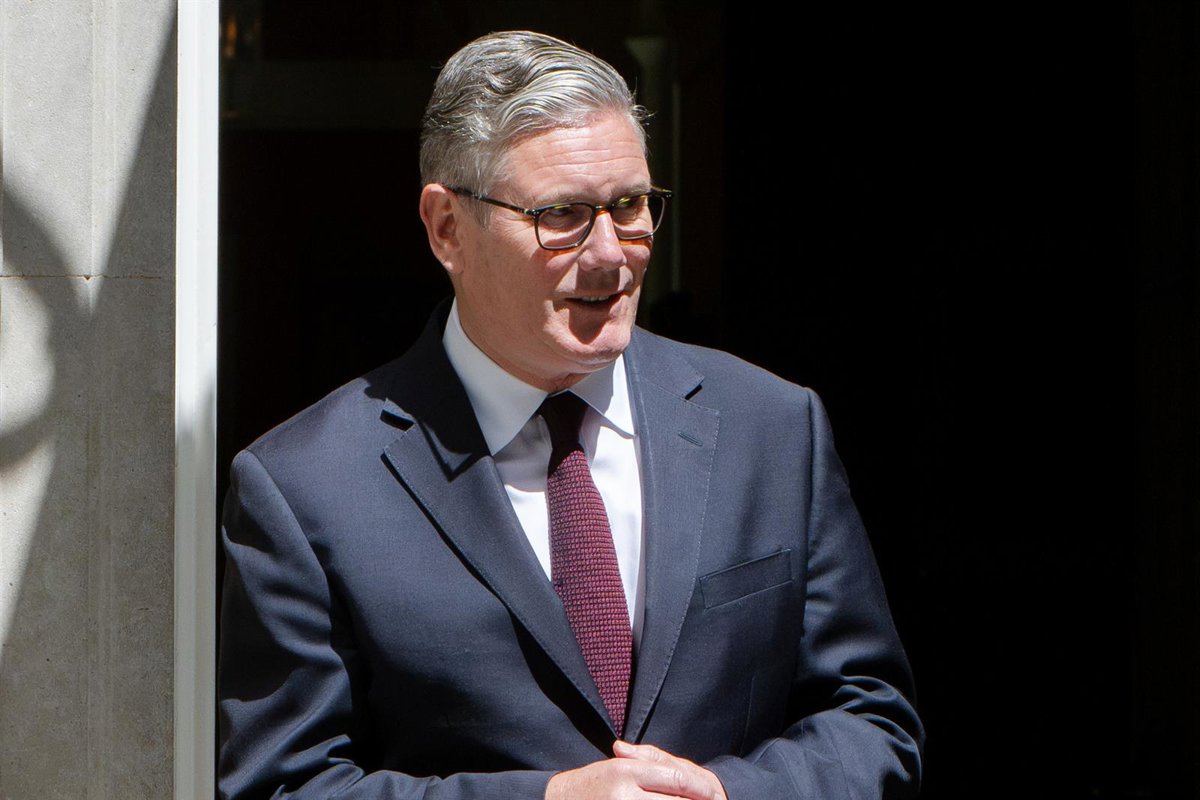
The Prime Minister of the United Kingdom, Keir Starmer, presented this Tuesday the long-awaited military spending plan with which he hopes to raise more than 15 billion pounds (more than 17 billion euros) and will place the United Kingdom at 4.2% of GDP in military investment, close to the 5% committed last year at the NATO summit.
“We are already carrying out the largest sustained increase in defense spending since the 1980s (…) I can announce that, within the framework of the Defense Investment Plan, we will increase that figure by 15,000 million pounds, establishing a new investment record,” indicated the British ‘premier’ in an event with which he unveils a program that the United Kingdom wanted to launch before the NATO leaders’ summit in Ankara next week and which is preceded by controversy over the disagreements with former Defense Minister John Healy that led him to resign.
Starmer’s plan, who will leave office in the summer after announcing his resignation cornered by internal pressures in the Labor Party, will involve 300 billion pounds (about 348.29 billion euros) over the next four years in spending “to support the Armed Forces and reinforce national security.”
In response to the debate regarding the plan’s figures, after Healy criticized that the program was insufficient, he defended that a 27% increase in the budget is planned until 2029 and will raise military spending to 2.7%, “a trajectory that will allow it to reach 3% in the next legislature.”
In any case, regarding total spending on defense and security issues, taking into account that NATO’s military spending parameters include investments in infrastructure and energy security, this plan places the United Kingdom at 4.2% of that commitment, as Starmer has defended. “From any point of view, this is a historic change of enormous magnitude for our country, a legacy of which I am proud,” he said.
The Labor leader has framed this military increase plan in reinforcing deterrence against the security threat represented by “foreign states” that have the country as their “objective.” “Thugs hired by foreign powers commit acts of violence, vandalism and arson in our streets; disinformation campaigns seek to sow division and fuel disorder, spreading lies and undermining our democracy,” he listed.
In this sense, he has stressed that the “paradox of peace” is that “the best way to avoid a war is to prepare for it”, stressing that on the international stage there is rearmament and that “aggression is increasing.”
In any case, the plan comes at a time of political uncertainty and when Starmer has announced his resignation, which will take effect in a matter of weeks when the Labor primary process concludes. Asked if he has consulted this program with his possible successor, Andy Burnham, he has avoided giving details and has limited himself to saying that no one disputes that the review of military investment was necessary.
“Any prime minister will want to know what capabilities he has at this time and any Labor prime minister would want to support it,” he indicated, reiterating that “the first duty” of any leader is to “guarantee the defense and security of the country.”
INVESTMENT IN NAVY, FIGHTERS AND NEW TECHNOLOGIES
In any case, the British Prime Minister has framed this program in the country’s security needs, insisting that it “will make the British people safer.” “It will concentrate our resources where they matter most,” he stated, after claiming that it will promote a “generational transformation” of the British Armed Forces.
In the effort to “modernize and equip” the Army, the purchase of at least six ‘hybrid’ warships is planned to train the Navy in capabilities to coordinate unmanned systems in the air, on the surface and under the sea to provide more resilient air defense. In addition, it has pointed to the construction of new submarines or the development of a new British-made nuclear warhead as new deterrent elements for British forces.
Likewise, in terms of the Air Force, it has confirmed the forecasts of acquiring twelve F-35A fighters. “We will maintain our role in guaranteeing the security of the United Kingdom and Europe, and we will leave our country in a much more solid and secure position,” he concluded.