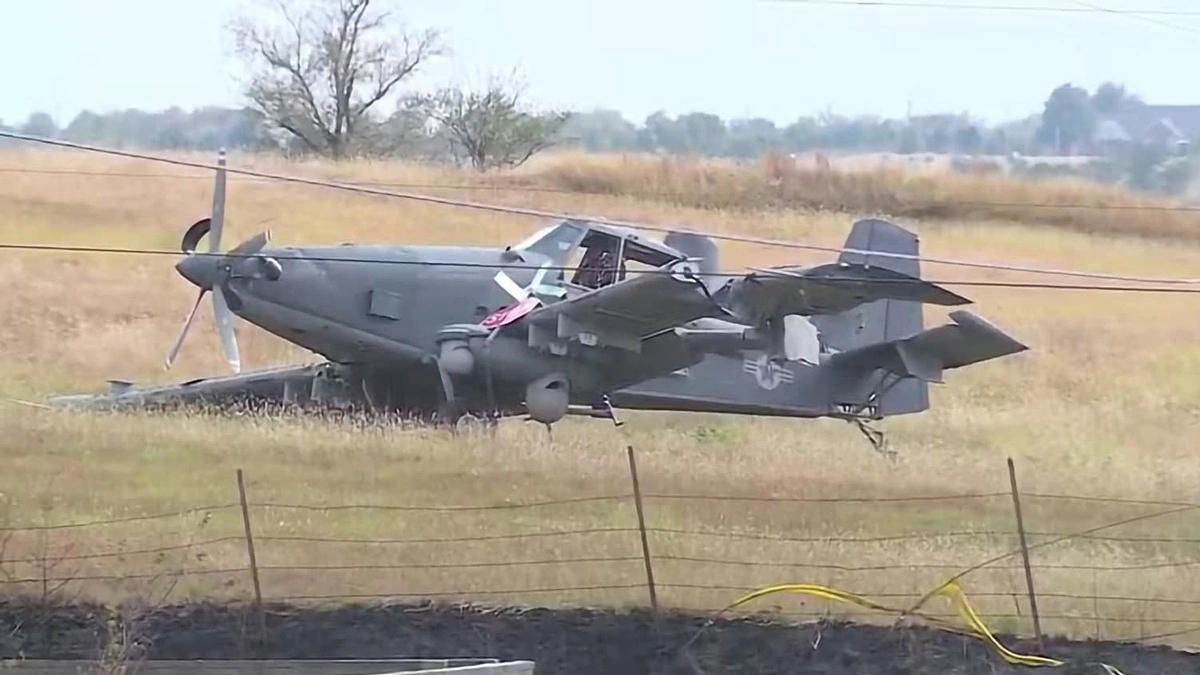
The pilot mistakenly locked the fuel supply valve for the engine, instead of the oil tank valve, causing the OA-1K fighter to make an emergency landing and completely fail in October 2025.
On October 23, 2025, an OA-1K Block 1 attack of the US Air Force had to make an emergency landing in a field near Oklahoma City while on a training flight. The plane almost hit a moving car, then hit two electric poles and caused a small fire on the lawn. The crew of two escaped safely.
The Accident Investigation Board (AIB) of the US Air Force on June 29 published an investigation report, which concluded that the incident was due to the pilot “mistakenly closing the fuel supply valve for the engine, instead of the oil tank valve in the body”.
The oil tank valve in the fuselage allows the pilot to choose to get fuel from the fuselage or wing compartment when flying, while the engine fuel supply valve will completely cut off the oil supply to the engine to extinguish fires or prevent explosions in the event of an incident.
The moment the OA-1K plane almost hit a car in October 2025. Video: X/OSINTdefender
On the day of the accident, the OA-1K departed from Will Rogers International Airport. The student pilots sitting in the front cabin are active duty military personnel, while the student pilots in the back cabin are civilian contractors acting as trainers. After takeoff, the aircraft maintained an altitude of about 1,000 m and began conducting checks during the cruise flight phase.
During this process, the instructor asks the student to open the fuel tank valve in the fuselage to check system function. “However, the student accidentally turned the engine fuel supply valve control lever to the off position, instead of turning the fuel tank valve control lever to the open position,” the report said.
This operation interrupted the fuel flow to the engine, causing the OA-1K to stall in the air. The student pilot realized the mistake after about 4-5 seconds and reopened the valve, but did not notify the instructor who was at the wheel to respond to the incident.
Investigators noted that the engine fuel valve control and fuel tank valve were painted different colors to distinguish, but were only located about 12 cm apart. On the OA-1K Block 1 variant, the throttle lever in the pilot’s left hand is also made larger than the Block 0 variant, causing it to obscure the fuel tank valve control lever.
Control lever for engine fuel valve (circled in red) and oil tank valve (circled in white) in the OA-1K cockpit. Image: USAF
“The student pilot mistook the control lever while performing the check process and accidentally cut off fuel to the engine. This person then looked to the other side of the cockpit to handle the communication problem,” AIB said.
AIB identifies a range of human factors that contribute to accidents, including work overload. When taking off and gaining altitude, students must perform many tasks such as communicating with the ground, activating the autopilot, checking the system and troubleshooting radio problems with the instructor.
“Communication problems aggravated the situation. The trainee did not notify the instructor about the radio malfunction, as well as reopening the engine fuel valve after closing it by mistake. As a result, the instructor did not understand exactly what caused the OA-1K to stall,” AIB said.
The investigation concluded that the flight crew prioritized intervention in the fuel supply system, issued a distress signal and prepared for an emergency landing, instead of implementing the Essential Action Procedures (CAP) developed for the engine restart scenario. They also did not adjust the propeller blade angle to reduce drag and maximize flight range while troubleshooting the problem.
“The aircraft was at an altitude of about 700 m, enough to carry out such response procedures,” AIB said.
The incident caused the OA-1K to be damaged beyond repair and scrapped, with an estimated loss of $17.9 million.
OA-1K attack after emergency landing near Oklahoma City on October 23, 2025. Image: KOCO 5 News
The OA-1K light attack was built by order of the US Special Operations Command (SOCOM) to perform reconnaissance and ground attack missions, based on the Air Tractor AT-802 agricultural aircraft.
Each aircraft has an estimated factory price of 15-17 million USD. However, the actual cost can be up to 27-40 million USD per unit if long-term contracts with the manufacturer are included, including spare parts guarantees, installation of secret equipment and maintenance packages, maintaining operations lasting many years.
The OA-1K has a maximum speed of nearly 400 km/h when not carrying weapons, a cruise speed of 330 km/h, and a flight range of more than 2,400 km. The aircraft is equipped with 10 pylons to carry AGM-114 Hellfire missiles, APKWS laser-guided rockets and GBU-12 Paveway II guided bombs.
As of May, manufacturer L3Harris has built a total of 18 OA-1Ks.