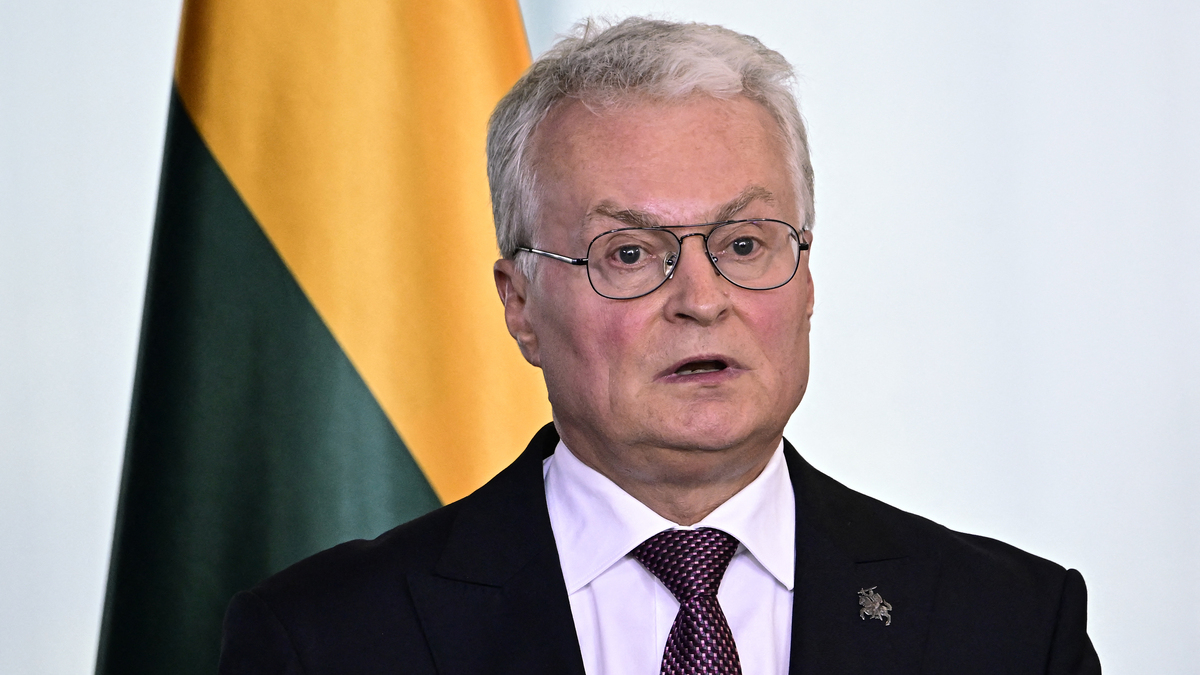
Lithuanian President Nauseda left open the possibility of allowing Western countries to deploy nuclear weapons in the country for the purpose of deterring Russia.
“We want to become an integral part of this nuclear deterrence,” Lithuanian President Gitanas Nauseda said at a press conference in Berlin, Germany, on July 3, adding that he had previously initiated a constitutional amendment to lift current restrictions on the ability to deploy nuclear weapons in Lithuania.
Immediately afterwards, a group of 50 Lithuanian parliamentarians submitted this amended bill. Amending the Lithuanian constitution requires approval twice by at least 94 of the 141 members of parliament, with an interval of at least three months between the two votes.
Mr. Nauseda said that Article 137 of the Lithuanian constitution, which prohibits the deployment of weapons of mass destruction and the establishment of foreign military bases on Lithuanian territory, has become “outdated” and “no longer relevant”.
“The geopolitical situation is deteriorating. Our Constitution was written when the geopolitical circumstances were completely different,” Mr. Nauseda said.
Lithuanian President Gitanas Nauseda in Berlin, Germany, July 3. Image: AFP
Similar to Lithuania, the Finnish parliament voted in June to lift the complete ban on nuclear weapons, aiming to bring the country in line with NATO’s deterrence policy after joining the alliance in 2023. This bill allows for the placement, transportation, supply or storage of nuclear weapons on Finnish territory when necessary for defense purposes.
Lithuania, a NATO and EU member country bordering Belarus and the Russian overseas territory of Kaliningrad, has paid special attention to security and defense after the outbreak of the Russia-Ukraine conflict in February 2022.
This is one of the countries that spends the most on defense in NATO in terms of economic proportion, spending more than 5% of GDP on defense annually. Lithuania is also home to NATO’s multinational combat group with a permanent brigade of up to 5,000 German soldiers.
Inconel 625 Buttweld Fittings
Monel K500 Buttweld Fittings
Stainless Steel 253Ma Buttweld Fittings
Stainless Steel 304 304L Buttweld Fittings
Stainless Steel 310 310S Buttweld Fittings
Stainless Steel 316 316L Buttweld Fittings
Stainless Steel 316Ti Buttweld Fittings
Stainless Steel 317 317L Buttweld Fittings
Stainless Steel 321 321H Buttweld Fittings
Stainless Steel 347 347H Buttweld Fittings
Stainless Steel 904L Buttweld Fittings
Super Duplex Steel Uns S32760 Buttweld Fittings
Astm A105 Flange
Astm A694 Flange
Duplex Steel Uns S31803 Flanges
Hastelloy B2 Flanges
Incoloy 800 800H 800Ht Flanges
Incoloy 825 Flanges
Inconel 625 Flanges
Inconel 718 Flanges
Nickel Alloy 200 Flanges
Smo 254 Flanges
Stainless Steel 316Ti Flanges
Super Duplex Steel Uns S32750 Flanges
Astm A105 Carbon Steel Forged Fittings