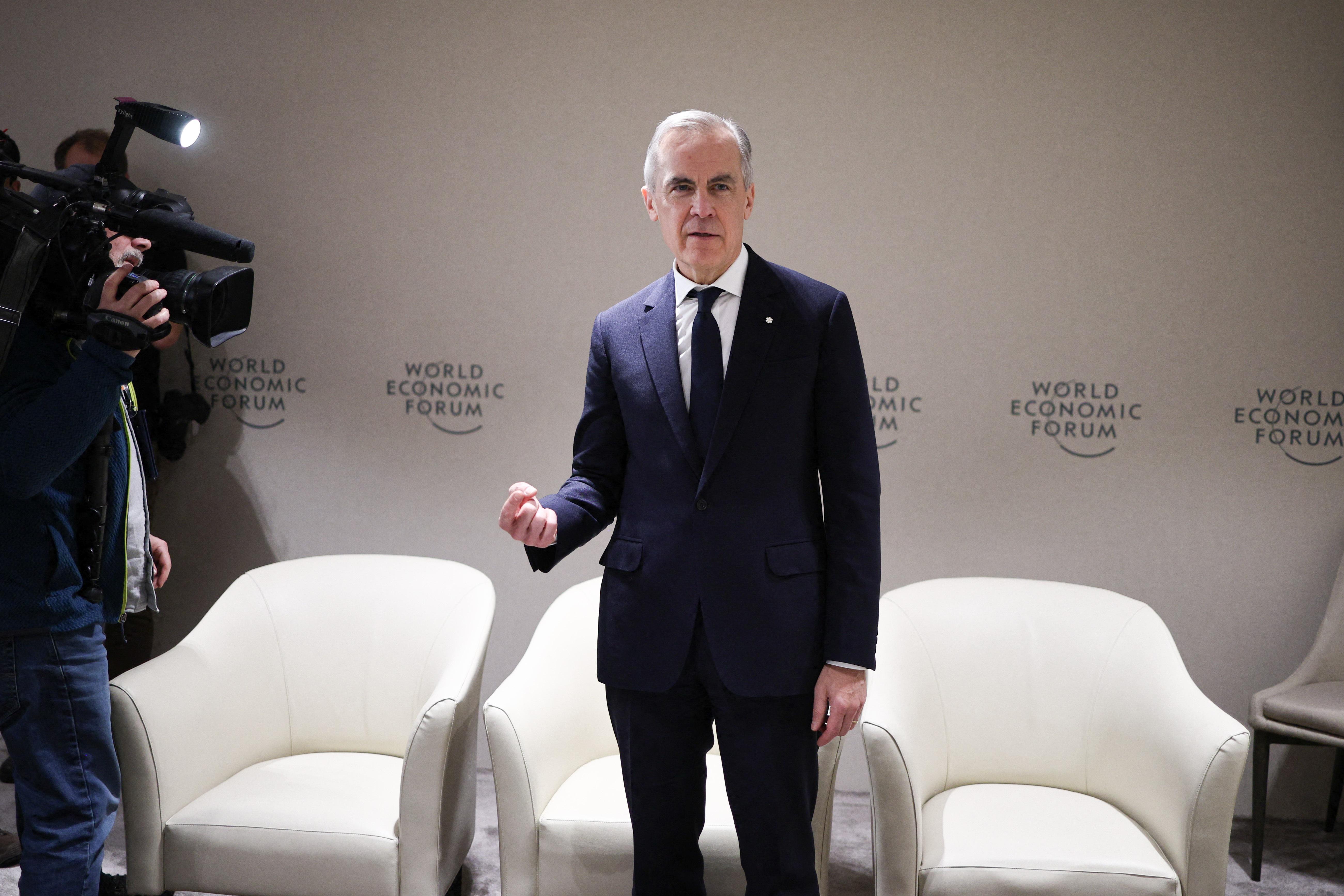
There is a phrase, pronounced by Canadian Prime Minister Mark Carney in Davos on January 20, which summarizes better than many analyzes the moment the international system is experiencing: the world has emerged from “a pleasant fiction” to enter “a harsh reality”, that of great powers acting with increasingly weaker constraints. Hence the prime minister’s appeal to the unity of the “intermediate powers”: “They are not powerless. They have the ability to build a new order that includes our values”.
A report, signed by Nobuto Sato, revolves around that diagnosis Jiji Pressone of the two main news agencies in Japan, distributed internationally through the “Japan Connect” service of AFPBB News, the newspaper launched in 2007 byAgence France-Presse. The document lists the symptoms of a crisis that is now difficult to classify as an economic situation. Competition between the United States and China would extend the battlefield far beyond the military, weaponizing tariffs, export controls, and supply chains. Meanwhile, multilateral institutions – led by the United Nations and the World Trade Organization – would slide into growing dysfunction, as the Trump administration continues on an isolationist course: exit from the Paris Climate Agreement, withdrawal from the World Health Organization, high tariffs eroding the post-war trading order.
The gap between institutions and reality
“Global governance is seriously shaken. I think it is a critical situation,” warns Kazuhiro Maeshima, an American politics professor at Sophia University in Tokyo, in the report. His interpretation is, so to speak, sociological before diplomatic: post-Cold War globalization would have widened inequalities, fueling the perception in public opinion that national wealth was flowing abroad. The reaction embodied by Donald Trump would be grafted onto that resentment, with “my country first” as the distinctive feature of an era that Maeshima defines as “post-post-Cold War”.
The diagnosis coming from Japanese diplomacy is not dissimilar. Ryo Nakamura, director general for global affairs at the Ministry of Foreign Affairs, identifies the crux in a structural gap: “While the international community has gone through profound transformations, the framework of international cooperation has changed very little, and the gap between that framework and reality has continued to widen.” The paradox, moreover, is evident: just as collective tools are weakening, the challenges that no State can face alone are multiplying – the climate, pandemics, terrorism, refugee crises, the regulation of artificial intelligence.
The price of the unit
The recent parable of the G7 also suggests that multilateralism survives at a high cost. The format has held up, but – according to the reconstruction of the Japanese agency – only by setting aside the divisive dossiers. “Keeping the United States at the table requires putting aside bigger issues like climate change and free trade,” observes Céline Pajon ofFrench Institute of International Relations (IFRI). Maeshima’s judgment is clear: “After having effectively reduced the G7 framework to a mere formality during his first administration, Trump is emptying it again in his second term.”
Japanese paper
It is in this void that the central hypothesis of the report is placed – and here the Tokyo agency does not hide its national perspective: Japan as a hinge. “It can leverage its unique position as an ally of the United States while being able to collaborate closely with European and Asian countries,” says Maeshima, who cites as an example Tokyo’s support for the UK’s accession to the Comprehensive and Progressive Agreement for Trans-Pacific Partnership (CPTPP), finalized in December 2024: the first European country to join the free trade agreement.
The evaluation finds support in Paris. Japan is “a democratic and politically stable country that has consistently defended and promoted multilateralism and liberal norms,” observes Céline Pajon, head of research on Japan and the Indo-Pacific at the Center for Asian Studies of the Institut français des relations internationales (IFRI), the main French think tank in the field. The scholar underlines its function as a link “between the American ally and the European partners”, as well as a stimulus to the opening of the G7 towards the Global South. Nakamura collects: “Japan has friendly relations with numerous countries. In multilateral relations we want to play a connecting role.”
Crisis or opportunity
The underlying question remains, the one that gives the title to the Jiji Press report: can global governance be reconstructed? The interlocutors interviewed do not grant easy optimism, but neither do they give up. Maeshima speaks of a “historic turning point for the order that the United States has dedicated itself to building”, to immediately add that “this is also an era in which global governance is truly necessary: we must transform the crisis into opportunities”, pushing for the reform of the United Nations and the World Trade Organization. Nakamura, for his part, indicates the political condition of the relaunch: “To obtain the understanding of public opinion we must demonstrate that promoting international and multilateral cooperation serves the national interest”.
This is perhaps the most revealing passage of the entire analysis. To survive, multilateralism must no longer justify itself to the chancelleries, but to the voters. “Multilateralism is not dead,” concludes Nakamura. “There is still a lot we can do.”
launceston-casino-online
About
CircuitVerse – pullman casino
pullman-casino
root by pullmancasino
pullmancasino – watch faces for Apple Watch, WearOS, Galaxy Watch, Pixel Watch, Huawei Watch, and more – Facer
Chordie Guitar Chords and Lyrics
264867
queensland
queenslandd (@queenslandd.bsky.social)
queensland casino | GAIN Power
Memberlist.Php
Tasmaniacasini
Tiltify – Made for Fundraisers
dfsino by Grace
tasmaniacasino's profile | Backloggd
tasmaniacasino
Townsvillecasino
townsville
townsville
townsvillecasino הפרופיל של — The Movie Database (TMDB)
BandLab – Make Music Online
Pump Your Sound
Caesarswindsor
Find A Spring – Members