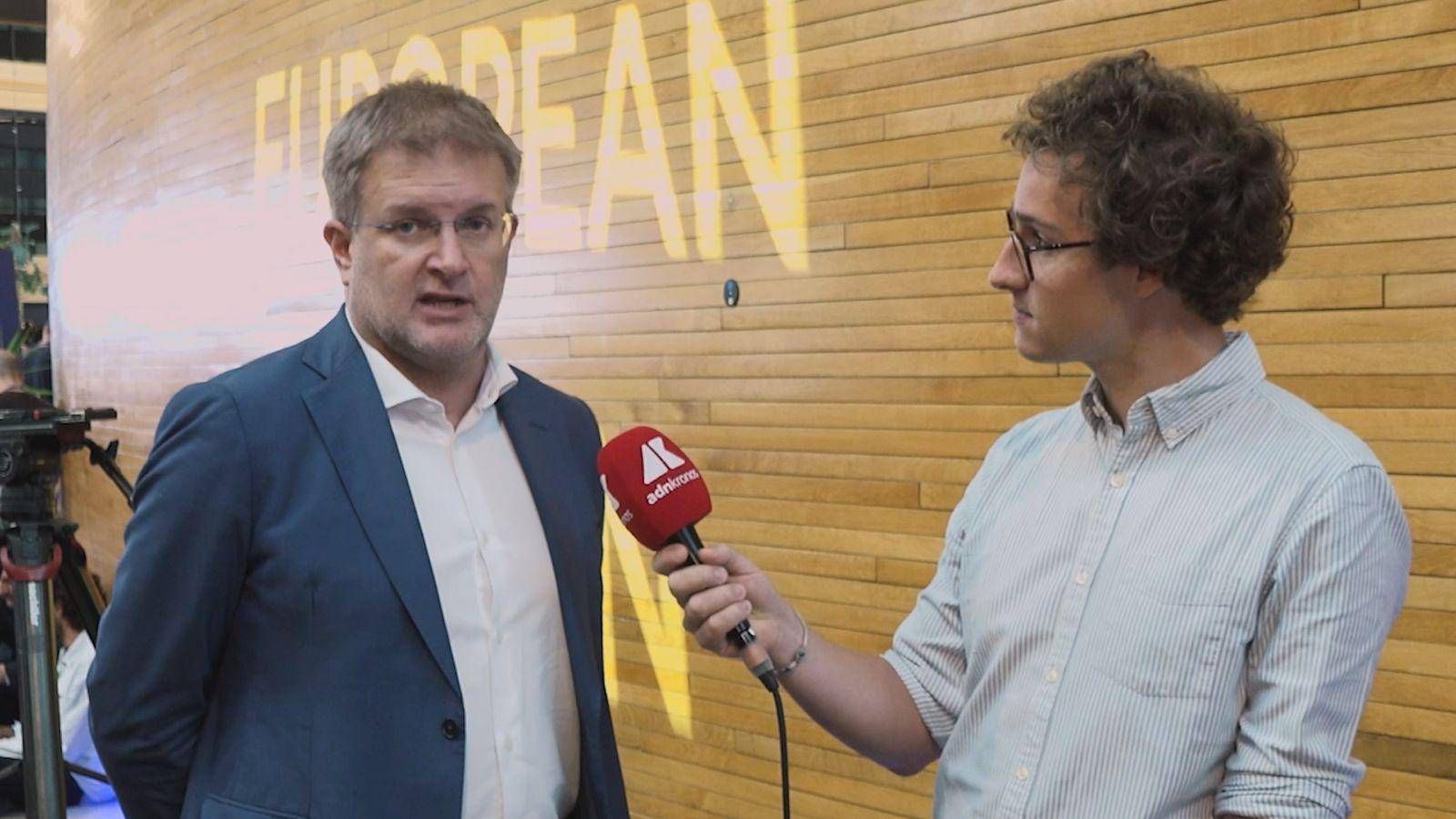
In her speech on the State of the Union, the President of the European Commission Ursula von der Leyen “confirms the line” dictated by the “alternative majority” in the European Parliament, made up of the People’s Party, the Conservatives and the groups to their right, regarding the dossier migration. This was declared by the head of the delegation of Fratelli d’Italia (Ecr) Carlo Fidanza on “Voci dal Parlament” ofAdnkronosoffering a positive opinion on the part of the speech relating to the chapter on migration, but overall “in chiaroscuro”.
“More disappointing is the part about competitivenessthe fight against industrial desertification, which is the slope on which Europe has dangerously headed due to excessive regulation and the follies of the Green Deal which are weighing down our industries and their competitiveness”, continues Fidanza, according to whom it was a “too mild” part of the speech.
“For us it represents the number one priority, because this means critical raw materials, it means energy, energy costs, energy infrastructure.” In short, everything that allows European companies to be more competitive and citizens to incur lower costs: “this was, I believe, the great unfinished business of this speech”, concludes the MEP.
Energy: “return to the language of the past”
The energetic chapter of the speech is precisely rejected by Fidanza, who defines it as “a return to the language of the past”. “It’s not good, because we have to push more in a direction in which the ecological transition must certainly take place, but keeping together the needs of our industries and their competitiveness“, he adds.
The MEP accuses von der Leyen of having focused “once again” on the topic of electrificationwithout specifying where the necessary electricity is produced from. “The answer to this cannot only be renewables, in which Italy has also invested, reaching a historic record under the Meloni government, regardless of what the left says.” Instead, we need sources that guarantee “stable flows”: for Italy, he explains, this means gas in the transition phase and nuclear in the medium term“the technical time it will take to achieve it”.
“Thinking of creating electricity from nothing or only with renewables is an ideological assertion, but it is not reflected in its concreteness”, says Fidanza. For the FdI MEP, von der Leyen’s speech on energy was “a tribute paid to the Greens and the left wing of the coalition in terms of narrative”, but without “any type of concreteness” and without a real answer regarding industrial strength: “the one that Europeans expect, which then means defending the work of Europeans, because without industry there is no work”.
Security Council and European army: “industry first”
On the defense front, Fidanza asks us to evaluate von der Leyen’s proposal to establish a with caution European Security Councilsupported by a consultation mechanism equivalent to NATO Article 4. For the FdI MEP, we must first worry about the development of European industrial capacity. “We must develop above all industrial capacity, the real lack that Europe has today“, he observes, underlining that the EU is dependent on extra-European military supplies which in some cases it cannot reproduce autonomously, regardless of how many European preference laws can be passed. From a complete industry also comes “the political capacity to make decisions”, he adds.
The rapid technological progress of modern warfare and the need to defend ourselves from threats such as drones therefore, according to Fidanza, take precedence over the “proclamations of new bodies, which lead us to imagine very large cooperations when instead the European industrial base that serves to substantiate that defense capacity is missing”.
As for the path towards a European army, the MEP believes that in this historical phase it should be configured as the sum of twenty-seven national armies integrated with rapid reaction forces and a shared military capacity. But above all, that “he cannot ignore being the European pillar of NATO“, where a “very strong technological integration already exists. It is enough to spend an hour in an Italian base to understand that our military now only speaks with NATO codes, and so do most of the other European countries, obviously, that participate in NATO”. The Alliance therefore remains the “essential framework of reference against which we must not create duplications, because we would spend money and create absolutely useless bureaucracies”.
“Canada? Friends but not at the expense of the USA”
Von der Leyen’s speech also touched on relations with the Canadato which the President of the Commission offered to become the first “associate member” of the EU. A proposal that Fidanza immediately defines as “a bit particular”. “I think that the EU, even when it proposes tools for greater integration with partners, should meanwhile maintain its European characteristic, that is, do so with countries that have at least a geographical, let’s say physical, affiliation to the European continent”. The cooperation relationship between the EU and Canada “is already very strong: it can be strengthened, but I believe that there is no need to do so with an association agreement”, he adds.
For the FdI MEP, the rapprochement between Brussels and Ottawa must not, however, come at the expense of the relationship with Washington. “We who are jealous guardians of the transatlantic relationship, and have also been so in moments of greatest tension with the United States in recent years, we wouldn’t want to then make a move with Canada at this stage to mean letting the United States go“, he states. “We need, with all the efforts that must also be made on the other side, obviously, to protect, defend, strengthen transatlantic relations with all of America, not just with one part of it”, he continues.
On a more strictly commercial level, Fidanza instead postpones the debate on the ratification at national level of Ceta, the EU-Canada agreement, to the future. “About this we will think concretely in the next legislaturerealistically: I don’t think there will be time at the level of the national Parliament to open this page before the elections”, he notes. The MEP underlines that the agreement, in force since 2017, “has already developed” its beneficial effects, but highlights some issues to be explored further: “I believe there is something to be explored in greater detail regarding what happened when the safeguards ended, for example on the issue of imports of Canadian wheat which brought about some imbalance in the market which had not occurred in the previous seven years, until there was protection.”
Ceta is in provisional application for all matters that fall under the exclusive competence of the EU, which has allowed the abolition of around 99% of pre-existing customs duties, bringing EU-Canada trade to around 130 billion euros per year, 80% more than in 2016. Some key sectors that fall under the competence of the member states, such as investment protection and the related system, remain excluded from the provisional application. jurisdiction, market access for investments and provisions on transparency of administrative procedures, review and appeal at national level.