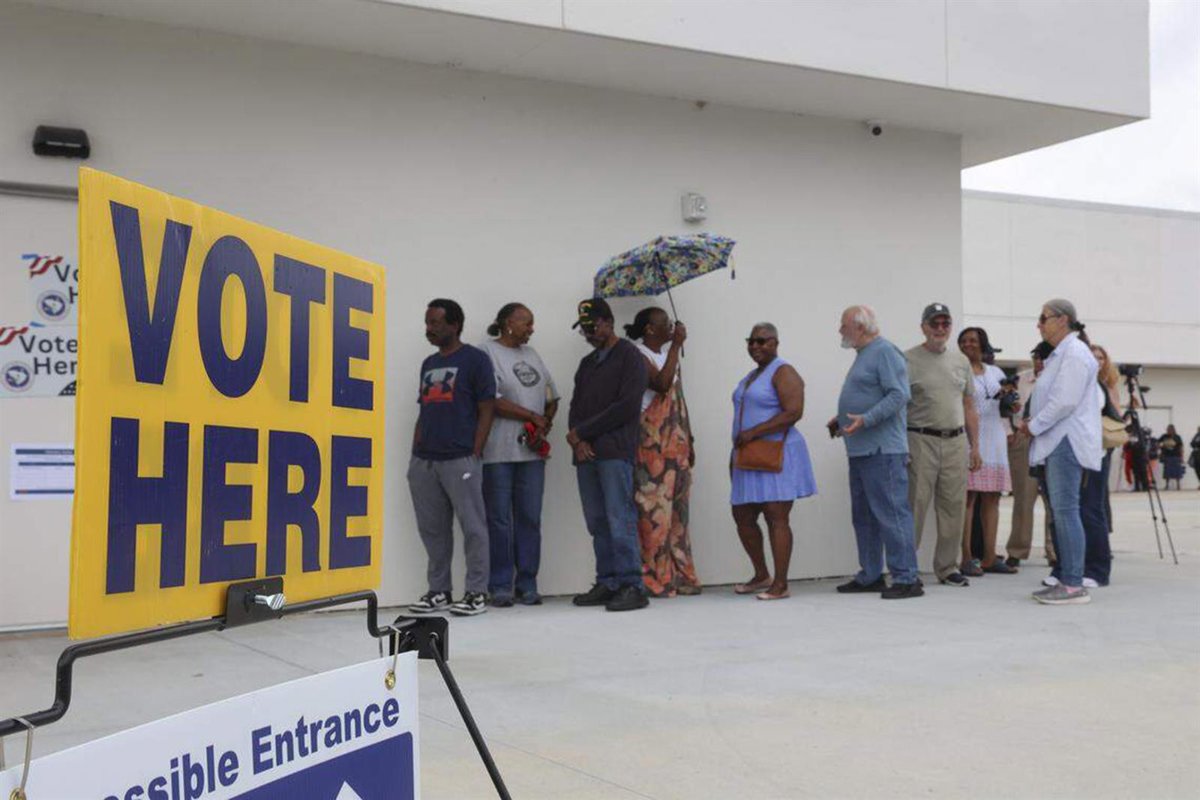
The latest ruling by the United States Supreme Court in the state of Louisiana has turned the classic partisan battle over the redistribution of electoral maps between Republicans and Democrats into a frontal attack against the Voting Rights Act of 1965, which shields the representation of black minorities at the polls.
The term ‘gerrymander’ – the political tactic of manipulating district boundaries – was popularized by a cartoon published in 1812 in the Boston, Massachusetts, press that depicted Essex County as a salamander. The drawing was a play on words to refer to Democratic-Republican Governor Elbridge Gerry, who that year signed a measure aimed at keeping his party in power after redefining the electoral map for the state Senate elections.
This practice, however, had already been established almost from the beginning of democracy, with the founding father Patrick Henry being one of the first to resort to it in order to guarantee victory against his rival, James Madison, in the first congressional elections in Virginia at the beginning of 1789.
In recent years, ‘gerrymandering’ has ceased to be a simple strategy to weaken the political rival and has become a geographical mechanism to dilute the vote of black minorities, fragmenting their districts or concentrating them in one to reduce their weight at the polls.
This has brought a long judicial queue in the courts, which have become the true battlefield in which the value of each ballot is decided, according to the Brennan Center for Justice, a think tank whose objective is to protect constitutional rights.
THE VOTING RIGHTS ACT OF 1965
The repression by the Police against black protesters in Alabama on March 7, 1965, framed in the protests promoted by the activist Martin Luther King, ended up precipitating the enactment of the so-called Voting Rights Act, described as one of the most important achievements of the civil rights movement.
The historic legislation, designed to force states to comply with the Fourteenth Amendments – which guarantees the equality of every citizen before the law – and the Fifteenth Amendments – which prohibits restricting voting based on race – allowed the elimination of discriminatory practices, such as literacy tests or the obligation to pay taxes to vote.
In 1982, Congress amended the second section to allow those maps that could dilute the vote of black communities to be challenged, although for years it has suffered numerous setbacks that have gradually dismantled its fundamental pillars.
One of them was the ruling of the Supreme Court in June 2013, which in practice annulled the fifth section, which requires states with a past of segregation and racial exclusion to obtain prior approval from the federal government in order to modify electoral rules. The plaintiffs then alleged that the country had changed dramatically since 1965, especially at a time when Barack Obama was at the helm of the White House.
Less than 24 hours after the fall of the fifth section, numerous states, such as Texas and North Carolina, announced voting restrictions that specifically affected the black, Hispanic and low-income electorate, requiring stricter identification methods for voters.
But the offensive didn’t stop there. A new Supreme Court ruling in 2021, aligned with the restrictions promoted by Arizona, caused significant damage to the second section – the one that prohibits states from limiting voting based on race or color -, making it difficult to challenge any discriminatory rule against minorities.
The decision left civil organizations without their last major defense tool and gave way to a new wave of restrictions at a time of tensions in the streets across the country after the murder, a year earlier, of the African-American citizen George Floyd at the hands of a police officer in Minneapolis, in the state of Minnesota.
THE ELECTORAL MAP OF LOUISIANA
The last coup de grace that completely dismantled the second section of the law came on April 29. The Supreme Court overturned the map that required maintaining two black-majority districts in the state of Louisiana, considering it unconstitutional for prioritizing race and discriminating against the majority of white voters.
The redistricting was carried out after a lower court ruling that determined that the previous design, from February 2022, harmed the black vote by reducing it to a single district. The Supreme Court’s decision – written by Justice Samuel Alito and rejected by liberals Elena Kagan, Sonia Sotomayor and Ketanji Brown – will make it even more difficult to file lawsuits in southern regions, historically with a black majority.
As happened in June 2013, states such as South Carolina, Tennessee, Florida and Alabama have put their respective maps on the table in light of the precedent created by the Supreme Court in April. Beyond the partisan mathematics – which will allow the Republicans to scratch some seats in the face of the next mid-term elections – the true background of this dispute continues to be in the weight of the black vote, which tends to have a Democratic tendency.
PARADOX OF COLOR BLINDNESS
The debate around “color blindness” centers on the premise that laws and institutions must guarantee neutrality. Under this logic, the Supreme Court judges maintain that the Constitution is “colorblind” regarding race, which justifies their radical opposition to treating it as a legal criterion.
However, this approach is unsustainable, as it clashes with “centuries of legal and constitutional prejudices”, as legal historian Paul Finkelman explains to Euroa Press. In recent years, this profound asymmetry has had its greatest exponent and social catalyst in the mobilizations of the Black Lives Matter movement.
Judicial support for redistricting as if it were a simple partisan strategy functions as a legal “subterfuge.” Thus, by allowing the racial factor to be camouflaged, a ‘green light’ is given to the fragmentation of communities and the dispersion of the minority vote, leaving them without real options for representation.
“At the same time, these judges have until now allowed the federal government, through Immigration and Customs Enforcement, to detain, question and even arrest people based on their accent, the language they speak or their appearance. These are, of course, categories directly linked to racial and ethnic distinctions,” he explains.
Economist and jurist Chika Okafor agrees with Finkelman’s position in a study published in 2025 in which he points out that this approach is based on a false premise, since even if discrimination did not exist, minorities would receive fewer opportunities due to homophily, the tendency to associate with similar people.
In politics, this exclusion is further aggravated because majorities retain a greater numerical and resource advantage in their networks. The study thus concludes that abolishing minority districts under a supposed neutrality does not generate equity, but rather consolidates the existing structural inequality.
“Color blindness” has not only had an impact in the electoral field, but also in education. A ruling by the highest court put an end to ‘positive discrimination’ in university admission criteria after ruling that race could not be considered in these cases.
Guía avanzada para ganar en juegos de azar estrategias y consejos eficaces
Estrategias Infalibles Para Mejorar Tus
Descubre cómo jugar en un casino guía paso a paso para principiantes – distribuidoramanchitas
Estrategias Infalibles Para Mejorar Tus
Guía completa para principiantes en el mundo de las apuestas
Guia Avanzada Para Dominar Las Estrategias En El
Consejos Infalibles Para Aumentar Tus
Estrategias Paso A Paso Para Maximizar Tus
Consejos Infalibles Para Aumentar Tus
Guia Avanzada Para Maximizar Tus Oportunidades En
Guía avanzada para maximizar tus oportunidades en juegos de azar – Galvaqro
Guía avanzada para maximizar tus ganancias en el casino
Cómo ganar en juegos de azar guía paso a paso para principiantes – La Más Buenas 95.3 FM
Como Ganar En Juegos De Azar Guia Paso A Paso Para 2
Guia Avanzada Para Maximizar Tus Ganancias En El 2
Cómo ganar en el casino guía paso a paso para principiantes – MARITIME SERVICE NEPTUNO, C.A
Como Ganar En Un Casino Estrategias Paso A Paso
Explorando el mundo de los casinos una guía completa para principiantes – TRIPTICO
Guía paso a paso para ganar en el casino estrategias efectivas – Quiminova
Consejos Para Principiantes En Casinos Como
Consejos infalibles para aumentar tus ganancias en el casino | La Voz de Colombia
Estrategias Infalibles Para Triunfar En El Casino
Estrategias infalibles para triunfar en el casino consejos y trucos esenciales – RADIO AMOR FM
Te Gustaria Aprender A Jugar En Un Casino Guia
Apostar en el juego guía completa para principiantes y expertos – 2RM