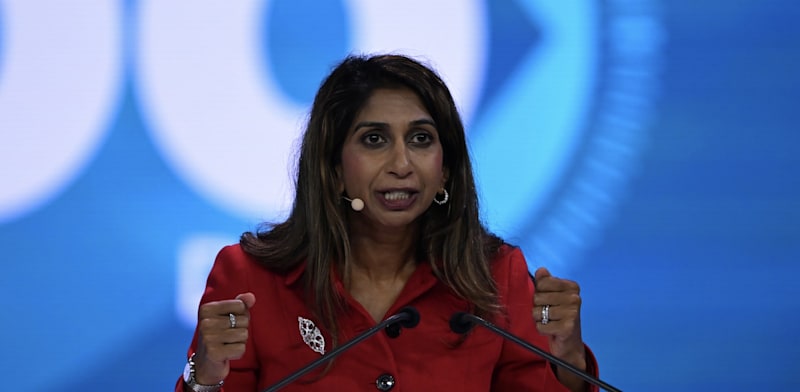
There are few politicians who have managed to cause as many storms as the former Home Secretary of the United Kingdom, Suala Braverman. Braverman has become one of the most controversial figures in British politics, partly thanks to her willingness to say things that many of her former colleagues in the Conservative Party also preferred to avoid.
She called for a dramatic reduction in immigration, accused the British police of selective enforcement in favor of pro-Palestinian demonstrators, warned against the spread of Islamism and warned of the rise of anti-Semitism.
● Government money is running out: the riots in France are a warning sign for Europe
● Europe’s fashion capital on looting alert: Versace and Louis Vuitton empty shop windows
When she called the pro-Palestinian demonstrations that took place in the streets of London following the October 7 attack “hate marches,” she caused another stir. Shortly after, in November 2023, she was removed from the position of Minister of the Interior.
The many confrontations with the conservative party ended in a political separation. In January 2026, after many years in the party, Braverman announced her joining Reform UK, Nigel Farage’s party.
Her move was another blow to the conservatives, who are struggling to cope with the rise of the rival party on the right. For Braverman, this is more than a transition between parties. She claims that the conservative party has abandoned the principles on behalf of which it was elected, and that the time has come to offer voters a real political alternative.
She also deploys this criticism in her new book, Patriot: Empire, Betrayal and Hope (“Patriot: Empire, Betrayal and Hope”). Braverman returns to the story of her family, to Margaret Thatcher’s childhood in Britain and the years when she worked at the heart of the political system. She describes the internal struggles in the Conservative governments, her disappointment with the way Brexit was implemented and what she sees as the surrender of the British elite to identity politics and immigration policies that harm the country’s future. It is also a political indictment against the party that was her home for years, and an attempt to explain why she decided to leave it.
Suala Braverman
personal: Born in 1980 (46 years old) in London, daughter of immigrants of Indian origin, married + 2
professional: A lawyer. Served as Legal Advisor to the Government and Minister of the Interior under Prime Ministers Liz Truss and Rishi Sunak. Currently serves as spokesperson and representative for education and skills matters in the right-wing Reform UK party
one more thing: About her husband Ral Braverman she said that he is a “proud and Zionist Jew”, and said that she has “close family members who serve in the IDF” Amdox
“This government has chosen a side”
In an interview with Globes, Braverman talks about her decision to leave the Conservatives, about the changes Britain is undergoing and the treatment of Jews in it.
Your foreign minister criticizes Israel, announces the imposition of sanctions on us and immediately afterwards smiles and shakes hands with the Iranian foreign minister at the UN. What is happening to him? Why is he behaving like this?
“We have a government run by a twisted morality. This Labor government chose, and it did not choose, the side of Israel. It chose Hamas, the Palestinians, Gaza, the hate marches, the Islamists and their supporters. This was made very clear in the Foreign Secretary’s recent speech at the Labor conference, which was shocking in the extreme, and was designed to show how the extreme pro-Palestinian minds were right. He told them – we hear you, you You’re right, we’re on your side.
“Ed Miliband is a very strange character,” says Braverman. “Because he always begins his attacks on Israel by saying that he is a proud Jew himself. This is how he gives himself cover. He uses his Jewish heritage and identity to give himself political cover, with an anti-Zionist Labor government that has made horrific decisions in recent months, whether it is imposing an arms embargo on Israel, officially recognizing Palestine, supporting arrest warrants against Israeli ministers, and to a large extent joining the anti-Zionist hate movement calling for an intifada.”
One of the chapters in your book deals with the saga that happened after October 7th. That day or the day after, there are already protesters all over the world, including London and other places in the UK, and the Home Secretary. What happened there and how did it finally lead to your dismissal?
“On October 8, even before all the victims were identified, even before the Israeli government thought about self-defense, more than 100,000 Britons, or people in Britain, marched. Not to mourn the women and children, the elderly, the men and boys who were murdered and butchered. Not to stand by Israel, the victim, but to celebrate October 7, to glorify Hamas, to call for another intifada, to say that from the river to the sea Palestine will be free, which is basically a call to wipe Israel off the map and kill Jews. I’m not Jewish, but I felt shocked by the scenes I watched coming from Israel.”
According to her, “These protests were an internal threat to British citizens, Jewish and non-Jewish. According to the law, you cannot direct the police in this country as the Home Secretary, but you supervise the police, and MI5 and the counter-terrorism police. These marches continued throughout the month of October regularly, and they became more aggressive and louder. Members of the Jewish community were actually forced to stay at home on the days of the marches.
“And yet the police did nothing. People waved the flags of terrorist organizations. And the police were present, hundreds of additional police officers were stationed to monitor these marches. But the instructions they received from the senior police chiefs were not to stop, not to enter the crowd when there is anti-Semitic language, harassment, aggressive behavior. We just want to let the marches continue because of freedom of speech. Let the march continue, keep Jews out of the way. Let’s just suspend their rights for now because we don’t really care about them. And if anyone thinks something is unacceptable, we’ll check the security cameras later.”
A pro-Palestinian demonstration in London in October 2023 / Photo: Reuters, Anadolu
“Jihad is not terrorism”
And what are you doing at this time?
“I spoke with the London police chief almost every day. I would tell him, ‘This is unimaginable. Your tactics and strategy are wrong. You need to arrest people. They glorify terrorism, it’s a clear criminal offense.’
“Another absurdity he told me is that ‘we don’t think that a group of masked men chanting jihad on the streets of London is a criminal offense because in fact jihad, according to our experts, is more about an internal struggle for enlightenment and fulfillment rather than terrorism’.”
so what did you do
“When I didn’t make any progress, I called the Prime Minister (Rishi Sunak). He convened meetings with the police chief and we tried to get him to change his tactics. He firmly refused instructions, advice, directives or challenges from the ministers, because he said that ‘we are operationally independent. You, the Prime Minister or your Interior Minister, cannot dictate’. This is technically true.”
“We planned a hate march”
“This tension continues throughout October, and then on the first day of November in Britain we celebrate Remembrance Sunday, which is one of the most important days in our national calendar. It is the time when we remember the soldiers who fought in the world wars. On that day, a hate march against Israel was planned and I made it clear to the police chief that this march must be banned.
“Unfortunately, only the chief of police can submit a request to the Minister of the Interior requesting to ban a march, and he was unwilling to submit such a request. I lost trust in him. I wrote an article for the Times in which I presented that I believed the Metropolitan Commissioner had failed to protect the Jewish community. I exposed this failure, and instead of supporting me, the Prime Minister fired me for telling the truth.”
Braverman believes that “if this prime minister had supported me, banned marches, fired the chief of police and basically brought an end to these carnivals of extremism, Islamism and anti-Semitism on the streets of Britain – I doubt if we would have seen Jews fearing for their lives in Britain and I don’t think we would have seen the terrible murder in Manchester last year.”
“Direct link to immigration”
Many people will say that this anti-Semitism is related to the massive immigration from Muslim countries over the past decades.
“Yes, there is a direct causal link between the experiment of mass immigration in the last decade and the growing threat of Islamism. We opened borders to hundreds of thousands of people, mainly men from Islamist countries – Afghanistan, Iran, Iraq, these are the main countries from which people arrive by boat. They constitute a national security threat.”
We hear that in Britain there are thousands of terrorist suspects, or people who have the potential to commit acts of terrorism who simply live among you.
“Our security services, although they try their best, are not winning this battle. The British intelligence services have a watch list of about 43 thousand people who are considered potential terrorist threats, and 90% of them are Islamists. MI5 employs only 5,000 people. So it is not enough.
“We need to talk about Islamism. There is too much fear. I encountered too much cowardice in the last conservative government to talk about this issue, to deal with it decisively. People have a fear of being called Islamophobes, there is a fear of saying controversial but necessary things – it is this fear that has allowed this problem to develop and become a crisis.”
You talk a lot about the problem of political correctness in the police, which leads to discriminatory treatment between racial or religious groups.
“They are very afraid of upsetting the Muslim community, or the black community, in fact, any ethnic minority community. And they believe that the police must take a very soft approach to certain crimes, because they are afraid of being called racist.”
There is something unusual in that one of the fiercest critics of British immigration policy is herself the daughter of immigrants. Braverman’s parents, of Indian origin, came to Britain from Mauritius and Kenya. She grew up in a home where Britain was seen as a land of opportunity, allowing her family to build a new life. After qualifying as a lawyer, she entered politics and was elected to Parliament on behalf of the Conservative Party in 2015. She later served as the Attorney General of England and Wales and as the Home Secretary. However, it was during her tenure in the government that her criticism of the party to which she belonged sharpened. For her, the Conservatives promised the public time and time again to reduce immigration, but in practice allowed it to reach unprecedented proportions.
“My parents immigrate”
In terms of stopping or restricting immigration. You are the daughter of parents who immigrated to the UK, isn’t it a bit hypocritical of you to say now that you don’t want others to come?
“This is a question I get asked a lot, especially by the left. So yes, my parents were immigrants and I am the daughter of immigrants, but that does not dictate my politics. My parents arrived in the 1960s, immigration was much lower then than it is now. In fact, more people left Britain than arrived at that time, and they also arrived as different types of immigrants than those who come today. They arrived with an attitude of gratitude and respect for Britain, for the British people, and they instilled in me a sense of debt To Britain for what it gave them and us. Today, the numbers are much higher and out of control, so the pressure on our country is too great. And secondly, the types of people who come to this country take more than they give.”
“Bad Brexit performance”
You were among the most prominent supporters of Brexit in the Conservative Party. But a great many of us here in Israel look at Brexit and see it as a failure. Do you think it was a failure?
“That’s a good question,” says Braverman. “It was genius on the part of the British people that they voted to leave the EU. It was a call for self-government, autonomy and freedom. The problem was implementation. After a lot of fighting, division and chaos, the last government took us out of the EU technically, legally and constitutionally. But they didn’t put the right measures in place to allow us to make the most of those freedoms. For example, on immigration, one of the reasons for leaving the EU was so that we could control the numbers. But what Did the last government do the opposite of what it promised.”
You left the Conservative Party for the British Reform Party, which is even further to the right. Are you afraid that the British right will start to hear more and more anti-Semitic voices?
“Yes. I think it’s a real danger. Especially in the age of social networks. It seems that these people get their support from there. And some of these rightists take a very separatist, almost racist approach to foreign policy. And it spills over into anti-Semitism. The Jews are becoming the cause of all the problems in the world.”
الزواج في أستراليا للأجانب العرب: إشعار الزواج المزمع NOIM
تعارف الجزائر للزواج: بدائل عن قنوات الدردشة | نصيب ومودة
دليل التعارف الجاد والزواج | نصيب ومودة
زواج في اربيل والسليمانية: التعارف الجاد وشروط المحكمة
زواج المسلمين في هولندا: العقد المدني ثم النكاح | نصيب ومودة
أوراق الزواج في ألمانيا للأجانب العرب: الخطوات | نصيب ومودة
كيف أجد زوج صالح؟ خطوات عملية للشابة وأسرتها | نصيب ومودة
زواج الملتزمين: كيف تصف التزامك وتتحقق من التزام غيرك
أفضل تطبيقات الزواج الإسلامي: ماذا تعني «حلال» فعلًا؟
زواج الأجانب العرب في تركيا: دائرة الزواج في البلدية | نصيب ومودة
أفضل تطبيق زواج في العراق: معايير الاختيار ومقارنة موثقة
تعارف في ليبيا بنية الزواج: أين تبدأ وكيف تحمي نفسك | نصيب ومودة
الزواج في السويد للأجانب العرب: فحص الموانع خطوة بخطوة
الزواج في البرازيل للأجانب العرب: التأهيل في الكارتوريو
رجال للزواج: كيف تصلين إلى رجل جاد بأمان | نصيب ومودة
زواج العرب في قبرص: تعارف جاد للمقيمين | نصيب ومودة
زواج عن طريق الإنترنت: التعارف والعقد والتوثيق | نصيب ومودة
تعارف في عمان: التعارف بنية الزواج في سلطنة عُمان | نصيب ومودة
موقع زواج خليجي مجاني: ما الذي تجده وكيف تستخدمه | نصيب ومودة
تعارف في الأرجنتين للزواج: دليل المقيم العربي والمسلم
أفضل تطبيق زواج في فلسطين: اختر بالجنسية والإقامة معًا
زواج العرب في فنزويلا: تعارف جاد بنية الزواج | نصيب ومودة
تطبيق تعارف للزواج للنساء: ما الذي يحمي خصوصيتك | نصيب ومودة
أفضل تطبيق زواج عربي: معايير المقارنة وخمس منصات | نصيب ومودة
تعدد الزوجات في السعودية: التوثيق عبر ناجز وما يجب معرفته
زواج مسيار دبي: كيف يوثَّق وما الذي تسأل عنه قبل العرض
أفضل تطبيق زواج في المغرب: معايير واضحة ومنصات موثقة | نصيب ومودة
أفضل تطبيق زواج في لبنان: ماذا تسأل قبل أن تنضم | نصيب ومودة
زواج من ليبية: إذن الزواج والوثائق ثم البحث بجدية | نصيب ومودة
أفضل تطبيق زواج في السودان: كيف تختار بين المنصات المتاحة