China’s Ministry of Commerce announced that it has launched two investigations into US policies that hinder the flow of goods in this country.
Chinese investigations last six months or more. On March 27, China’s Ministry of Commerce said this was a “reciprocal” move to two US investigations based on Article 301 of the 1974 Trade Act. After the results, the country will introduce corresponding policies to protect its interests.
However, this move shows that Beijing has not immediately retaliated against the newly launched US investigations.
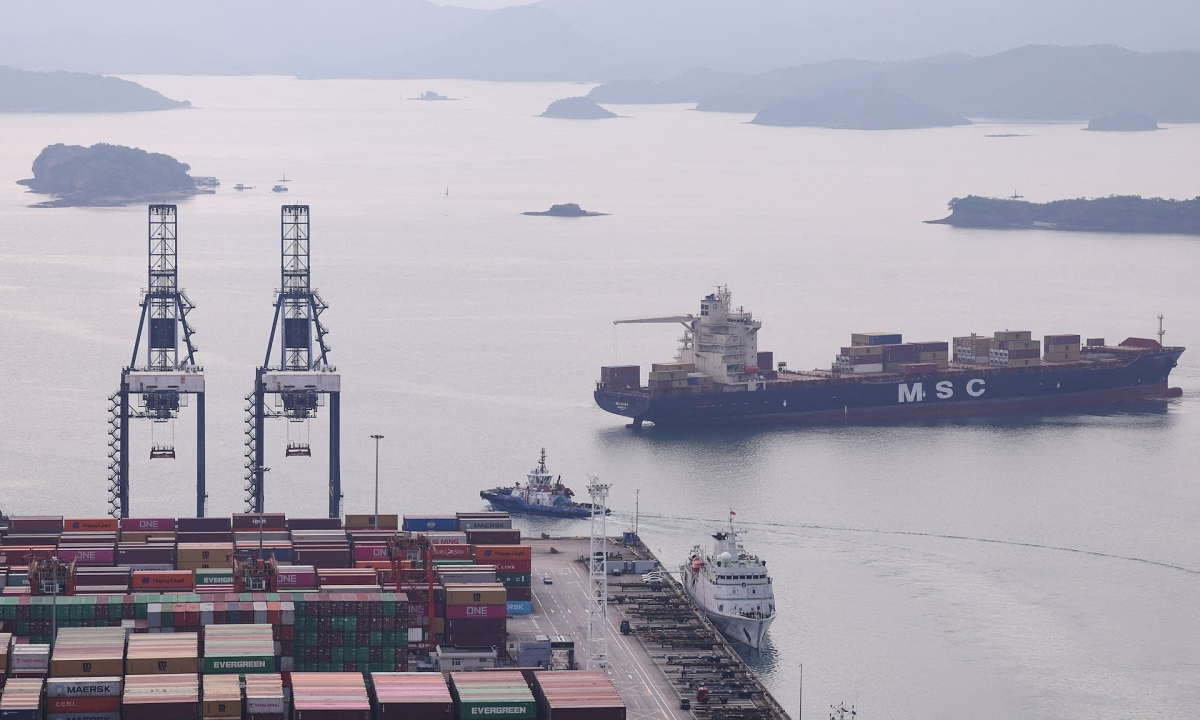
Container ship at Diem Dien port (Guangdong, China) in October 2025. Image: Reuters
On March 11, US Trade Representative Jamieson Greer said he had opened an investigation into industrial overcapacity at 16 partners. Those are 16 partners, including China, EU, India, Japan, Korea, Vietnam, Thailand…
A day later, the US continued to launch another investigation under Section 301, to ban the import of goods produced with forced labor. This investigation involves more than 60 countries.
These moves are aimed at restoring import tax pressure after the US Supreme Court last month rejected the taxes President Donald Trump imposed based on the International Emergency Economic Powers Act (IEEPA). The results of the investigation could lead to new taxes being imposed this summer.
Greer said he hopes to complete the investigations before the temporary tariffs imposed by the US expire in July. After the Supreme Court’s ruling, Mr. Trump signed an executive order imposing an additional import tax of 10% for 150 days, invoking authority under Article 122 of the 1974 Trade Act.
Economic relations between the US and China experienced a turbulent year after Mr. Trump took office for his second term. Washington’s continuous imposition of new import tariffs sparked retaliation from Beijing. At one point, the two sides imposed 3-digit tax rates on each other. Tensions later eased, when both countries reduced tariffs after rounds of trade negotiations.
US import taxes on Chinese goods are currently at a general level of 10%. However, taxes imposed according to other laws for each industry such as aluminum, steel, and cars remain the same at 10-50%.