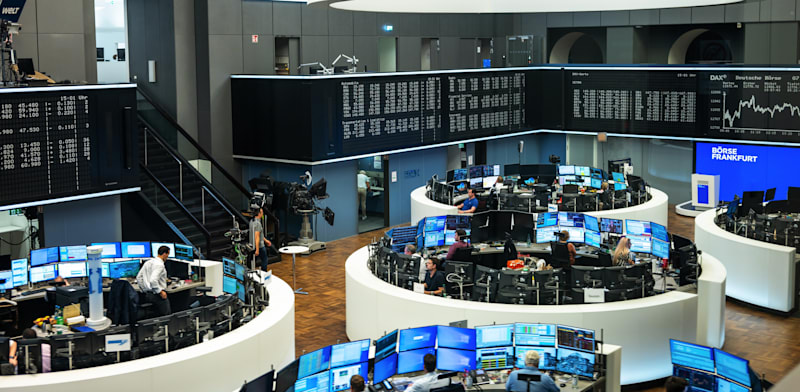
Trade overview: current reports, trends, indices, stock prices, bonds, foreign exchange and commodities and analyst recommendations
11:20
Trade in Europe continues to decline. The DAX index weakened by about 0.2%, the FTSE lost its value by about 0.8% and the KAC retreated by about 0.4%.
Oil prices are now climbing over 2%, although the increases are less sharp than those recorded earlier today (around 4%). As of now, Brent crude is trading around $96 per barrel, while US crude (WTI) is trading around $91 per barrel.
10:10
European stock exchanges open the trading day with price drops, in accordance with the negative sentiment recorded in most markets in the world against the background of the nightly American attacks in Iran. The Frankfurt Stock Exchange falls by about 0.4%, the London Stock Exchange loses by about 0.8% and the Paris Stock Exchange weakens by about 0.3%.
9:40
Asia
Trading in Asia is ongoing this morning with prices falling, against the background of the new attacks carried out by the US against Iranian targets during the night, which, according to the US military, threatened US forces and the movement of vessels in the Strait of Hormuz. Later, alarms were sounded in Kuwait and the Revolutionary Guards claimed that they had attacked the American base from which the attack was carried out in Iran.
The Nikkei fell by about 0.5%, the Hang Seng fell by about 1.3%, the Shanghai Stock Exchange climbed by about 0.2% and the Seoul Stock Exchange lost about 0.5% – although the declines were moderate compared to those recorded earlier in the trading day. Asian markets are highly dependent on oil that comes from the Middle East, and are therefore particularly sensitive to fluctuations in oil prices.
In general, the sentiment in markets around the world is negative this morning. US government bond yields are rising, the dollar is strengthening around the world, and Wall Street futures are down by up to 0.4%.
The BTIG investment house warned this morning that the stock indices in South Korea are at high risk of a “sharp downward trend reversal” after the increases of the past week. The analysts point to the absolute and dangerous dominance of the two chip giants, Samsung and SK Hynix, which alone dictate the direction of the South Korean market and expose it to high volatility.
Wall Street
On Wall Street, trading closed higher last night. The industrial-biased Dow Jones advanced about 0.4% to a new high, amid the drop in oil prices. The S&P 500 and Nasdaq also closed at new highs, though they struggled to rally during the trading day. The S&P 500 ended marginally higher, as did the Nasdaq, which climbed only about 0.1%.
The S&P 500 was weighed down by chip stocks, which took a break from the unprecedented rally they recorded in recent weeks. The Philadelphia Stock Exchange ( SOXX ) fell more than 1%, after climbing to an all-time high on Tuesday, supported by shares Micron which jumped by almost 20%; This, after the Swiss investment bank UBS tripled its target price for the memory chip manufacturer, to $1,625 – which reflected an upside of over 100% compared to its price at the time of the recommendation. UBS estimated that the demand for high-bandwidth memory chips, which are a critical component in AI processors, will continue to generate unprecedented profit margins for the company that will surpass conservative market forecasts.
Micron continued to climb yesterday as well, but other major players in the field, such as Intel andQualcomm traded in the red. In general, it seems that stocks of memory chip manufacturers have become the preferred way for investors to get exposed to the field of AI recently. The South Korean SK Hynix, a significant player in the field, also yesterday extended its jump in the last 12 months to more than 1,000%, becoming the third Asian company to reach a market value of one trillion dollars.
Eric Parnell, chief market strategist at Great Valley Advisor Group, told CNBC that “the revolutionary impact of AI in the coming years and decades is one that cannot be overstated, but the current valuations of many of the chip companies that provide the computing infrastructure that is designed to make all of this happen have become extremely frothy and way ahead of their time.” Parnell added that “it is possible that we are currently at the peak of a boom cycle in chip stocks, but it is important to remember that historically, they have been followed by low cycles.”
The indices were also weighed down by a retreat in cyber security stocks, afterZyskyler – a major player in the field – published a disappointing forecast for the current quarter and plunged by over 30%. The company provided a revenue forecast for the current quarter in the range of 875 to 878 million dollars, a figure that fell short of the forecast of 879 million dollars aimed at by the analysts, according to LSEG data. The disappointment also radiated on stocks like Palo Alto andCrowd strike which weakened during trading. The basket fund Global X Cybersecurity ETF fell close to 5%.
Another share that gathered interest belongs to the investment bank J. times. Morgan . The stock fell more than 2% after CEO Jamie Dimon said the bank could spend up to $20 billion on acquisitions over the “next several years.”
Among the stocks that climbed, you can find the shares of airlines and cruise companies, which strengthened against the background of the drop in oil prices. Among other things, the increases stood out United Airlines , Delta Airlines , Carnival andNorwegian Cruise Line .
After the closing of trading last night, the share of the cloud company Snowflake Soared 36% in late trading, after the company signed a plan to invest $6 billion in Amazon Web Services over five years. In addition, the company’s financial results for the first quarter beat analysts’ forecasts on the top and bottom lines.
In the report section today – the retail chains will focus on reports Best Buy and-Kohl’s . After trading closes, the focus will be on the computing giant’s financial results poor whose stock has already more than doubled its value in the last three months and is trading at an all-time high.
The commodity and currency markets
In the commodities market, oil prices fell by more than 4% yesterday, following the Iranian report of reaching an initial draft of a framework agreement with the US – a trend that continued even after the White House denied the report. The declines strengthened slightly after it was reported that US Secretary of State Marco Rubio stated that some progress had been made in the talks with Iran, and that the US intends to give the negotiations “every opportunity to succeed”.
However, this morning, following the new American attacks on Iran and the Iranian response that followed, oil prices are climbing close to 3%. Brent crude is trading around $97 per barrel, while US crude (WTI) is trading around $91 per barrel. The markets are now repricing the risk of disruptions in the strategic Strait of Hormuz.
Citi Bank noted yesterday that investors have already begun to exclude end-of-life scenarios from their pricing, but at the same time warned that the ongoing rise in oil prices is beginning to seep into broader inflationary pressures, in particular through “second round ripples” (in the original: “second round effects”), which encourages some central banks to lean in a more hawkish direction.
US debt market
In the American debt market, there were slight decreases in government bond yields yesterday, although in view of the American attacks on Iran and the Iranian reaction in Kuwait – they are climbing significantly this morning. The ten-year yield increases by approximately 5 basis points to 4.52%, the 30-year yield increases by approximately 4 basis points to 5.05% and the two-year yield also increases by approximately 4 basis points to 4.07%.
It should be noted that the increase in yields also came before the publication of the PCE index for the month of April in the US which will be released at noon today – the inflation index preferred by the Federal Reserve – which is expected to show a significant increase in April, similar to the consumer price index that was released earlier this month.
Macro
At noon today, the PCE report for the month of April will be published in the US – the price index preferred by the Federal Reserve, which is expected to shed more light on the direction in which inflation is going in the US. According to FactSet data, the index is expected to indicate an annual increase of 3.9% – the highest level since 2023 and well above the Fed’s price stability target, which stands at 2%. This, in a manner coordinated with the consumer price index for the month of April, which also showed the highest annual increase since 2023.
Jose Torres, senior economist at Interactive Brokers, told the financial website Morningstar that the key question is whether the Fed, under new chairman Kevin Warsh, will interpret the increases in the consumer price index and PCE as one-time shocks, or adopt a hawkish stance aimed at combating rising inflationary pressures.
forecast
Goldman Sachs raised its forecast for the S&P 500 from 7,600 points to 8,000 points – which reflects an upside of over 6% until the end of this year. Strategist Ben Snyder raised his 2026 earnings per share forecast for the S&P 500 to $340, a figure that reflects a 24% increase in earnings this year.
In a message to clients, Snyder wrote that “earnings growth has driven the entire return of the S&P 500 since the beginning of the year, and we expect this dynamic to continue in the coming months.” Snyder cited the “exceptionally strong” first-quarter reporting season as one of the reasons for raising his target.
Snyder added that “Looking forward, our baseline scenario is for a market multiple that will remain unchanged, because the tailwind to valuations, resulting from lower government bond yields, is offset by a ‘headwind’ to valuations, resulting from a slowdown in economic growth and earnings growth; skepticism on the part of investors about the durability of the profits associated with the establishment of the AI infrastructure; And the continued uncertainty surrounding the technological disruptions of artificial intelligence and the geopolitical forecast.”
Goldman even believes that if the geopolitical forecast improves, the market can even bypass the 8,000 point threshold.
CNBC reported yesterday that the profits of the companies in the S&P 500 index grew in the first quarter by more than 28% compared to the same period last year – according to FactSet data. This is the strongest earnings expansion for the index since the fourth quarter of 2021 – when they posted a 32% annual jump. It was also reported that the companies are also exceeding expectations at a higher rate than usual. FactSet data shows that about 84% of the companies in the S&P 500 index exceeded analysts’ profit estimates, a figure significantly higher than the average over the past five years, which stands at 78%.
For your attention: The Globes system strives for a diverse, relevant and respectful discourse in accordance with the code of ethics that appears in the trust report according to which we operate. Expressions of violence, racism, incitement or any other inappropriate discourse are filtered out automatically and will not be published on the site.
https://wellhealthorganic1.com/picada/
https://insalar.com/dani-bolt-qarabag/
https://sozluk.az/yerli-futbol-nece-deyisir/
https://buildessay.com/kingessays-com-reviews/
https://essayhunt.com/kingessays-com-review/
https://essaywebs.com/kingessays-com-review/
https://betfury.com/es/casino/games/soccer-solo-striker-by-evoplay
https://betfury.com/casino/games/folsom-prison-by-nolimit-city
https://betfury.com/casino/games/new-years-bash-by-habanero
https://betfury.com/casino/games/fan-tan-by-evolution
https://betfury.com/casino/games/starburst-xxxtreme-by-netent
https://betfury.com/casino/games/dynamite-riches-by-red-tiger
https://betfury.com/casino/games/dragon-spark-by-playtech
https://betfury.com/casino/games/anubis-moon-by-evoplay
https://betfury.com/es/casino/games/money-coming-by-tada-gaming
https://betfury.com/sports/standoff-2-230
https://betfury.com/casino/games/dead-men-walking-by-nolimit-city
https://betfury.com/es/casino/games/book-of-fallen-by-pragmatic-play
https://betfury.com/casino/games/bamboo-ways-by-push-gaming
https://betfury.com/casino/games/hot-chilli-bells-100-by-bgaming
https://betfury.com/es/casino/games/tanked-by-nolimit-city
https://betfury.com/news/american-european-blackjack
https://betfury.com/casino/games/gravity-wheel-by-iconic21
https://betfury.com/es/casino/games/bison-fortune-coins-by-tada-gaming
https://betfury.com/casino/games/ashoka-by-elk-studios