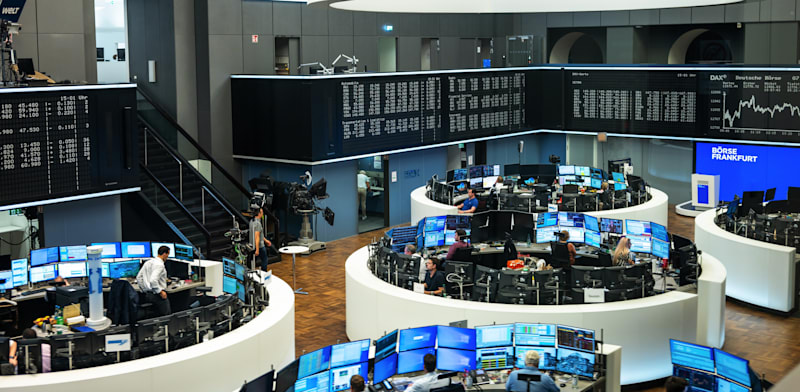
Trade overview: current reports, trends, indices, stock prices, bonds, foreign exchange and commodities and analyst recommendations
10:20
European stock markets opened the day with slight declines. For now, the Dax has weakened by about 0.1%, while the Putsy and the Kac shed about 0.4% of their value.
In Asia, trading closed in a mixed trend. The Nikkei advanced by about 0.6%, the Hang Seng climbed by a similar rate, the Shanghai Stock Exchange added about 0.4% to its value and the Seoul Stock Exchange lost about 2%.
In the global foreign exchange market, the Japanese yen weakened against the dollar to a new low. CNBC reported that the dollar received a boost from a sharp jump in US bond yields and pushed the yen to a 40-year low, while traders are preparing for a crucial employment report in the US and increasing bets on an imminent interest rate hike by the Federal Reserve.
The dollar climbed to a new high of 162.77 yen at the start of the Asian trading day, well above the levels that prompted Japanese authorities to intervene several months ago to shore up the weak currency. “We believe we are close to possible action,” said Chidu Narayanan, head of macro strategy for the Asia-Pacific region at Wells Fargo, referring to the prospect of further intervention. “We are at critical levels, not necessarily in terms of a specific exchange rate target, but at levels where the (Japanese) Ministry of Finance may need to intervene to maintain its credibility.”
At the same time, futures contracts on Wall Street are now registering declines of up to 0.7%.
Yesterday, Wall Street closed the day with higher prices. The Nasdaq climbed by about 1.5%, the S&P 500 climbed by about 0.8% and the Dow Jones added about 0.3% to its value. Thus, the New York Stock Exchange closed the second quarter and recorded its best quarter since 2020. The road was bumpy and quite volatile – the indices recovered impressively from the low recorded at the end of March, and the S&P 500 climbed about 15% over the past three months, Nasdaq jumped 21%.
technology sector (XLK ) was the main engine of these gains, with chip stocks leading the entire sector. The basket fund of the chip industry (SOXX ), recorded the strongest quarter in its history with a jump of over 90%. By comparison, the Nasdaq 100 rose 25% in the second quarter.
But the main message is that the rally in the American market is not only “broad increases”, but mainly resulted from the high concentration around the chips sector. While the S&P 500 rebounded strongly, technology stocks, particularly chips tied directly to AI demand, led most of the performance. This means that the AI market continues to be the dominant force driving Wall Street.
The main growth engine of chip stocks in the first half of the year was the demand for memory and storage chips. In fact, the top of the list of best performing stocks in the S&P 500 is almost entirely made up of memory and storage companies.
micron, The largest manufacturer of memory chips in the US, ranks second in the S&P 500 index since the beginning of the year after its stock jumped 301% in six months, which raised its market value to over a trillion dollars. The first place is occupied by SanDisk with a jump of 764%. They are followed by Western Digital and Seagate, with Intel also among the top five after climbing 257%, amid growing belief on Wall Street that its ambitious recovery plan is beginning to yield results.
At the same time, South Korean memory chip maker SK Hynix is working to raise $29.4 billion through an IPO in the US.
On the other hand, some of the biggest names in the industry actually lagged significantly behind the sector. Nvidia, a symbol of the AI chip revolution and the company with the largest market capitalization in the world, has risen only 7% since the beginning of the year – making it the weakest stock in the chip index. Boardcom, the second largest chip maker in the US in terms of market capitalization, also showed a relatively modest performance with an increase of 9%.
Despite the recent volatility, analysts have become more optimistic about the industry. According to Bloomberg data, the profits of chip manufacturers are expected to grow by 49% in 2027, compared to a forecast of only 35% given in April. The revenue growth forecast was also improved to 37%, compared to 29% previously. This is a much higher growth rate than that expected for companies in the S&P 500 index, where profits are expected to grow by only 17% in 2027, alongside a 7.4% increase in revenues.
But last week’s selloff reminded investors that this rally isn’t immune either. The chip index fell by 7.9% last week – the sharpest weekly drop since April 2025 – amid growing doubts on Wall Street about the durability of chip demand. Abnormal volatility was also recorded yesterday, when the index went from a 3.2% drop during trading to a 3.8% increase at the close.
For your attention: The Globes system strives for a diverse, relevant and respectful discourse in accordance with the code of ethics that appears in the trust report according to which we operate. Expressions of violence, racism, incitement or any other inappropriate discourse are filtered out automatically and will not be published on the site.